
Ship Maintenance and Repair: Planning the Five-Year Cycle
How ship maintenance and repair is planned around class surveys: the planned maintenance system, ISM element 10, condition monitoring and drydocking.
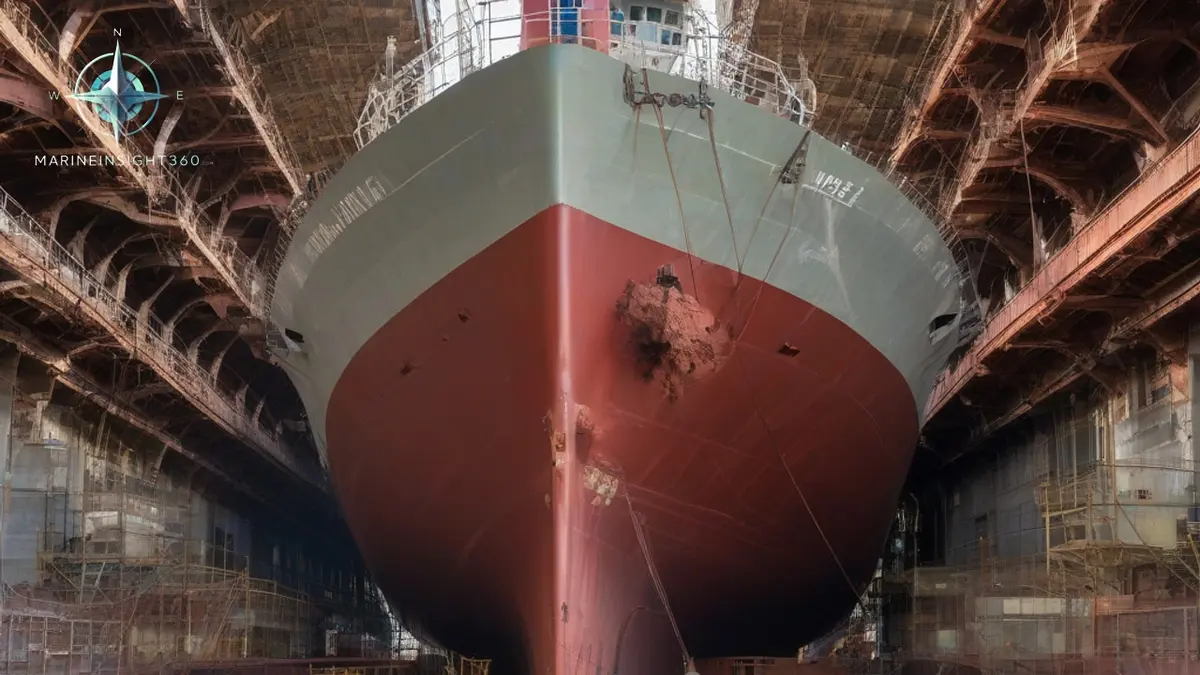
Ship maintenance and repair is a five-year cycle set by classification society surveys rather than by convenience. Routine work is planned and recorded in a planned maintenance system on board. Heavier work is grouped into drydockings, normally two in each five-year class period, with no more than 36 months between bottom surveys.
Owners trading to United States, United Kingdom, Australian and northwest European ports plan the cycle around ABS, Lloyd's Register, DNV or ClassNK survey dates. A lapsed survey turns into a USCG or Paris MoU detention at the next port state inspection.
Getting the split right is the largest single lever a technical department has over cost and off-hire. That means deciding what the crew does at sea, what a riding squad does alongside, and what genuinely has to wait for the dock.
The class cycle everything hangs on
Under the harmonized survey system, a ship carries an annual survey around each anniversary of the class date, an intermediate survey at the second or third anniversary, and a renewal survey, usually called the special survey, every five years. Two bottom surveys fall within that period, one of them in conjunction with the renewal survey. Eligible ships may substitute an in-water survey for one of the bottom surveys, which saves a docking but needs advance approval and good hull condition.
The renewal survey is the expensive one. Thickness measurement scope grows with the age of the ship, and a fourth or fifth special survey on a twenty-year-old hull can uncover steel renewal that dwarfs the planned budget. Ordering ultrasonic thickness measurement before the ship arrives at the yard, rather than during the docking, is the difference between a priced repair and an open-ended one.
What a planned maintenance system does
A planned maintenance system, usually shortened to PMS, is both the maintenance program and the software that runs it. It holds a register of every item of machinery, links each item to jobs due on running hours or calendar intervals, records what was done, by whom and with which spares, and connects to the stock inventory.
Class societies will approve a properly run PMS as the basis for continuous machinery survey. That matters commercially: instead of opening machinery for a surveyor during a single docking, maintenance is spread across the five-year cycle and credited from PMS records, with the chief engineer performing the work and class verifying it at an annual audit. A PMS treated as paperwork loses that credit and the ship pays for it in dock time.
What the ISM Code requires
Element 10 of the International Safety Management Code covers maintenance of the ship and equipment. The company must establish procedures to keep the ship in conformity with the applicable rules and with any company requirements, which in practice means four things.
- Inspections held at appropriate intervals.
- Nonconformities reported with their probable cause, where known.
- Corrective action taken and recorded.
- Critical equipment and systems identified, with specific measures to promote reliability, including regular testing of standby arrangements and equipment not in continuous use.
That last point is the one auditors probe hardest. A ship with an emergency generator, emergency fire pump and steering gear changeover that are tested and logged has a defensible system. A ship where the critical equipment list was written once and never used does not.
Condition monitoring: what actually predicts failure
- Lubricating oil analysis for wear metals, water content and base number, which flags bearing and liner wear before it becomes damage.
- Vibration analysis on rotating machinery, catching misalignment, imbalance and bearing degradation.
- Thermography on switchboards, cable terminations and bearings, where a loose connection shows up as heat long before it fails.
- Performance monitoring of cylinder pressures, exhaust temperatures and turbocharger condition against sea trial baselines.
- Wear-down and crankshaft deflection readings taken and trended, not simply recorded.
Condition-based maintenance only pays when the data is trended over time. A single reading with nothing to compare it to tells you almost nothing.
Planning a drydock so it does not overrun
A renewal-survey docking commonly runs two to four weeks depending on scope, and overruns are almost always caused by decisions made months earlier.
- Write the repair specification early and precisely, with quantities, standards and acceptance criteria rather than vague descriptions.
- Separate firm scope from provisional items so the yard prices variations against an agreed rate schedule.
- Ship owner-supplied spares to the yard ahead of arrival and confirm receipt.
- Treat blasting and coating as the critical path, because it usually is, and protect it from other trades.
- Run a disciplined variation order procedure. Unpriced growth work is where dockings lose control.
- Plan tank and void space work early, since ballast tank coating condition drives both cost and survey outcome.
The repair work that regulation is now driving
Beyond routine steel and machinery work, retrofit scopes now dominate many dockings: ballast water treatment system installation and commissioning, energy saving devices and propeller or bulbous bow modifications aimed at carbon intensity performance, hull coating upgrades and biofouling management, and preparation for alternative fuels on ships whose owners expect a long remaining life. These jobs need engineering and class approval well before the ship books a berth.
The mistakes that cost the most
- Deferring known defects to the docking without funding them in the docking budget.
- Ignoring spare parts lead times, which now routinely exceed the notice period for a docking.
- Poor handover between superintendents, so the reason behind a deferred repair is lost.
- Letting PMS job closures drift, which invalidates the continuous survey credit.
- Sending a ship to a cheap yard without allowing for towage, deviation and off-hire in the comparison.
The Marine Insight 360 Marine Machinery section covers individual maintenance routines and defect diagnosis in more depth.
Sources and further reading
- ISM Code section 10, Maintenance of the Ship and Equipment
- Special Survey, hull requirements
- Approved Planned Maintenance System: class requirements
What to read next
Recommended Reading
Magnetic Compass Maintenance: Daily Checks, Adjustment Intervals and the Deviation Card
Practical magnetic compass maintenance for watchkeepers: daily error checks, bubble and gimbal care, adjustment triggers, deviation cards and PSC records.
STCW Certification: What It Is, the Five Basic Courses, and How to Get It
STCW certification is the international training standard every seafarer needs. The five basic safety courses, what they cost, renewal rules, and how to start.
Why Predictive Maintenance Is Becoming the Future of Ship Management
Discover how predictive maintenance is helping shipowners reduce breakdowns, improve safety, lower maintenance costs, and increase vessel reliability.