
Shipbuilding Companies: Who Builds the World Fleet and Where
China, South Korea and Japan take almost every merchant newbuilding order. Here are the major shipbuilding companies and how yards are ranked by CGT.
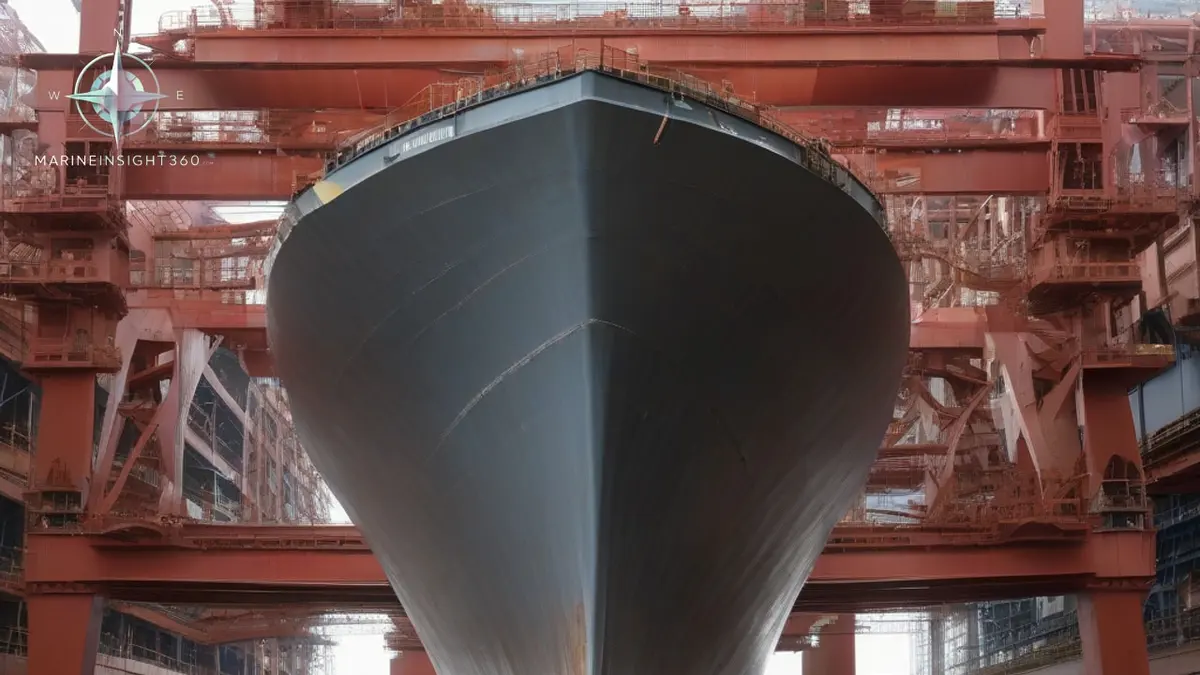
Three countries take almost every merchant order
The world's merchant fleet comes from a remarkably small group of yards. China, South Korea and Japan build the large majority of merchant tonnage, and within those countries a handful of shipbuilding companies take most of the work. China State Shipbuilding Corporation is the largest group by volume, while South Korea's orders are dominated by HD Korea Shipbuilding and Offshore Engineering, Hanwha Ocean and Samsung Heavy Industries.
European yards remain competitive in cruise ships, ferries, offshore vessels and naval work rather than in bulk merchant tonnage.
The scale gap is measurable. Chinese yards secured 35.4 million compensated gross tons of new orders in 2025, a fall of about 35 percent against 2024 but still far ahead of any rival, and China held 134.03 million CGT of the global orderbook at the end of June 2026, roughly 65 percent of the total. Japanese yards took 2.8 million CGT of orders in 2025, down nearly 53 percent year on year, for a global share near 5 percent.
Read the rankings in CGT, not ship count
Compensated gross tonnage is the unit that makes yard comparisons meaningful. It takes gross tonnage and weights it by how much work a ship type actually takes to build, so a chemical tanker or an LNG carrier counts for more per ton than a simple bulk carrier. A yard delivering fewer, more complex ships can therefore outrank a yard delivering more hulls.
That is exactly why market share by ship count misleads. South Korean yards have consistently held a share of global orders well above their hull count because they win the high-CGT types. Of 59 large LNG carriers ordered globally in the first half of 2026, Korean yards took 36 and Chinese yards 23, and LNG carriers remain the ship type with the highest revenue per berth slot.
The Chinese groups
China State Shipbuilding Corporation is a state-owned conglomerate that absorbed the country's other major state shipbuilder, giving it an enormous spread of yards across container ships, bulkers, tankers, gas carriers and naval construction. Alongside it sit large private and provincial builders that compete hard on price and delivery date in the standard tanker and bulker segments.
The Chinese advantage has been capacity and cost, with credit availability from domestic financial institutions making orders easier to close. The 2025 order decline shows the flip side: policy risk. Trade measures aimed at Chinese-built tonnage caused real hesitation among some owners during the year.
The South Korean big three
HD Korea Shipbuilding and Offshore Engineering is the holding company behind the HD Hyundai yards and is the largest of the group. Hanwha Ocean, the former Daewoo Shipbuilding and Marine Engineering, and Samsung Heavy Industries complete the trio. All three concentrate on high-value tonnage: LNG and LPG carriers, large container ships, floating production units and, increasingly, defense work.
South Korean builders booked 10.98 million CGT in 2024, around 17 percent of the global market. Their strategy is deliberately not volume. It is to hold the segments where engineering complexity, cargo containment licensing and delivery reliability keep price competition from becoming purely a cost contest.
Japan and Europe
Japanese shipbuilding has consolidated into a smaller number of groups, with Imabari Shipbuilding the largest, and has focused on bulk carriers and a domestic customer base. The sharp 2025 order fall reflects both consolidation and a deliberate reluctance to chase low-margin work.
European yards serve different markets entirely. Cruise ships, ropax ferries, offshore construction and service vessels, research ships, dredgers and naval tonnage are where the yards in Italy, Germany, France, Finland, Norway, Spain, the Netherlands and Romania hold position. These are low-series, high-outfitting products where the local supplier network matters more than steel throughput cost.
What an owner is really choosing
- The berth slot. In a strong market the delivery date is the scarcest item on the table and often decides the yard before price does.
- The refund guarantee. A newbuilding contract is a series of stage payments, and the bank standing behind the yard's guarantee is part of the risk assessment.
- Series position. Ordering hull five of a proven series is a very different technical risk from ordering hull one of a new design.
- Supervision cost. The owner's site team lives at the yard for the build, and travel, housing and staffing costs vary sharply by location.
- Flag and trade exposure. Where a ship is built is now a commercial and regulatory factor, not just a sourcing decision.
For anyone tracking the market, follow the CGT figures published by the recognized order trackers and treat single-month share swings with caution, because a few large LNG orders can move a national share by several points. The Marine Insight 360 Ships and Vessels section covers the vessel types behind those orders in more detail.
A newbuilding is supervised by a classification society from the drawings onward. DNV, Lloyd's Register, ABS, Bureau Veritas, ClassNK, Korean Register and RINA approve the plans, attend the steel, witness the tests and issue the class certificate at delivery, alongside the flag administration's statutory certificates. Under IMO efficiency rules the design must also prove its calculated efficiency at the sea trial.
What goes wrong is usually schedule and series. A yard running late pushes delivery past the contractual cancellation date, and the owner decides whether to take the ship or call the refund guarantee. First of class hulls throw up vibration, alignment and coating defects that surface during the guarantee year and are argued over afterwards. A defect repeated across a series turns one warranty claim into a fleet problem.
Sources and further reading
- China's shipyards still lead the world, but US threats took a toll in 2025, South China Morning Post
- South Korean Shipbuilders Achieve Market Share Gains, The Maritime Executive
What to read next
Recommended Reading
Cruise Ship Building Companies: Who Actually Builds the Fleet
Four European yards build almost every large cruise ship. Here is what Fincantieri, Meyer Werft, Meyer Turku and Chantiers de l'Atlantique deliver.
Great Lakes Shipping Companies: Who Moves Cargo on the Lakes
Who the Great Lakes shipping companies are, what lakers carry, how the Soo Locks and the nine-month season shape operations, and what the jobs are like.
NEURA and HD Hyundai Begin Real-World Testing of Shipbuilding Robots
NEURA Robotics and HD Hyundai are testing humanoid and quadruped robots in a live shipyard, aiming at the welding and inspection work yards cannot staff.