
Cruise Ship Building Companies: Who Actually Builds the Fleet
Four European yards build almost every large cruise ship. Here is what Fincantieri, Meyer Werft, Meyer Turku and Chantiers de l'Atlantique deliver.
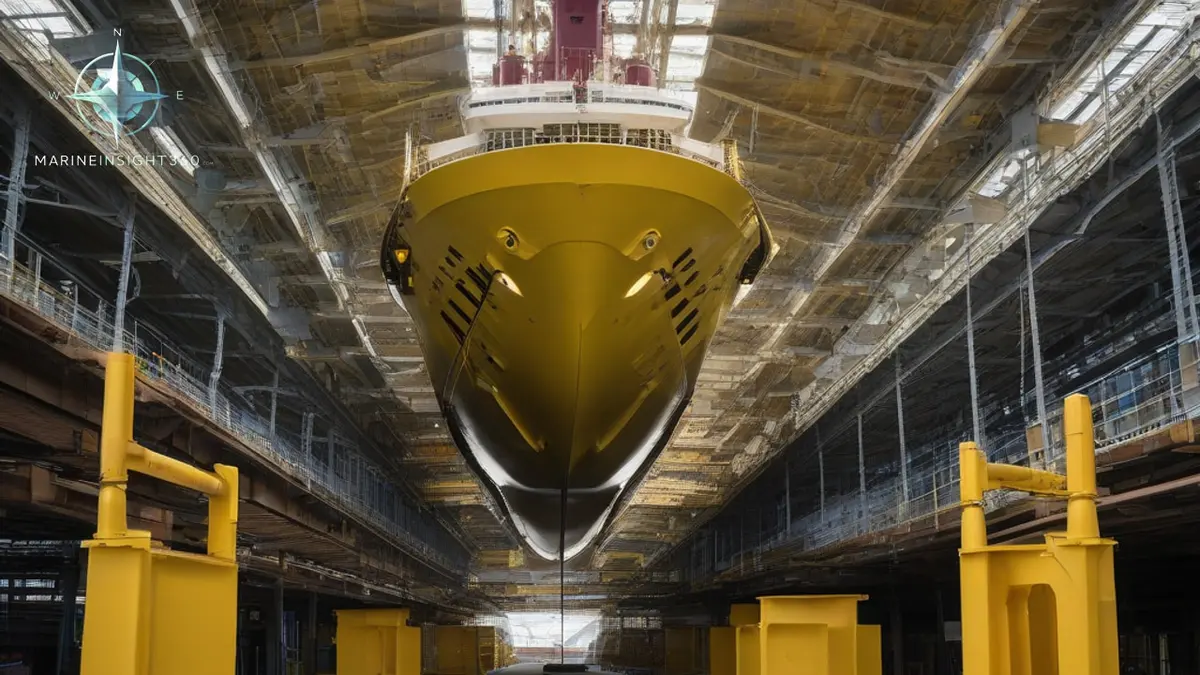
Four yards build almost every large cruise ship
The cruise ship building companies that matter for large newbuildings make a very short list. Fincantieri in Italy leads it. Chantiers de l'Atlantique at Saint-Nazaire, Meyer Werft at Papenburg and Meyer Turku in Finland complete it. Between them these four groups deliver the overwhelming majority of large cruise ships, at a combined rate of roughly ten hulls a year. No Asian yard has broken that hold at the top end of the market.
That concentration is unusual. In every other commercial ship type, Chinese and South Korean yards dominate on volume. Cruise construction went the other way, and understanding why explains a lot about how the segment prices, schedules and staffs itself.
Why cruise construction stayed in Europe
A large cruise ship is not a scaled-up cargo ship. It is a floating hotel with tens of thousands of individually fitted cabins and public spaces, complex fire zones under SOLAS, extensive HVAC and hotel services, and a passenger safe-return-to-port capability that drives redundancy into the propulsion and electrical design. The build hours per ton are far higher than for a tanker or a boxship, and most of that labor is outfitting rather than steelwork.
That outfitting depends on a deep regional supply chain of interior contractors, cabin module builders, galley and theater specialists and system integrators clustered around the yards. A shipyard can be replicated. The supplier network around it takes decades. Attempts to move large cruise construction outside Europe have repeatedly run into that gap.
The four groups in more detail
Fincantieri
The Italian group is the largest of the four by yard count and builds across multiple Italian sites as well as naval and offshore work. Its subsidiary Vard, based in Norway, builds smaller expedition cruise vessels, which gives the group coverage from the expedition segment up to the largest contemporary ships.
Chantiers de l'Atlantique
The Saint-Nazaire yard has built most of MSC Cruises' larger tonnage and delivered three newbuildings in 2025. Its World Class order for MSC has been extended, keeping the dock committed well into the next decade.
Meyer Werft and Meyer Turku
The two Meyer yards operate as a group across Germany and Finland. Meyer Werft also delivered three newbuildings in 2025. Its position was reinforced when MSC Cruises signed a letter of intent for four ships with options for two more, an order reported at a minimum of 10 billion euros, or about 11.74 billion US dollars.
An orderbook that runs to the mid-2030s
The forward delivery schedule across the four European cruise builders now extends to 2036. Industry tracking put the total cruise orderbook at 72 ships, with 14 scheduled for delivery in 2026. For an owner, that has a hard consequence: berth slots, not shipyard willingness, are the binding constraint. A brand that decides today to add tonnage is negotiating for a delivery date years out, and the slot itself has become a tradeable asset.
The same scarcity affects the secondhand market. When new capacity cannot arrive quickly, older ships stay in service longer and command stronger prices, which changes the economics of refits, life-extension work and engine conversions.
What the concentration means for crew and suppliers
For seafarers, the practical effect is that the technical standard of new cruise tonnage is set by a small number of design offices. Engine room layouts, automation platforms and safety system architecture are broadly familiar across ships from the same builder, which shortens the familiarization period when an officer moves between vessels in a group.
For suppliers and marine engineers ashore, the concentration means the buying decisions for a whole segment sit with a handful of procurement teams. Getting equipment approved at one of these yards is slow and document-heavy, but an approval carries across a long series of sister ships.
Beyond the big four
Smaller and specialist tonnage is built more widely. Expedition ships, river cruise vessels and yacht-style small ships come from a broader set of yards in Europe and Asia, where the outfitting load per ship is lower and series lengths are shorter. Buyers in that part of the market have real choice on both price and delivery date.
Anyone tracking newbuilding activity should follow the published orderbooks rather than press announcements, because letters of intent are frequently reported before contracts are signed and can shift by a year or more. The Marine Insight 360 Ships and Vessels section covers vessel types and their design drivers in more depth.
What goes wrong in cruise construction is rarely the steel. It is outfitting: interior contractors running late, cabin modules delivered out of sequence, and commissioning of hotel, HVAC and safety systems compressed into the final months. A slipped delivery cascades into cancelled inaugural sailings and compensation to passengers already booked, which is why owners contract liquidated damages against the delivery date.
Fire during outfitting is the other recurring hazard. A part-built ship is full of hot work, temporary cabling and combustible interior material, with the permanent detection and suppression systems not yet live. Yards and the class surveyors from RINA, Lloyd's Register, DNV and Bureau Veritas police hot work permits and fire watches for that reason, and an outfitting fire can cost a delivery slot in an orderbook with no slack.
Sources and further reading
- Meyer Werft Secures Future with First MSC Cruises Order, The Maritime Executive
- Cruise Shipbuilding Keeps European Yards Busy to mid-2030s, MarineLink
- Orderbook Update: 14 New Ships in 2026, 72 in Total, Cruise Industry News
- CLIA, Made in Europe report
What to read next
Recommended Reading
Container Tracking: How Shippers Actually Follow a Box Across the Ocean
How container tracking works, from free carrier lookups to visibility platforms: what each tool layer does, what it costs, and how to pick for your volume.
Shipbuilding Companies: Who Builds the World Fleet and Where
China, South Korea and Japan take almost every merchant newbuilding order. Here are the major shipbuilding companies and how yards are ranked by CGT.
What Are Cruise Ships? How Floating Resorts Actually Work
What cruise ships are, how sizes run from small expedition vessels to 7,600-passenger mega ships, how they are crewed, and the rules that govern them.