
The ASEAN Maritime Centre and the South China Sea Reality Behind the Philippines Hub Pitch
The Philippines has offered to host an ASEAN Maritime Centre. What it could deliver, why the transshipment case is harder, and what operators should watch.
What the Philippines is proposing and what stands in the way
The Philippines has offered to host a new ASEAN Maritime Centre, a regional body intended to coordinate maritime safety, freedom of navigation and peaceful transit across Southeast Asia. President Ferdinand Marcos Jr said after the ASEAN summit in Cebu that leaders had reached broad consensus on creating it, and that the centre is not intended to confront any country.
The unavoidable complication is China and its claims in the South China Sea. Those claims shape every navigation and incident question the centre would be asked to handle, which is why the Philippines maritime hub pitch is read as an ambition with a political ceiling.
Why the location argument is strong
Geography is the strongest card the Philippines holds. The archipelago sits on the eastern flank of the South China Sea, beside the lanes that connect Northeast Asian manufacturing with the Malacca Strait and the Indian Ocean. Ships bound for Japan, South Korea and southern China pass within easy reach of Philippine ports.
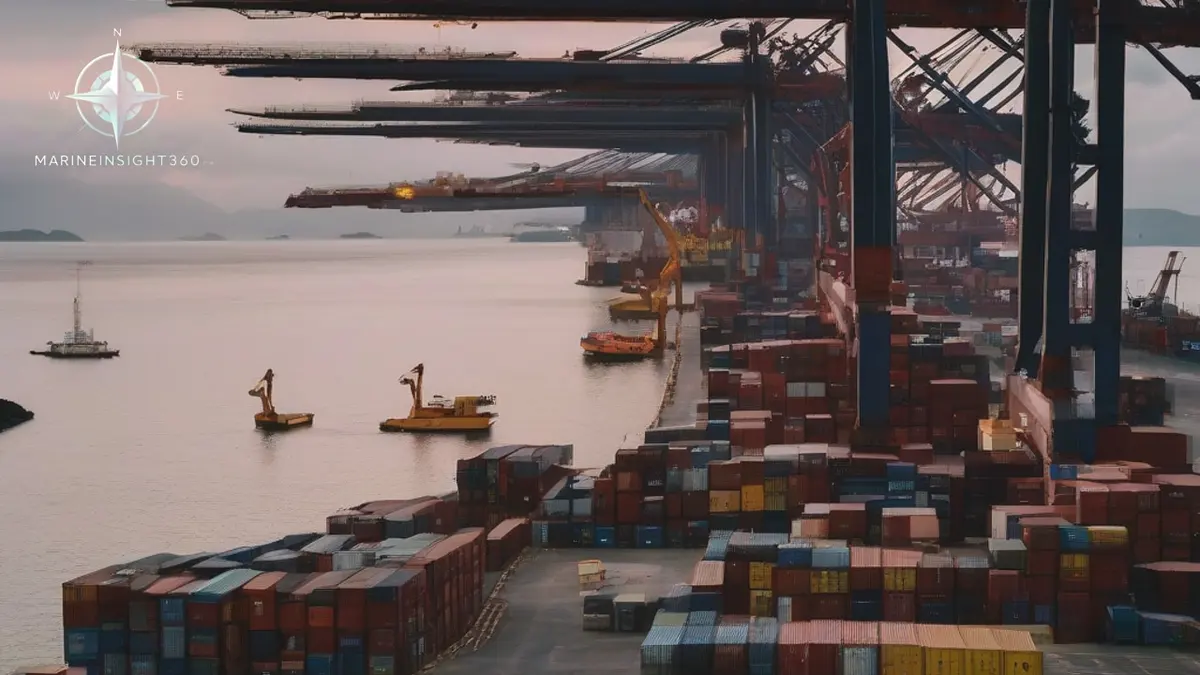
That position supports two different ambitions that often get blurred together. One is a coordination centre for maritime governance and incident reporting. The other is a commercial transshipment hub competing with Singapore, Tanjung Pelepas and Kaohsiung. The first is diplomatic. The second comes down to cost per container move.
The commercial case is harder than the geographic one
Analysts have repeatedly identified high costs, aging port infrastructure and underinvestment as the constraints on Philippine transshipment ambitions. Domestic shipping and port handling charges sit above regional benchmarks, and shipbuilding and repair capacity trails neighboring countries.
- Cost per move. Carriers choose hubs on total terminal cost, crane productivity and berth availability, not on distance from the trade lane.
- Draft and berth length. Mainline ships need depth alongside and quay length that many regional ports still lack.
- Network effect. A hub is valuable because many services already call there. Breaking into that circle needs a carrier to move an entire service, not a single ship.
- Domestic regulation. Cabotage restrictions and the customs treatment of transshipped cargo determine whether foreign feeders can work efficiently.
None of these is unfixable, but each takes capital and years. A coordination centre can be announced. A hub has to be built and then won from an incumbent.
What a regional maritime centre could realistically deliver
Set the container economics aside and the coordination function still has value for working mariners. Southeast Asian waters carry heavy traffic through narrow channels, with mixed fishing fleets, frequent unlit small craft and a long casualty record.
- Shared incident reporting, so a master who is challenged, shadowed or blocked has one place to report it.
- Search and rescue coordination across overlapping and sometimes contested national regions.
- Consistent distribution of navigational warnings for exercise areas and disputed features.
- Pollution response planning for a region that handles a large share of global tanker traffic.
What operators and masters should watch
The Code of Conduct negotiations between ASEAN and China remain the item with the most direct operational consequence. A binding text covering incident procedures would change how encounters near disputed features are handled. Until then, commercial ships transiting the region should treat challenges by state vessels as possible and routine reporting as necessary.
- Brief bridge teams on the likelihood of VHF challenges and record every exchange in the bridge log with time and channel.
- Keep passage plans on established routes and avoid transiting close to disputed features, whatever the legal position.
- Check flag state and protection and indemnity circulars before fixing a voyage into a contested area.
- Confirm that war risk cover and charterparty clauses match the trading area actually planned.
The reading that matters for shipping
A maritime centre hosted in Manila would give the region a coordination point it currently lacks, but it will not by itself move container volumes or settle a sovereignty dispute. Judge the Philippines on terminal productivity and customs reform for the commercial question, and on the Code of Conduct for the security one. They are two separate scorecards, and progress on one says nothing about the other.
Regional coordination already has working precedents, and that is the test a new centre has to meet. The ReCAAP Information Sharing Centre in Singapore has run incident reporting for piracy and armed robbery in Asian waters since 2006, and the Tokyo MoU coordinates port state control inspections across the Asia-Pacific, publishing detention figures by flag and by authority each year. A Manila centre would need to slot into that machinery rather than duplicate it.
Credibility is the other constraint. The European Maritime Safety Agency inspected Philippine seafarer training repeatedly over more than a decade before the European Commission confirmed in 2023 that it would keep recognizing Philippine certificates of competency. That sequence shows how a hosting bid gets judged: on audit findings, detention records and reform actually delivered, rather than on the language of a summit communique.
Sources and further reading
- Philippines Asean maritime hub pitch meets South China Sea realities
- High costs mar PH promise as transshipment hub
- Enhancing the Philippines Shipbuilding and Port Capabilities
What to read next
Recommended Reading
South Korea Tops Global Shipbuilding Orders in October, Surpassing China
South Korean yards took 1.54m CGT of October orders against China's 820,000 CGT. What CGT market share and the orderbook actually tell owners.
PBBM: South China Sea must remain sea of peace, cooperation
Explore President Marcos Jr.'s call for peace and cooperation in the South China Sea and its impact on shipping.
South China Sea or West Philippine Sea: What’s the Deal?
South China Sea or West Philippine Sea: What’s the Deal?: regulatory and compliance context for US, UK, Canada, Australia, Singapore and European...