
The Mayflower Ship: Design, the 1620 Passage and Mayflower II
What kind of vessel the Mayflower ship was, how her 1620 Atlantic crossing was navigated and repaired at sea, and what the Mayflower II replica proved.
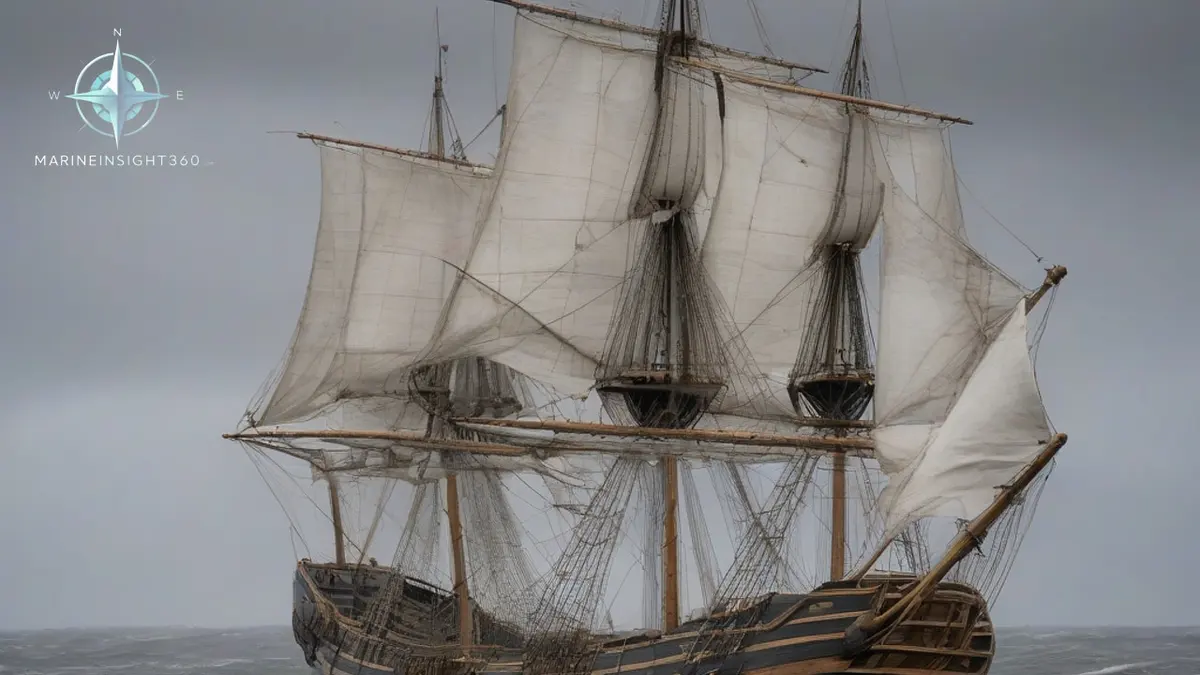
The Mayflower ship was an ordinary English merchant vessel of about 180 tons. She measured roughly 90 to 110 feet (27 to 34 m) long on a beam near 25 feet (7.6 m). Three masts carried square sails on the fore and main, with a lateen mizzen aft. Nothing about her was built for passengers. She carried 102 of them across the North Atlantic in 1620, in a tween deck space intended for cargo.
The crossing took 66 days, in the worst season of the year for a westbound passage.
Seen from the bridge of a modern ship, the interesting part is not the destination. It is that a working cargo ship with no reliable way to fix her longitude, no engine, no weather forecast and no means of calling for help completed a westward Atlantic passage against the prevailing weather and then repaired a fractured structural member at sea.
A wine trader, not an expedition vessel
The Mayflower spent her working life in the European carrying trade, including the wine run to Bordeaux. That mattered practically: a ship that had carried wine casks had a hold considered sweeter than one that had carried fish or hides, which is why such vessels were preferred for passengers and provisions. Her hull form was full and blunt, built to carry weight rather than to sail fast or point close to the wind.
The high sterncastle that gives the period its silhouette also made her slow to work to windward and prone to being driven to leeward in a blow.
The passage, in seamanship terms
She cleared Southampton in August 1620 in company with the Speedwell. The smaller ship leaked badly enough to force two returns to port, at Dartmouth and then Plymouth in Devon, and the venture finally sailed alone. Departure that late in the year committed the ship to autumn North Atlantic weather, and the passage that followed took 66 days before a landfall at the northern end of Cape Cod in November 1620.
Two consequences ran through the whole voyage. Westbound sailing works against the prevailing westerlies of the temperate North Atlantic, so progress came in long tacks and in periods of lying ahull with sails furled while gales passed. And the passengers lived on the tween deck below the main deck, a space with headroom measured in feet, no natural light and no ventilation once the hatches were secured for heavy weather.
Finding the way without longitude
Navigation in 1620 rested on three tools and a great deal of judgment.
- Latitude by observation. A cross-staff or backstaff gave the altitude of the sun or the pole star, and from that a workable latitude when the horizon and sky allowed it.
- Dead reckoning. Course from the magnetic compass, speed estimated by eye or by a line streamed astern, and time by sand glass, all recorded on a traverse board and worked up into a position.
- The lead line. Soundings and a tallowed lead that brought up a sample of the bottom, the only reliable warning of shoaling water on a coast with no charts worth the name.
Longitude had no practical solution for another century and a half. The working method was to run down a chosen latitude until land appeared, which is why an error of a few degrees north or south mattered less than an error in easting or westing.
The cracked beam and the iron screw
The best documented engineering moment of the voyage is a main structural beam amidships that cracked and bowed under working loads in heavy weather. Surviving accounts describe the crew and passengers securing it with a large iron screw brought from the Netherlands, jacking the beam back into place and shoring it so the ship could continue.
Whatever the exact device was, the episode records a decision every master still faces: whether structural damage is repairable at sea or forces a turn back. They judged it repairable, and the hull held.
Landfall, shoals and a changed plan
The intended destination lay well to the south, near the mouth of the Hudson. After sighting Cape Cod the ship turned south to make for it and ran into shoals and heavy breakers off the elbow of the Cape, the ground known today as Pollock Rip. With a foul tide, a falling wind and a lee shore of shifting sand, the master turned back north and anchored in the shelter of what is now Provincetown harbour.
The settlement site was chosen by hydrography, not by charter.
Mayflower II and what the replica proved
No plans of the original survive. Mayflower II, built by traditional methods at Brixham in Devon during 1955 and 1956, was a reconstruction from research rather than a copy: about 106 feet (32 m) long, 25 feet (7.6 m) in beam and around 236 tons displacement. In April 1957 she crossed the Atlantic under Alan Villiers, one of the last masters with deep square rig experience, and made the passage in 53 days.
That crossing settled arguments no drawing could. It showed how such a hull actually behaves running before an Atlantic gale, how little she could point, and how the rig was handled by a small crew. Mayflower II is preserved at Plymouth, Massachusetts, where she remains one of the most studied working reconstructions of a seventeenth century merchant ship. Readers following the development of ship design from this period will find the wider story in the Ships and Vessels section.
A replica has to satisfy a modern regulator, which is where the reconstruction stops being a copy. Mayflower II sails under the United States flag, so her hull, rig, stability and life saving equipment fall to the USCG, and carrying anyone beyond her own crew depends on that certification. The 1620 ship answered to none of it, and the difference shows in ballast, freeboard and crew numbers.
Her measurements are also less solid than they look. The 180 tons is tons burthen, a cargo capacity reckoned in wine casks rather than a displacement or a gross tonnage, so it cannot be compared directly with a modern figure. No classification register recorded her either: Lloyd's Register dates from 1760, so everything before it rests on port books, charters and court papers.
Sources and further reading
- Mayflower: History, Voyage, Landing and Facts
- Mayflower II, Plimoth Patuxet Museums
- Mayflower II, Tall Ships America
What to read next
Recommended Reading
The Hull of a Ship: Purpose, Design and the Trade-offs Behind It
What a ship hull does, how naval architects shape it, and why block coefficient, bulbous bows, stern form and double hulls change fuel burn and survivability.
The Clipper Ship: How Sail Design Chased Speed and Why the Era Ended
A clipper ship traded cargo capacity for speed. Here is how the hull and rig were designed, what the tea and wool runs demanded, and why steam ended the era.
What Are Masts on a Ship? Purpose, Types and Modern Design
What masts are on ships: their purpose on sailing and motor vessels, common types and materials, and how modern mast design has changed.