
Types of Fire Extinguishers Used on Ships
The portable and semi-portable fire extinguishers carried on ships, which fire classes each one fights, where they go and how they are maintained under SOLAS.
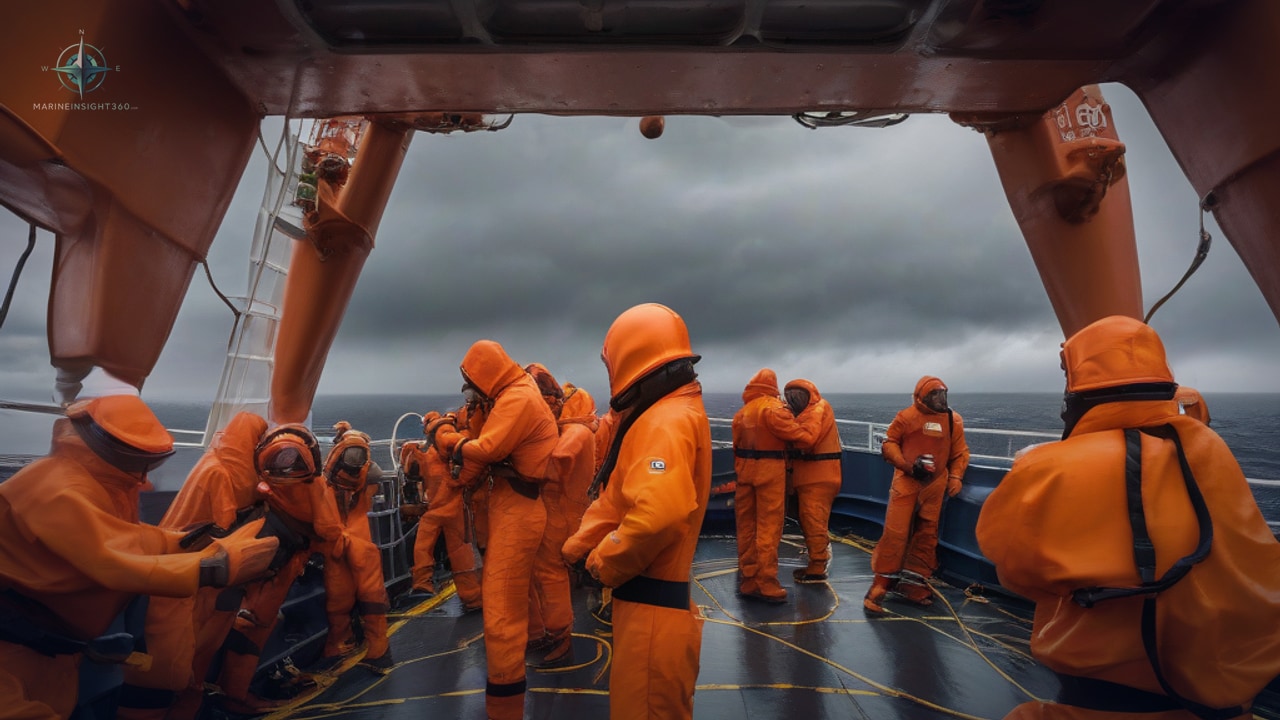
Every ship to which SOLAS applies carries portable fire extinguishers throughout its accommodation, service spaces and machinery spaces, and larger semi-portable units in the engine room. They are the first attack on a small fire, before fire hoses or a fixed system are needed. The requirements are in SOLAS Chapter II-2 and Chapter 4 of the Fire Safety Systems (FSS) Code, with detailed guidance in IMO resolution A.951(23) on marine portable fire extinguishers.
Fire classes
An extinguisher is chosen for the kind of fuel it will meet. IMO's guidelines set out two classification systems side by side. The international (ISO) classes are:
- Class A: ordinary combustible solids such as wood, paper, textiles and furnishings.
- Class B: flammable liquids such as fuel oil, lubricating oil, paint and solvents.
- Class C: flammable gases.
- Class D: combustible metals such as magnesium.
- Class F: cooking oils and fats, as in a galley deep-fat fryer.
The American (NFPA) system uses different letters: Class C means fires in electrical equipment and Class K means cooking oils. IMO's own table for how many extinguishers go in each space uses the American letters, so on board you will meet both. In the ISO system electrical equipment is not a class; extinguishers are usually labelled to show whether they are safe to use on live electrical equipment.
The main types
Water
Water extinguishers are for Class A fires in the accommodation and service spaces. They work by cooling the burning material. They must not be used on burning oil or on live electrical equipment.
Foam
Foam extinguishers are used on Class A and Class B fires. The foam blankets a burning liquid, cutting off the air and stopping flammable vapour escaping, which makes foam the usual choice in machinery spaces and near fuel and oil systems.
Carbon dioxide
Carbon dioxide (CO 2 ) extinguishers are used on Class B fires and on electrical equipment, because the gas does not conduct electricity and leaves no residue. They are kept near switchboards and electrical equipment and in machinery spaces. SOLAS does not allow CO 2 extinguishers to be placed in accommodation spaces; in a small enclosed space the gas can displace enough air to suffocate the people in it.
Dry powder
Dry powder extinguishers are the most versatile. Multipurpose (ABC) powder works on solids, liquids and gases, and powder is safe on electrical equipment. It knocks a fire down quickly by interrupting the chemical reaction of combustion, but it gives little cooling, so the fire can reignite, and the residue can damage electrical and electronic equipment. Special powders are made for metal fires.
Wet chemical
Wet chemical extinguishers are made for cooking oil fires in galley fryers. They cool the oil and react with it to form a layer that seals the surface. Water must never be used on burning cooking oil. The portable extinguisher is the back-up, not the main protection: SOLAS requires deep-fat cooking equipment to have a fixed fire-extinguishing system and an automatic cut-off of its power supply.
Older types that are no longer used
Soda-acid and chemical foam extinguishers, which were set off by turning the unit upside down or breaking an acid container to start a chemical reaction, are obsolete. They have been replaced by the stored-pressure and gas-cartridge types above. Carbon tetrachloride (CTC) extinguishers were withdrawn because the liquid gives off toxic gases, including phosgene, when it meets a fire.
SOLAS prohibits new fire-extinguishing systems using halons or perfluorocarbons, and MARPOL Annex VI bans new halon installations, because of the damage they do to the ozone layer.
Size, number and placement
Under the FSS Code a portable extinguisher must weigh no more than 23 kg when fully charged. Powder and CO 2 extinguishers must hold at least 5 kg, and foam extinguishers at least 9 litres. Ships of 1,000 gross tonnage and upwards must carry at least five portable extinguishers in their accommodation, service and control spaces, and IMO's guidance sets the minimum number and type for each kind of space.
For extinguishers that can be recharged on board, spare charges are carried for 100 per cent of the first ten extinguishers and 50 per cent of the rest, up to a total of 60, together with instructions for recharging. Extinguishers that cannot be recharged on board are backed up by additional extinguishers instead.
One of the extinguishers intended for a space is kept near its entrance, so it can be picked up on the way in. The ship's fire control plan shows where every extinguisher is. Older ships may have been built to earlier rules and can differ in some of these details.
Semi-portable extinguishers in machinery spaces
Machinery spaces need larger units for oil fires that a portable extinguisher cannot handle:
- Each boiler room must have at least one foam extinguisher of at least 135 litres, or equivalent, fitted with hoses on reels that can reach any part of the room.
- Spaces containing internal combustion engines must have foam extinguishers of at least 45 litres each, or equivalent, enough to direct foam onto any part of the fuel and lubricating oil systems.
- These spaces also need portable foam extinguishers placed so that no point is more than 10 metres' walk from one, with at least two in each space.
"Or equivalent" means a unit of the same fire-fighting capability, so a wheeled dry powder unit can be used in place of foam. The large units are mounted on trolleys so one person can move them to the fire.
Portable foam applicators
A portable foam applicator unit connects to the fire main through a fire hose. It consists of a foam nozzle or branch pipe, either self-inducing or used with a separate inductor, and a portable tank holding at least 20 litres of foam concentrate, with a spare tank of the same size. Under the current FSS Code it must deliver a foam solution flow of at least 200 litres a minute at the fire main's normal pressure.
Inspection and maintenance
- The crew check every extinguisher monthly, as IMO's maintenance guidelines (MSC.1/Circ.1432) require, to confirm each one is in place, sealed, charged and undamaged.
- A competent person inspects them at least once a year.
- Extinguishers and their propellant cartridges are pressure tested at intervals of no more than ten years.
- At least one extinguisher of each type and year of manufacture is test-discharged every five years, which can be done as part of a fire drill.
Using a portable extinguisher
Raise the alarm first and keep your escape route behind you. Then pull the safety pin and use the technique for the type:
- Water and powder: aim at the base of the flames and sweep across it.
- Foam on a burning liquid: do not drive the jet into the liquid, which splashes burning fuel. Let the foam fall gently onto the surface or bounce it off a wall or other surface behind the fire, so it builds up a blanket.
- CO 2 : get close, because the gas has a short range, and direct it at the base of the fire.
If the fire is not going out, get out and close the door behind you.
For the fixed systems that take over when extinguishers are not enough, see water sprinkler and water mist systems, and for one of the engine room's highest-risk spaces, what to do in a purifier room fire.
Recommended Reading
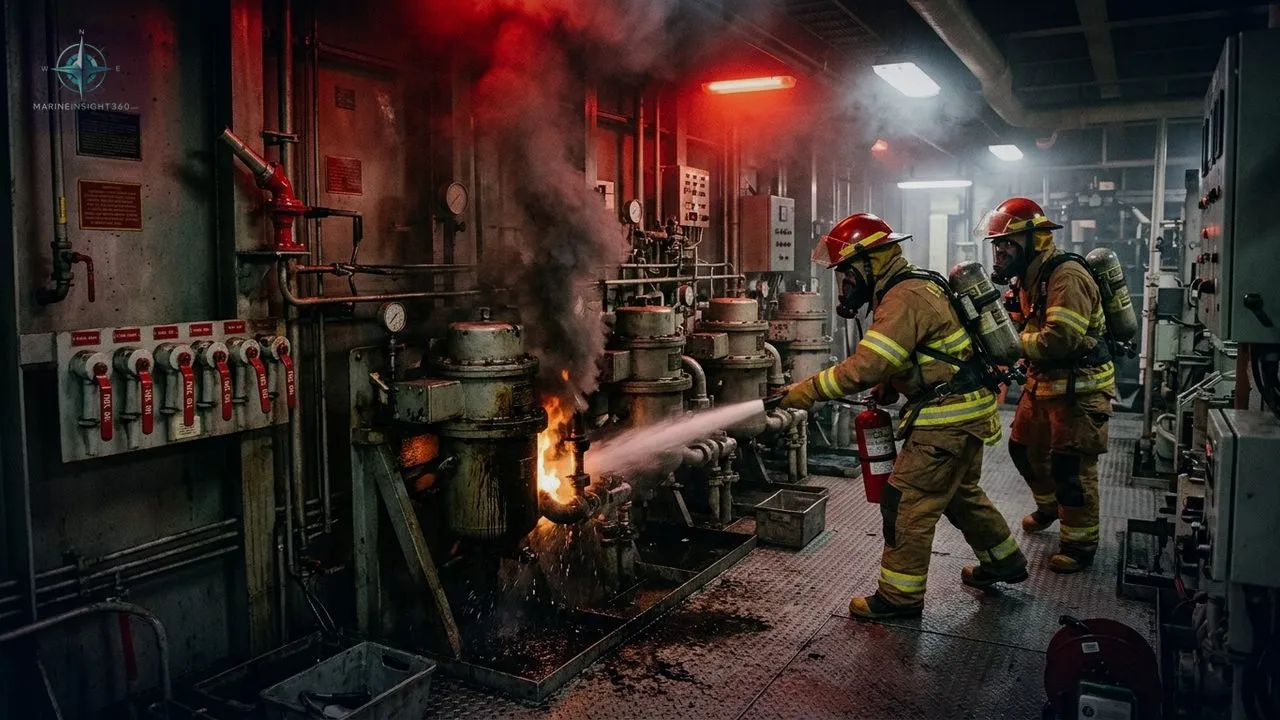
Purifier Room Fire: Causes, Prevention and What to Do
Why purifier room fires start, how they are prevented, and the steps for fighting one, from remote stops and quick-closing valves to the fixed CO2 system.
Water Sprinkler and Water Mist Fire Extinguishing Systems
Water Sprinkler and Water Mist Fire Extinguishing Systems: safety, training and compliance context for US, UK, Canada, Australia, Singapore and...
Marine Fire Safety: What the FSS Code Requires on Every Ship
How marine fire safety works under the FSS Code: fire mains and pumps, fixed gas and sprinkler systems, detection, escape gear and the drills that bind it all.