
Types of Port Cranes and What Each One Does
The main types of port cranes: ship-to-shore gantries, mobile harbour cranes, bulk unloaders, RTG and RMG yard cranes, floating cranes and ship's own gear.
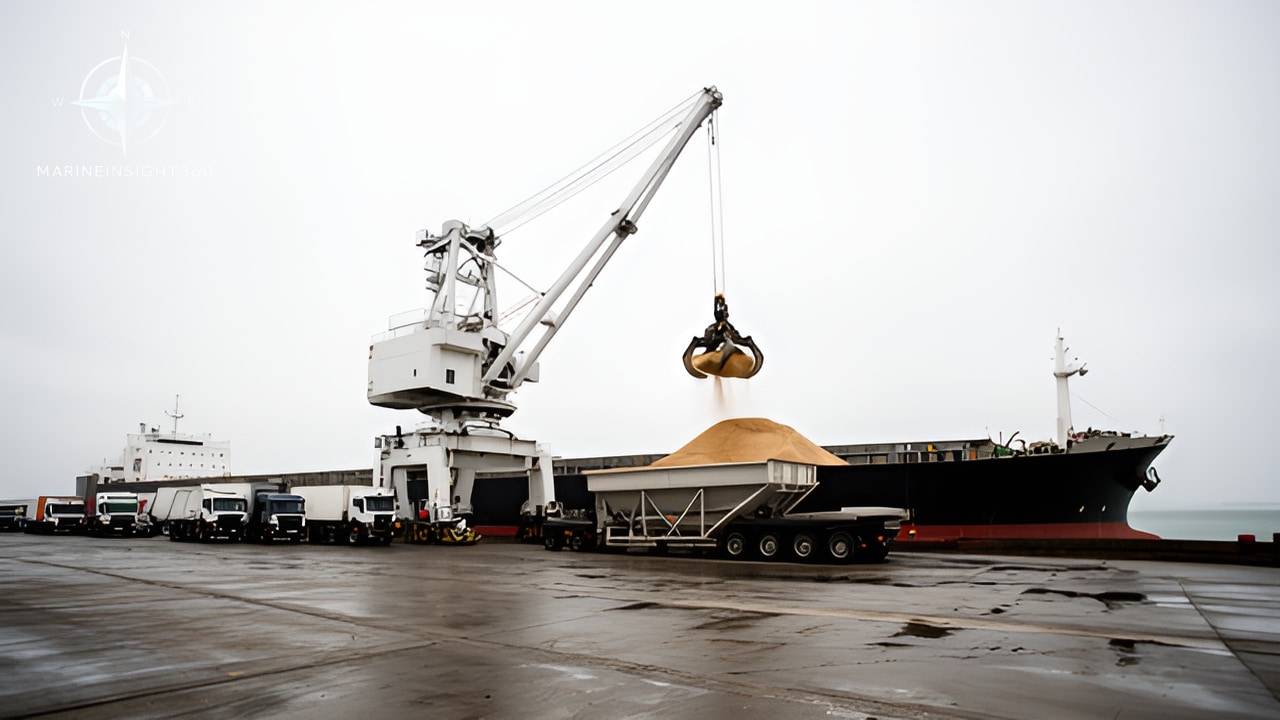
Port cranes fall into two broad groups. Quay cranes work the ship: ship-to-shore container gantries, mobile harbour cranes, level-luffing cranes and bulk grab unloaders. Yard cranes and machines move cargo around the terminal, chiefly rubber-tyred and rail-mounted gantry cranes, straddle carriers and reach stackers. Floating cranes and the ship's own cranes cover ports and lifts that shore equipment cannot.
Ship-to-shore container gantry cranes
The ship-to-shore (STS) crane is the tall gantry that lines every container quay. Its four legs run on rails laid along the quay, so the whole crane travels sideways to line up with each bay of the ship. A boom reaches out over the vessel, and a trolley runs along it carrying the hoist ropes, the spreader and, on most designs, the driver's cab.
The trolley picks a box from the ship, runs back over the quay and lands it on a terminal tractor or the quay apron. A short back reach behind the landside legs gives room for hatch covers and odd cargo.
On most designs the waterside part of the boom is hinged. When a ship berths or sails, the boom is raised clear of the masts and bridge, and it is lowered again before work starts.
STS cranes are described by the width of ship they can work, which follows the history of the Panama Canal:
- Panamax cranes reach across a ship that fits the original Panama Canal locks, about 32 m wide and around 13 containers across.
- Post-Panamax cranes reach ships too wide for the original locks.
- Super post-Panamax cranes serve the largest container ships, which are more than 60 m wide and carry well over 20 boxes across the deck. Ships such as MSC Irina need cranes of this size at every port they call.
Most modern STS cranes are electric, fed from the shore supply through a cable reel. At automated terminals the driver often works from a control room in an office building, watching camera feeds, and the crane carries out much of each move automatically.
Spreaders and twistlocks
The spreader is the frame that grips the container. It telescopes to fit 20 ft, 40 ft and 45 ft boxes, and at each corner a twistlock drops into the container's corner casting and turns 90 degrees to lock. Sensors confirm that all four twistlocks are seated and locked before the hoist can lift. A twin-lift spreader can carry two 20 ft boxes end to end, and some cranes have two spreaders side by side for tandem lifts of two 40 ft boxes. How these moves fit into a full terminal cycle is covered in our article on container loading and unloading.
Mobile harbour cranes
A mobile harbour crane is a large slewing crane on rubber tyres. It drives to the berth where it is needed, sets down outriggers to spread its load into the quay, and works with a boom that luffs up and down. Liebherr and Konecranes are the best-known builders.
Their value is flexibility. The same crane can work containers with a spreader in the morning, bulk cargo with a grab in the afternoon and a heavy transformer on the hook the next day, which suits multipurpose terminals and smaller ports that cannot justify a dedicated STS crane. Two mobile cranes can work together on a single heavy lift.
Bulk handling cranes and unloaders
Dry bulk such as coal, iron ore, grain and fertiliser is discharged by grabs or by continuous unloaders.
- Grab unloaders are bridge-type cranes similar in layout to an STS crane, with a trolley carrying a large grab. The grab bites into the cargo, lifts and opens over a hopper on the quay that feeds a conveyor.
- Level-luffing cranes keep the hook at roughly the same height as the jib moves in and out, which saves energy and makes the load easier to control. They are common at general cargo and bulk berths.
- Continuous ship unloaders use a screw conveyor, a bucket elevator or, for grain and cement, pneumatic suction. They give a steady flow and less dust than grabs, but each design suits a narrower range of cargoes.
Export berths usually work the other way, with a travelling ship loader fed by conveyor from the stockyard.
Container yard cranes and machines
Behind the quay, containers are stacked in blocks, and different equipment lifts them in and out of the stacks.
Rubber-tyred gantry cranes
A rubber-tyred gantry (RTG) straddles a container block on tyres and can move from one block to another. A common layout spans six rows of containers plus a truck lane and stacks five or six high. Older RTGs run on diesel generators; many terminals have converted them to electric power through cable reels or overhead busbars.
Rail-mounted gantry cranes
A rail-mounted gantry (RMG) runs on fixed rails, so it is tied to one block but can be wider and faster than an RTG. Automated stacking cranes, which run without a driver aboard, are a form of RMG used at automated terminals. RMGs are standard at large rail terminals, where they span the tracks and load trains directly.
Straddle carriers, reach stackers and handlers
Straddle carriers are tall wheeled machines that drive over a container, lift it and carry it, typically stacking two or three high. Reach stackers are heavy vehicles with a telescopic boom and spreader, used at smaller terminals, depots and rail yards. Empty container handlers are lighter machines built to stack empties high. None of these is strictly a crane, but at many ports they do the yard work.
Floating cranes and ship's gear
Floating cranes are mounted on pontoons or crane vessels. They handle lifts too heavy for quay cranes, such as port equipment, bridge sections and offshore modules, and they can discharge ships at anchor where there is no suitable berth. Sheerlegs, with an A-frame boom that tilts forward and back but cannot slew, are a common heavy-lift design.
Many ships bring their own cranes. Geared bulk carriers, multipurpose ships and smaller container feeders have electro-hydraulic deck cranes, which lets them work at ports with little or no shore equipment. The crew maintain this gear, though in many ports it is driven by shore stevedores, and it is tested, examined and recorded in the ship's own register of lifting appliances.
Testing, inspection and wind limits
Port cranes are lifting appliances and are regulated as such. The ILO Occupational Safety and Health (Dock Work) Convention, 1979 (No. 152) requires every lifting appliance to be tested before it is first used and after any substantial alteration or repair, and thoroughly examined at least once every 12 months, with records kept in a register. Its fixed five-year retest applies to lifting appliances that form part of a ship's equipment.
For cranes on shore, the Convention leaves the retest interval to the national authority, and many countries set stricter rules than the Convention's minimum.
Wind is the main operational limit. Tall gantries carry anemometers, terminals stop work above a set wind speed, and cranes are secured with storm pins and tie-downs before high winds arrive. A gantry left free on its rails in a gale can be blown along the quay.
Who builds port cranes
China's ZPMC builds most of the ship-to-shore container cranes in service worldwide. Liebherr, Konecranes and Kalmar are the other names most often seen in container yards and on multipurpose berths, with Liebherr and Konecranes strongest in mobile harbour cranes and Kalmar in straddle carriers and reach stackers. The busiest terminals, such as those in our list of the world's biggest ports, usually run a mix of several suppliers' equipment.
Recommended Reading
Maritime Cybersecurity in 2026: Why Every Ship and Port Must Prepare
Practical measures for ships and companies A robust maritime cybersecurity programme does not have to start with costly hardware.
Shipping Agent Role: Port Call Duties Explained
Learn how a shipping agent coordinates vessel clearance, port services, documents and communications before, during and after a port call.
The Importance of Port Security
Introduction: Why Port Security Can No Longer Be an Afterthought Every single day, more than 90% of the world's traded goods pass through ports. These...