
Boat Approaches Tanker Near Yemen: What Happens On Board Next
A boat approaches a tanker near Yemen, then retreats when the armed team appears. Inside the UKMTO reporting chain, warning signs and onboard drills.
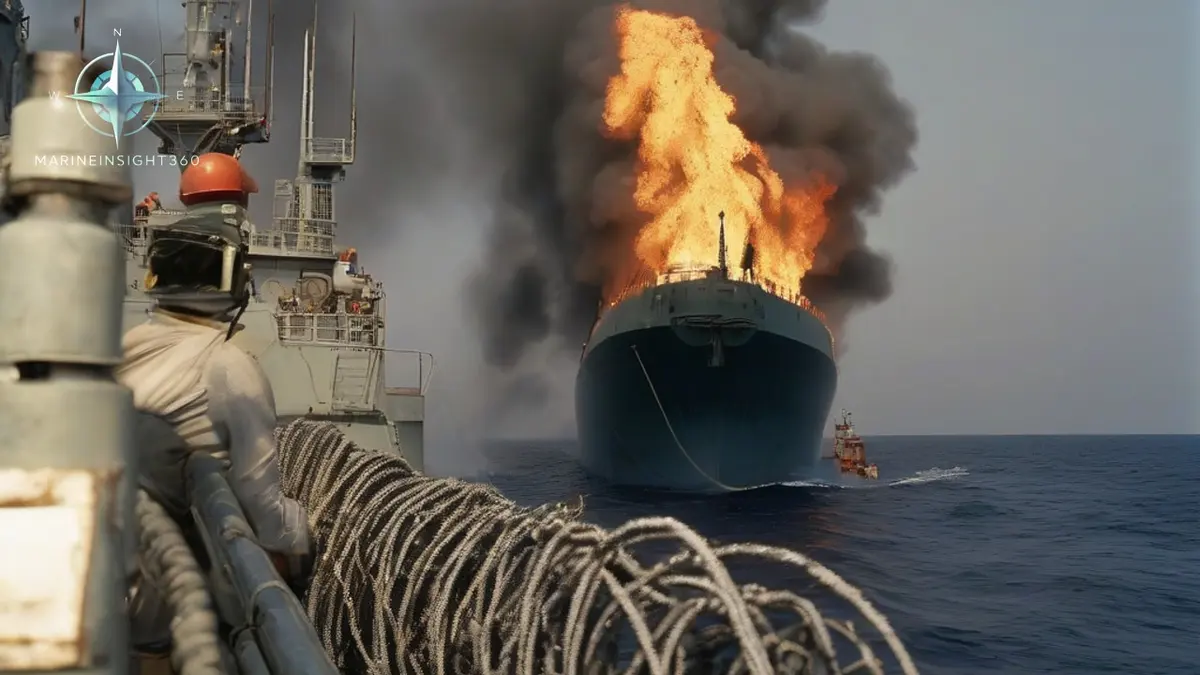
A boat approaches a tanker near Yemen, then retreats once the armed team is deployed. That outcome is the end of a long sequence, not the start of one. United Kingdom Maritime Trade Operations logs the approach. UKMTO is the Royal Navy cell that merchant shipping in the region reports to voluntarily. It issues an advisory to other vessels nearby and passes the position to naval forces.
On board, the deterrent that turned the skiff away was visible presence and a hardened ship, not a firefight.
Most reported approaches end this way. Documented cases in the Gulf of Aden and around Socotra include the tanker Caruzo, approached by a small craft with five people on board roughly 98 nautical miles north of Socotra, whose armed security team fired and forced the craft to alter course, and the bulk carrier Pentozali, approached by a skiff with five people on board around 200 nautical miles west of Socotra.
What the UK maritime agency does and does not do
UKMTO is a reporting and information hub, not an enforcement body. It runs the Voluntary Reporting Area, receives position and incident reports from merchant ships, and publishes advisory notices and incident alerts. It cannot dispatch a warship on its own authority; it passes information to the naval forces operating in the area.
That has a practical consequence for masters. A late report degrades the picture for every ship behind you. An accurate one, with time, position, course, speed, number of craft, persons on board and observed behavior, is what turns a single sighting into a usable warning for the next twenty ships in the traffic separation scheme.
The approach profile crews are trained to recognize
Not every fast craft near a tanker is hostile. Fishing skiffs work the same waters, and smuggling and migrant traffic add more contacts. The indicators that separate an attack profile from ordinary traffic are consistent:
- Sustained closing course from the quarter or stern, where the ship's speed advantage is smallest and the bridge blind spots are largest.
- Ladders, grapnels or hooks visible on board a small craft with no fishing gear.
- Weapons sighted, or a craft that maintains speed and heading through a clear alteration by the ship.
- Multiple craft working together, or a larger mother vessel loitering nearby that allows skiffs to operate hundreds of miles offshore.
Distance from land is not reassurance. Both of the cases above happened well over 90 nautical miles from the nearest coast.
What deploying an armed team means in practice
Privately contracted armed security personnel embark and disembark through recognized boarding points or floating armouries, and operate under a written set of rules for the use of force agreed with the flag state and the shipowner. Force is graduated and heavily weighted toward deterrence: visible presence on the bridge wings, hand signals, flares or a loud hailer, then warning shots into the water ahead of the craft, and only then aimed fire.
The master retains command throughout. The security team leader advises; the master decides on course, speed and whether the ship enters a citadel routine. Flag state authorization, coastal state law on carriage of weapons in territorial seas, and the port state rules at each end of the voyage all constrain how the team is armed and where it can embark. Operators who treat this as a paperwork exercise usually discover the gaps at the wrong moment.
The measures that work before any weapon does
Best Management Practices for Maritime Security remains the baseline, and the physical measures in it are what most often end an approach:
- Maximum practical speed and a bold, early alteration to open the closing angle.
- Freeboard and razor wire on accessible sections of the main deck, with access hatches secured.
- Fire hoses and water spray rigged and pressurized on the approach side.
- Extra lookouts with binoculars, and radar watch tuned for small returns in sea clutter.
- A hardened citadel with independent communications, tested by drill and not just listed in the ship security plan.
The reporting order when it happens
Report to UKMTO first by phone, then confirm in writing. Alert the naval coordination centre for the area, activate the ship security alert system if the situation escalates toward boarding, and inform the company security officer and the flag state. Bridge and engine room logs should record times, ranges and actions as they happen rather than being reconstructed afterward, because those entries become the evidence for the flag state investigation, the war risk underwriter and any subsequent claim.
Why a single skiff matters to the operator
An approach that ends in five minutes still costs money and safety margin. Crews stand extended watches, transit speeds rise and burn fuel, war risk premiums and crew bonus payments follow the reported incident count, and charterers reassess routing. That is the real reason companies invest in drills and hardening: the deterrent has to work on the first contact, because the second one is always the more determined.
Crews transiting the Gulf of Aden and the approaches to Bab el-Mandeb should re-read the current BMP guidance and the latest UKMTO advisory before the passage plan is signed off. Our Maritime Safety section tracks regional advisories and ship protection practice.
Sources and further reading
- Multiple vessels report suspicious approaches in Gulf of Aden, Seatrade Maritime
- UKMTO reports suspicious skiff activity in the Gulf of Aden, SAFETY4SEA
- UKMTO reports that small boats approached a tanker near Aden in Yemen, MarineLink
What to read next
Recommended Reading
Gulf Energy Infrastructure Under Attack: What a Struck Tanker Near Hormuz Means at Sea
Drone and missile attacks have hit Gulf gas fields, the Fujairah oil zone and tankers near Hormuz. What changes for tanker crews, insurers and charterers.
Sunken Ship: What Happens Next, Who Pays and Who Removes It
What happens after a ship sinks: who owns the wreck, who pays to remove it, how much oil sunken ships still hold, and what the Nairobi Convention requires.
How Boat Propellers Work: Pitch, Slip, Diameter and Cavitation
A boat propeller is a rotating wing. How pitch, diameter and slip set thrust, why cavitation is not ventilation, and how to match a prop to the engine.