
Bosphorus Strait Transit: Rules, Currents and Pilotage
How a Bosphorus Strait transit works: Montreux Convention rights, Turkish Straits traffic rules, Istanbul VTS reporting, currents and pilotage.
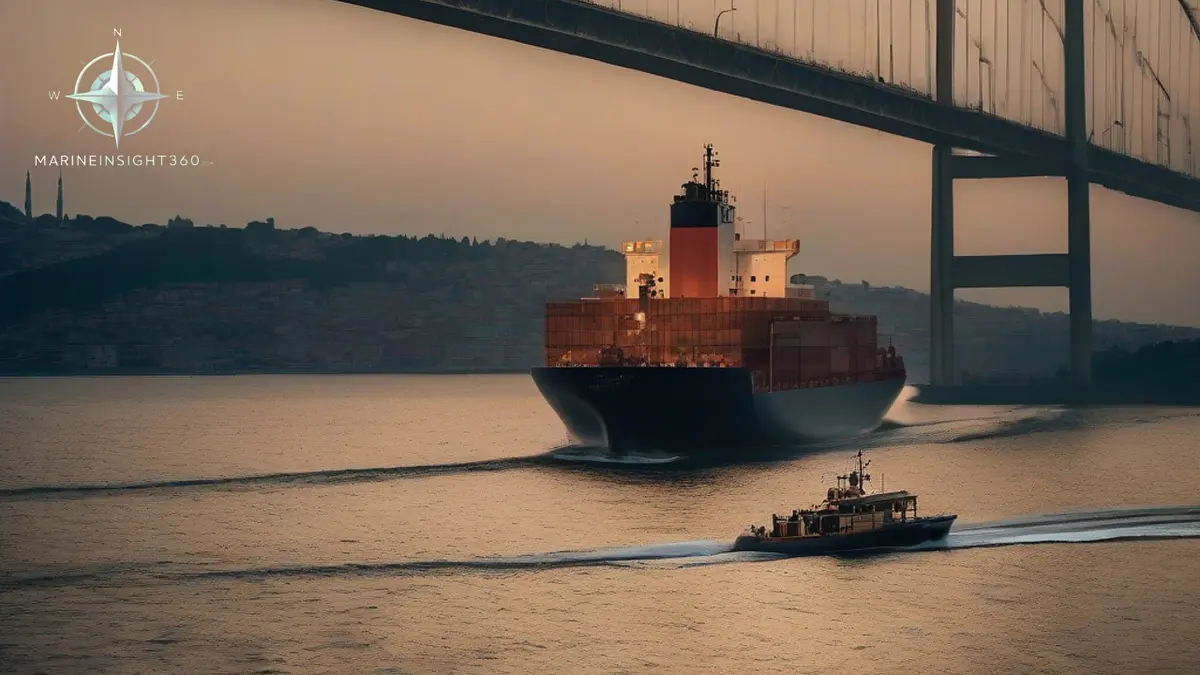
The Bosphorus Strait connects the Black Sea to the Sea of Marmara and, through the Dardanelles, to the Mediterranean. It is roughly 17 nautical miles (31 km) long and narrows to about 700 meters at its tightest point. A strong surface current runs south through it. A major city sits on both banks. Merchant ships hold a treaty right of free passage, but they exercise it inside one of the most tightly managed traffic systems anywhere.
Much of that traffic is Black Sea grain and crude bound for EU, UK and Japanese buyers, so European and Singapore-managed fleets plan this passage constantly.
For a bridge team the transit is short and demanding. You get a dozen course alterations, cross-traffic from ferries, a current that changes strength along the route, and a set of national traffic rules layered over an international convention.
What the Montreux Convention guarantees
The 1936 Convention Regarding the Regime of the Straits, signed at Montreux, established freedom of navigation through the Turkish Straits for merchant vessels of all flags, by day and by night, in peacetime. Turkey retains sovereignty over the waters and administers traffic.
The convention also treats pilotage and towage as optional rather than compulsory. That single provision explains a lot of what happens in the strait, and it is worth reading alongside the practical picture below.
The rules that actually govern the transit
The operating instrument is the Turkish Straits Maritime Traffic Regulation, applied through an implementation directive that Turkey updates periodically. It sets the traffic separation scheme, reporting requirements, minimum under-keel and air-draft considerations, and the conditions under which traffic is suspended or run one-way.
Traffic control sits with Istanbul VTS for the Bosphorus and Canakkale VTS for the Dardanelles. Ships report before entry, at defined calling-in points, and on departure. Anchoring inside the traffic separation scheme is prohibited except in an emergency, and the traffic control station must be notified immediately if it happens.
Vessels above the length thresholds in the regulations transit under special arrangements. In practice that means opposing traffic is suspended, passage may be restricted to daylight, and a slot has to be booked and held. Delays of a day or more are routine when weather closes the strait or a large-vessel convoy is running.
Conditions that stop or restrict traffic
- Restricted visibility below the declared minimum.
- Strong currents or gale-force winds.
- Large-vessel or dangerous-cargo transits requiring a clear strait.
- Casualties, salvage operations or search and rescue in the fairway.
- Scheduled events, including swimming and sailing races in summer.
Pilotage is optional and almost always worth taking
Because Montreux makes pilotage voluntary, ships can legally decline it. Very few prudent operators do. The pilots know the current sets at each bend, the ferry patterns, the VHF working practice and the local language, and the traffic authority looks more favorably on a ship that has one aboard.
Charterparties and insurance play a part too. Turkish Straits clauses in charterparties allocate delay risk and often assume pilotage will be taken, and P&I clubs have long advised members to use pilots and, for the largest ships, escort tugs. A grounding or contact damage after declining pilotage is a poor position to defend.
Currents are the technical problem
The dominant flow runs from the Black Sea toward the Marmara, driven by the fresh-water surplus in the Black Sea. Surface rates commonly run several knots and increase markedly after heavy rain in the Danube and Dnieper basins. A denser, saltier undercurrent runs the other way beneath it.
Two effects matter on the bridge. A northbound ship fights the current and loses steerage margin, particularly on the bends, so speed through the water must stay high enough to keep the rudder effective. A southbound ship runs with it, arrives at each turn faster than expected, and needs early helm.
Local reversals add a further complication. A southerly wind can set up a counter-current along one bank while the main stream still runs south mid-channel, so a ship can meet different sets on either bow within the same reach.
Bridge preparation checklist
- Update charts and publications, and load the current traffic regulation and reporting formats. Rules here change more often than in most straits.
- Send the pre-arrival report on time and with correct particulars. Errors in length, draft or cargo trigger delays.
- Test steering gear on both systems, engines and bridge equipment before entry, and run with the engine on manual and standby throughout.
- Brief the full bridge team on the turns, the calling-in points and abort positions, and keep an extra hand on the wheel.
- Confirm anchors are ready for immediate use but understand that anchoring in the scheme is an emergency measure requiring immediate notification.
- Plan for ferry traffic crossing the strait continuously. They are frequent, fast and operate to a schedule rather than to your convenience.
Why the strait matters commercially
Grain and vegetable oils out of Ukraine and Russia, crude and products from Black Sea terminals, and steel and containerized cargo all move through this one waterway. Any suspension pushes a queue of ships into the Marmara or the Black Sea approaches, and demurrage clocks start running.
That is the reason charterers scrutinize Turkish Straits delay clauses so carefully. The passage itself takes a few hours. The waiting is what costs money.
Two bodies sit behind the national regulation. The IMO adopted rules and recommendations for navigation through the Turkish Straits, the international layer Turkey's own traffic regulation implements. Turkey is also a Paris MoU member state, so a ship calling at a Marmara or Black Sea port after the transit is exposed to port state control inspection on the same regime as one calling at Rotterdam.
That matters for a ship that has just fought the current. Steering gear, engine controls and bridge equipment are exercised hard on this passage, and a defect that surfaces during the transit becomes a deficiency at the next inspection if it is not closed out. A P&I club will also ask why pilotage was declined before it argues a grounding, so the freedom to decline that Montreux preserves is rarely the saving it appears to be.
Sources and further reading
- Maritime Traffic Regulations for the Turkish Straits (UN Law of the Sea)
- Convention Regarding the Regime of the Straits, Montreux 1936
- Liabilities arising under the Turkish Straits clauses, Skuld
What to read next
Recommended Reading
Marine Scrubbers: Types, How They Work and Where the Rules Are Tightening
How marine scrubbers strip sulfur from ship exhaust, the difference between open-loop, closed-loop and hybrid systems, and where washwater discharge is banned.
Iran Imposes New Shipping Rules in the Strait of Hormuz: What Transit Now Requires
Iran now demands 48 hours notice, insurance proof and a 40 question form to transit the Strait of Hormuz. How the rules clash with UNCLOS transit passage.
How Wide Is the Strait of Gibraltar? Width, Depth and Currents
The Strait of Gibraltar is 14.2 km (7.7 nm) wide at its narrowest. Depths, the Camarinal Sill, the two-layer current and what watchkeepers plan for.