
Understanding Heavy Lifting and Ship Stability
Understanding Heavy Lifting and Ship Stability: shipboard and port-operations context for US, UK, Canada, Australia, Singapore and European maritime...
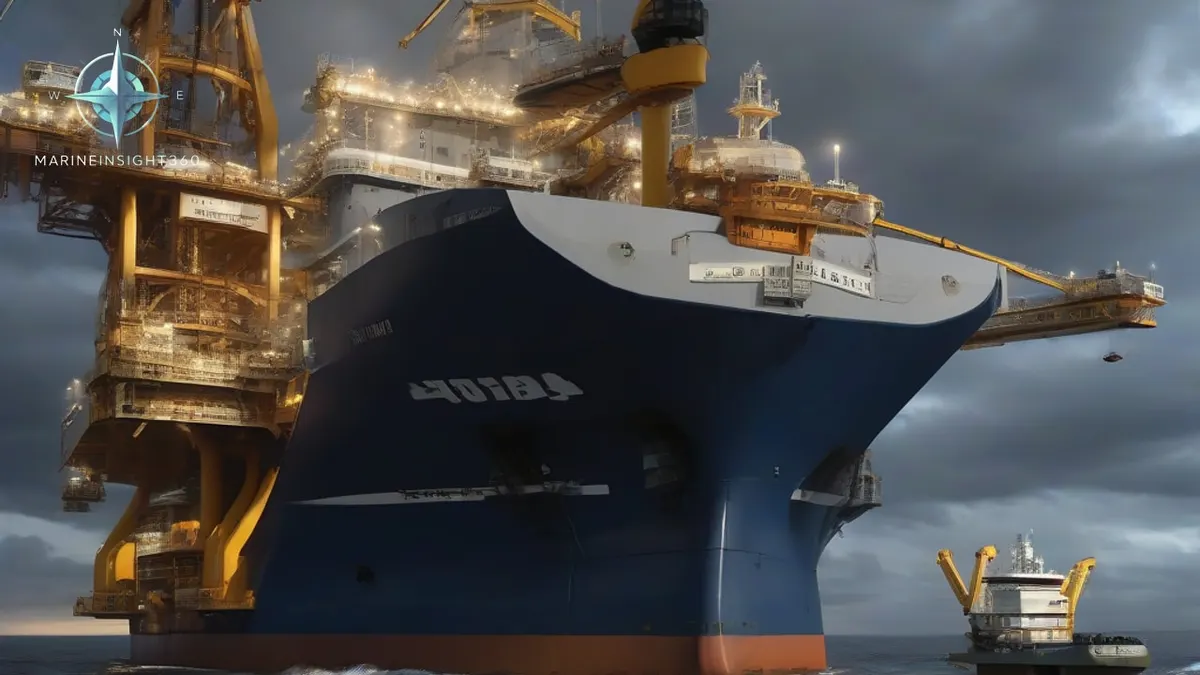
Understanding Heavy Lifting and Ship Stability
If you've never been on board a ship or seen one in person, take a look at images of ships used for heavy lifting (from ships to offshore installations). Notice the massive cranes aboard ships performing a series of precise maneuvers during heavy lifting operations, a common sight today.
It's hard to imagine heavy lifting operations, such as those on offshore installations, cargo operations (or any commercial vessel carrying a specific cargo), without these cranes.
Heavy Lifting Operations
Because these cranes or lifting equipment possess enormous power, certain aspects of stability and safety must be considered when designing and operating them. There are also contractual issues to consider, but we'll focus on one more crucial aspect: the stability of the vessel during these operations.
Many lifting operations occur simultaneously on a single vessel, so the risks involved must be carefully assessed before any cargo loading or unloading takes place. These cargoes are known as project cargoes (which require disassembly before transport and reassembly before delivery). Heavy lifting vessels and large commercial operations are typically subject to approved safety of life at sea regulations.
Let's examine how heavy lifting operations affect a vessel's stability.
Ship Crane
When a crane or ship's boom carries a load on either side of the centerline at a certain height above the deck, the ship tends to tilt in that direction (generally speaking). A similar phenomenon occurs with a simple pendulum, where the weight is free to swing. The weight shifts the center of gravity, so changes in the ship's center of gravity must be accounted for in advance to avoid compromising the ship's already excellent stability!
Sway Analogy in Fluid Statics
The term "sway," which we will use later, has an interesting characteristic. This occurs when a load is suspended at a certain height and the length of the "pendulum" is shortened by loading it closer to the crane head. This reduces sway (reducing the sway of the load is necessary to prevent damage to adjacent structures) and improves stability.
This is because the weight is always acting on the sling or pivot point, so the ship's stability is not further affected.
Ship Crane
Suppose our ship is in port carrying a very heavy load, a fraction of the ship's own weight. The crane/drone lifting the load from the port is initially in a vertical position. In other words, the center of gravity is aligned with the ship's centerline. When the load is fully loaded (i.e., when the crane's boom is outboard), the ship will tilt in that direction. The tilt must be kept to a minimum to control the tilt.
If you observe closely, you will see that the crane's boom must first raise its head and swing to move the load into position within the cargo hold. This initially means a smaller lateral shift (from port to starboard) of the center of gravity and a larger vertical rise.
This is particularly important when the lift force is almost directly inboard (because if the lift force is inboard, it can be thought of as the height of the ship's center of gravity). At this point, due to the pendulum motion, the ship tends to quickly upright and move to the other side!
What Is The Lower Deck Of A Ship?
Ship Motions – A Complete Guide
What Is A Hydrofoil Ship? Things You Should Know
Battle of the Ironclads – What are Ironcloads Ship?
Righting Maneuver
The righting motion itself has consequences, as the vessel will lose control and list to the other side. The center of gravity isn't always the primary cause; even if your vessel is partially heaving, its center of gravity won't remain constant. Finally, the center of gravity height (GM) is important.
A high negative GM angle creates an imbalance, which can lead to rolling (never a good thing!). While this imbalance doesn't persist throughout the entire heave, the sinking portion of the heave creates enough buoyancy to offset the torque, and eventually the center of gravity (GM) returns to zero. The vessel then regains positive stability. If the vessel inherently has negative stability, stability is achieved at a certain stability angle.
It's important to distinguish between heeling and instability because a ship can't simply be "leveled" by placing weight on its upper side. Why?
Suppose your ship is listing to port. Therefore, its starboard side is higher. One would assume that heeling to starboard would reduce the list. But this is incorrect. Why? Because the starboard side is higher than the port side, adding weight to the upper side raises its center of gravity, thereby lowering its center of gravity (GM). Consequently, stability is lost. Weight must be added to the lower side (in this case, the port side).
Initially, the ship lists slightly to port, but as GM increases, it becomes more stable. When sufficient righting moment is achieved, the weight on both sides balances, restoring the ship to an upright position.
Speaking of overloading, imagine a fishing boat loaded with fish. Now, if the boat has caught a large catch equal to its weight (unfortunately, this cannot be known in advance) and is about to tip inward, the excess weight will create enough instability to cause the boat to capsize, tipping over and causing it to roll sideways.
If stability is compromised, this rolling can persist and become dangerous, and if hatches are opened, the vessel can easily flood. (Note: Wet fish cargo can easily slide on the deck during rolling; extreme care must be taken to prevent the cargo from shifting.)
Heavy Cargo
Now, let's look at this from a broader perspective. We previously mentioned a special case involving small vessels. Remember our first discussion of heavy-lift vessels operating on the high seas? We were talking about lifting cargoes of up to 10,000 tons! Many of these vessels are equipped with specialized ballast water systems, as their operations involve more than just hauling a small catch.
These operations, especially on oil platforms, require high precision based on stability criteria, often expressed in errors of several meters. Vessels with this capability are often equipped with dynamic positioning (DP) systems. A central onboard computer system operates the entire vessel in conjunction with the propulsion engines, thrusters, and control surfaces (which take into account a digital model of the vessel's interaction with external dynamic forces).
Heavy Lifting Operations
Another system, available only on certain vessels, is the moon boom system, which allows lifting operations through hatches parallel to the vessel's depth. In this case, crane operation maintains the vessel's center of gravity close to the centerline, thereby limiting the vessel's heeling motion.
The following aspects should always be checked before operations:
For example, for a lift from position A to position B, the G-force values for both positions must be estimated according to the stability manual and maintained at acceptable levels. This list must be maintained to ensure that it does not negatively impact stability.
Since a low center height reduces vessel stability, the use of soft tanks with free surfaces is not conducive to stability, as free surfaces also reduce G-force. Therefore, it is recommended that these soft tanks be pressurized to minimize this effect.
In addition, you must ensure that the vessel will not come to rest at the planned heel angle. The crane should not lift any higher than necessary.
Recommended Reading
Angle of Loll: The Tilt That Means a Ship Has Lost Its Stability
What the angle of loll is, how it differs from a list, why a ship with negative stability flops to one side, and the exact order of actions that corrects it.
Iran retaliates with missiles and drones, defying Trump’s warning
Learn iran with practical maritime context, safety checks, operational guidance and related resources for global shipping readers.
Hapag-Lloyd Invests in APM Terminals Rotterdam to Drive Growth
Hapag‑Lloyd’s new stake in APM Terminals Rotterdam aims to expand capacity, improve hinterland links and enhance crew efficiency in Europe’s busiest port.