
Freshwater Generator on Ships: How It Works, Types and Components
How a ship's freshwater generator turns seawater into drinking water: vacuum evaporation, main components, operating limits, and when reverse osmosis wins.
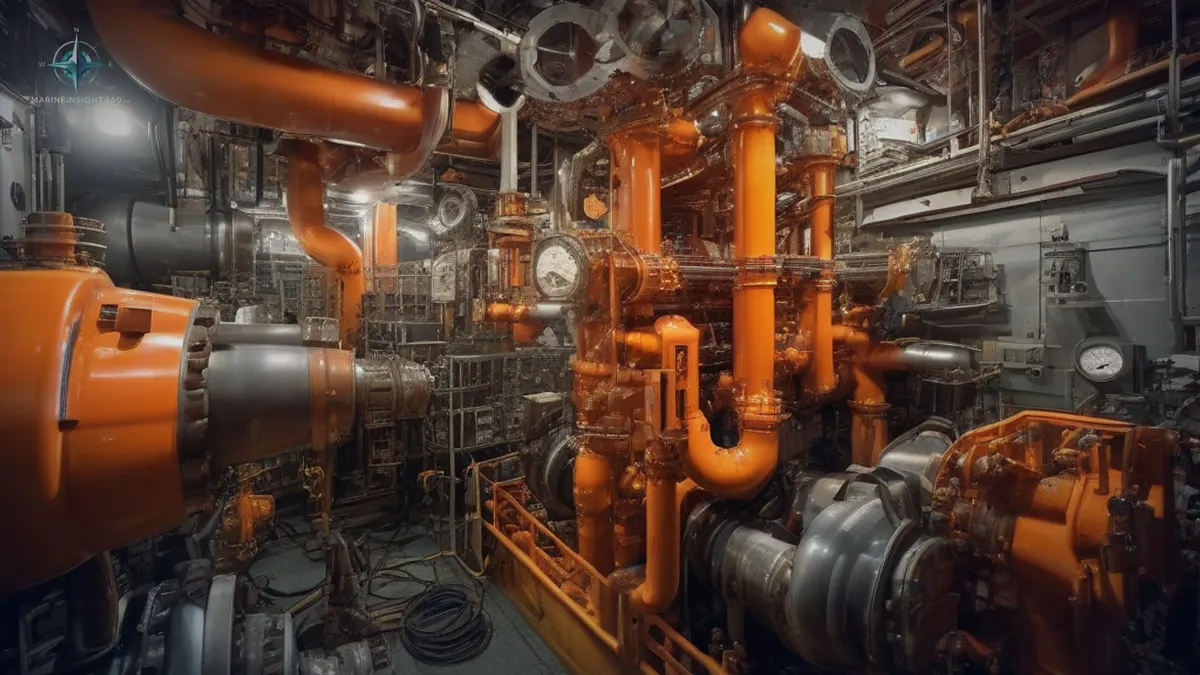
Water leaving a freshwater generator is not drinking water. What the plant makes is distillate: very pure, slightly acidic, flat-tasting, and missing the minerals a supply ashore would carry. The crew drinks it only after the ship corrects the pH, passes it through a mineralization unit and disinfects it, most commonly with ultraviolet sterilizers or chlorine dosing.
Making that distillate means boiling seawater under vacuum with waste heat from the main engine's cooling system, then condensing the vapor. One unit typically covers a crew's full daily demand for drinking, cooking, washing and machinery make-up water. Deep-sea vessels distill instead of bunkering in port because a ship carries two things in unlimited supply, seawater and engine heat, and this is the machine that puts them together.
Boilers, jacket cooling systems and some auxiliary machinery also depend on this distillate, so the unit matters to the whole engine room, not just the galley. The distillate feeds machinery with its own stopping rules, and the pipework carrying it has failure modes of its own.
The Trick Is the Vacuum, Not the Heat
Jacket cooling water leaves the main engine at about 70 to 80°C (158 to 176°F). At atmospheric pressure that gets you nowhere, because water boils at 100°C (212°F) and 80°C is just hot water. Lower the pressure, though, and the boiling point falls with it.
So the air ejector holds the shell well below atmospheric, the shell runs at around 50°C (122°F) in normal operation, and heat that would otherwise be rejected to the sea does useful work. The engine gets its cooling, the ship gets its water, and the fuel bill barely notices.
Follow the Feed Through the Unit
- A pump draws seawater from the sea chest and sends it through the condenser section, where it picks up heat before anything else happens. Pre-warming the feed this way raises the efficiency of the whole unit.
- Part of that seawater goes on to the evaporator; a separate stream drives the air ejector that maintains the vacuum inside the shell.
- Hot jacket cooling water from the main engine, usually at 70 to 80°C, runs through the evaporator section in a closed circuit.
- Under vacuum the seawater boils at roughly 40 to 60°C (104 to 140°F) instead of 100°C (212°F), and vapor rises off the evaporator plates.
- That vapor passes through a demister, which knocks out entrained salt droplets, then condenses on the cool condenser plates above.
- A small centrifugal pump draws off the distillate, a salinometer checks it, and water within limits goes to the storage tank. Leftover concentrated brine is stripped overboard by the ejector.
Main Components and What Each One Does
- Shell: the vacuum vessel that houses the evaporator, demister and condenser.
- Evaporator: a plate or tube heat exchanger where jacket water boils the seawater feed.
- Demister: a mesh separator between evaporator and condenser that stops salt-laden droplets riding up with the vapor.
- Condenser: the upper heat exchanger where incoming cold seawater condenses the vapor into distillate.
- Air ejector or eductor: creates and holds the vacuum, and carries the concentrated brine away.
- Distillate pump: a small centrifugal pump that moves fresh water to the storage tank.
- Salinometer: continuously measures distillate salinity and triggers rejection when the reading is too high.
- Air purge and safety relief valves: the purge valve stays open when the unit is stopped and closed when running; the relief valve protects the shell against overpressure.
- Temperature instruments: local thermometers plus remote sensors watch shell, feed and jacket water temperatures.
Cruise Ships Need More Water Than One Engine's Jacket Water Can Supply
Reverse osmosis (RO) is the other way to make fresh water at sea, forcing seawater through a membrane fine enough to hold back dissolved salt. The two technologies split the market along a simple line: what heat is available, and how much water the ship needs.
Cargo ships favor waste-heat evaporators because the energy is effectively free while the main engine runs. Passenger ships and cruise vessels have far higher daily demand than one engine's jacket water can support, so they lean on RO plants despite the cost of high-pressure pumps and periodic membrane replacement. Many large ships carry both and switch to RO in port or on standby, when the main engine is stopped and no jacket heat is available.
Machinery Water and Drinking Water Are Not the Same Problem
Drinking water has minerals put back in before the crew drinks it. For water destined for machinery the job is the reverse: magnesium and calcium ions in untreated water form scale inside heat exchangers and pipework, so machinery water may pass through a softener that swaps those ions out. Keeping drinking water and technical water each in the right condition is a standing item in the engine department's planned maintenance system.
What the Engineer on Watch Is Actually Checking
- Salinity below 10 ppm: distillate above the limit is rejected automatically instead of being sent to the tank, protecting both drinking water and boiler feed.
- No over-evaporation: boil the feed too hard and salt scale builds on the evaporator plates, which cuts output and forces chemical cleaning.
- Vacuum health: a falling vacuum raises the boiling point and output drops; the usual suspects are ejector wear, air leaks or a fouled condenser.
- Coastal water rule: crews shut the unit near coasts, ports and estuaries because polluted feed water can carry contamination the process does not remove reliably.
That last one is the part of this with the least agreement behind it. Every crew shuts the plant down near land; how far out you have to be before restarting is set by company standing orders rather than by any single international distance, and two ships off the same coast can be working to different numbers. If your night orders say only "restart when clear of the coast", the useful question is what your own company means by clear.
Recommended Reading
How Freshwater Generator Transforms Seawater into Freshwater for Consumption?
How Freshwater Generator Transforms Seawater into Freshwater for Consumption?: technology, equipment and fleet context for US, UK, Canada, Australia,...
10 Situations When a Ship’s Generator Must Be Stopped Immediately
10 Situations When a Ship’s Generator Must Be Stopped Immediately: safety, training and compliance context for US, UK, Canada, Australia, Singapore and...
Emergency Generator Operation and Testing Procedures
Emergency Generator Operation and Testing Procedures: regulatory and compliance context for US, UK, Canada, Australia, Singapore and European maritime...