
How Oil Is Separated From Water on Board a Ship
How oil is separated from water on ships: gravity separation, coalescing filters, the 15 ppm monitor and the MARPOL Annex I rules every engineer must follow.
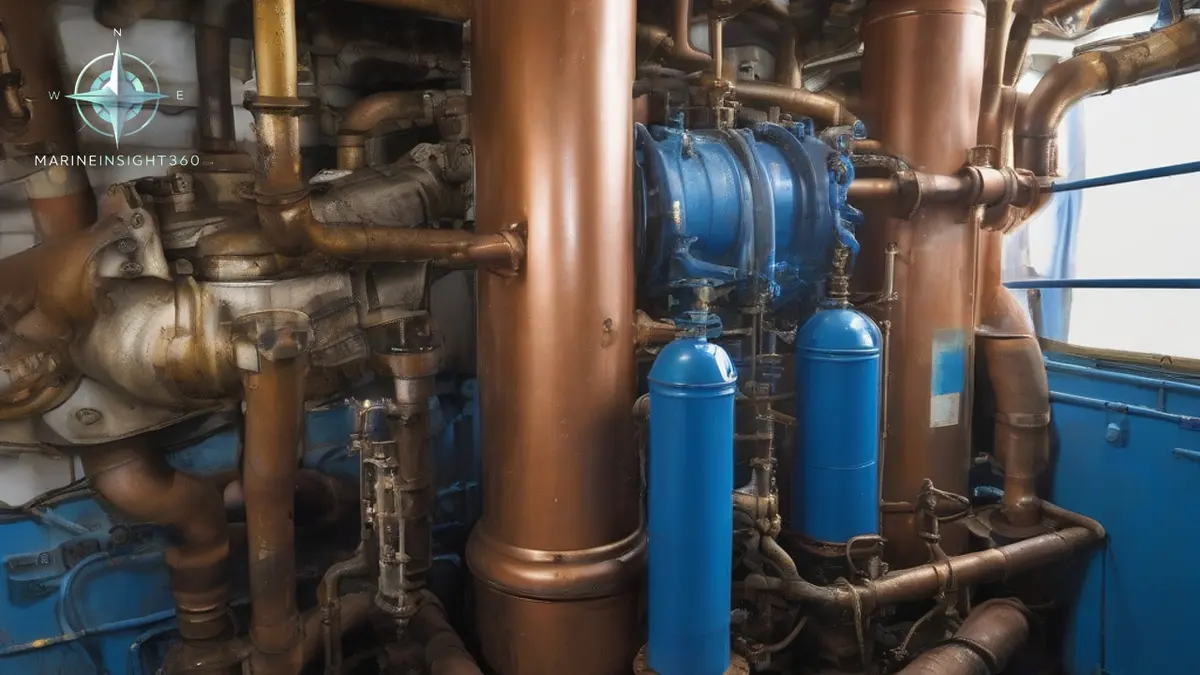
How is oil separated from water on board a ship? By exploiting the density difference between the two. Oil is lighter than seawater, so in a still tank it rises. A ship's oily water separator does this in two stages: a large gravity chamber where the bulk of the oil floats out, then coalescing filter elements that merge the fine droplets gravity cannot lift.
A monitor then measures the treated water and blocks any discharge above 15 parts per million of oil.
The engine room produces oily bilge water continuously, from leaking glands, purifier drains, condensate, deck washings and machinery weeps. It has to go somewhere, and the rules on where are unambiguous.
The physics: droplet size decides everything
Fuel and lubricating oils have a density around 0.85 to 0.95, against roughly 1.025 for seawater, so buoyancy is on the engineer's side. The catch is that rise velocity depends on the square of the droplet diameter. A 100 micron droplet climbs quickly. A 10 micron droplet climbs a hundred times slower, and a stable emulsion of sub-micron droplets barely climbs at all.
That single fact explains almost every separator problem on board. Anything that shears the mixture or stabilizes the emulsion, such as a centrifugal bilge pump running at full speed, or detergent finding its way into a bilge well, makes the droplets smaller and the separator's job much harder.
Stage one: gravity separation
Bilge water is drawn slowly into a large coarse separating chamber, usually by a low-shear pump such as a screw or diaphragm type rather than a high-speed centrifugal. Flow velocity is deliberately low so the water has residence time. Heating coils warm the mixture, lowering oil viscosity and speeding the rise.
Separated oil collects under the chamber top and is detected by a capacitance or optical probe, which opens a solenoid valve to drain it to the sludge tank. Coarse separation typically removes the great bulk of free oil, leaving a water phase carrying the dispersed fraction onward.
Stage two: coalescing filters
The second stage forces the remaining water through oleophilic filter elements. Fine droplets wet the media, collect on the fibers, and merge into larger drops that release and float to the top of the second chamber, where the same probe and drain arrangement removes them.
Coalescers are consumables. They blind with solids, sludge and biological growth, and once blinded they pass oil straight through while differential pressure rises. Element condition is the most common reason a separator that once worked will no longer hold 15 ppm.
The 15 ppm monitor is the gatekeeper
Treated water passes an oil content meter, commonly working on light scattering or absorption through a sample cell. If the reading exceeds 15 ppm the alarm sounds and a three-way solenoid valve immediately diverts the flow back to the bilge holding tank instead of overboard. The overboard line stays closed until the reading recovers.
The monitor must be tamper-evident, must record the date, time, alarm status and overboard valve position, and must keep those records available for inspection. Feeding it clean water, blocking the sample line or bypassing the three-way valve is exactly the offence that port state and criminal investigators look for.
What MARPOL Annex I actually requires
Under MARPOL Annex I, every ship of 400 gross tonnage and above must carry oil filtering equipment capable of producing effluent below 15 ppm, together with the alarm and automatic stopping arrangement. Discharge of machinery space bilge water outside special areas is permitted only when the ship is proceeding en route, the effluent is under 15 ppm, and the filtering equipment and alarm are operating. Dilution to meet the number is prohibited.
Every transfer, discharge, sludge landing and incinerator run is entered in the Oil Record Book Part I, signed by the officer in charge and countersigned by the master for each completed page. The Oil Record Book, not the separator, is what inspectors read first.
Discrepancies between logged sludge production and bunkers consumed are the standard opening move in a bypass investigation, and prosecutions under national law, particularly in the United States, have produced very large corporate fines and custodial sentences for individual engineers.
Why separators fail, and what crews do about it
- Detergents in the bilge. Cleaning chemicals emulsify oil into droplets no coalescer can recover. Segregate wash water and use approved low-emulsifying cleaners.
- Wrong pump. A high-shear centrifugal pump upstream creates the emulsion the plant then cannot break.
- Running at maximum rate. Reduced flow gives residence time and usually restores performance.
- No settling. Letting the holding tank stand and draining the free oil from the top before treating cuts the separator's load sharply.
- Neglected elements and probes. Backflush routinely, replace coalescers on condition, and clean the monitor sample cell.
Where the plant genuinely cannot cope, the fallback is legal and simple: retain the water on board and land it ashore to a licensed reception facility, recording the transfer with a receipt.
Tanker cargo residues use a different system
Oily water from cargo tank washing on a tanker is not treated by the engine room separator. It is retained in slop tanks, allowed to settle, and discharged through an oil discharge monitoring and control system that limits the instantaneous rate to 30 liters per nautical mile and records the whole operation. Crude oil washing and dedicated clean ballast arrangements reduce how much residue is generated in the first place.
The Shipboard Operations section covers those cargo-side procedures in more detail.
Sources and further reading
- MARPOL Annex I: Prevention of Pollution by Oil (IMO)
- Bilge alarm, 15 ppm bilge alarm (Wartsila Encyclopedia of Marine Technology)
- Oily water separator: clarifications on requirements for sampling points (DNV)
What to read next
Recommended Reading
Water Tornado: How a Waterspout Forms and What to Do at Sea
A water tornado is a waterspout. Here is how fair weather and tornadic spouts form, the five stages you can see coming, and how to steer clear of one safely.
Facilities for Muslim Seafarers During Ramadan on Board Ship
Practical ship management for Ramadan: suhoor and iftar timing, watch rosters, rest hours, heat exposure, prayer space and medical screening for fasting crew.
Black Water Flowing Into the Ocean After a Hurricane: What It Means for Ships
What black water flowing into the ocean after a hurricane like Sally really carries, the MARPOL Annex IV sewage limits, and how crews protect ships and health.