
Water Tornado: How a Waterspout Forms and What to Do at Sea
A water tornado is a waterspout. Here is how fair weather and tornadic spouts form, the five stages you can see coming, and how to steer clear of one safely.
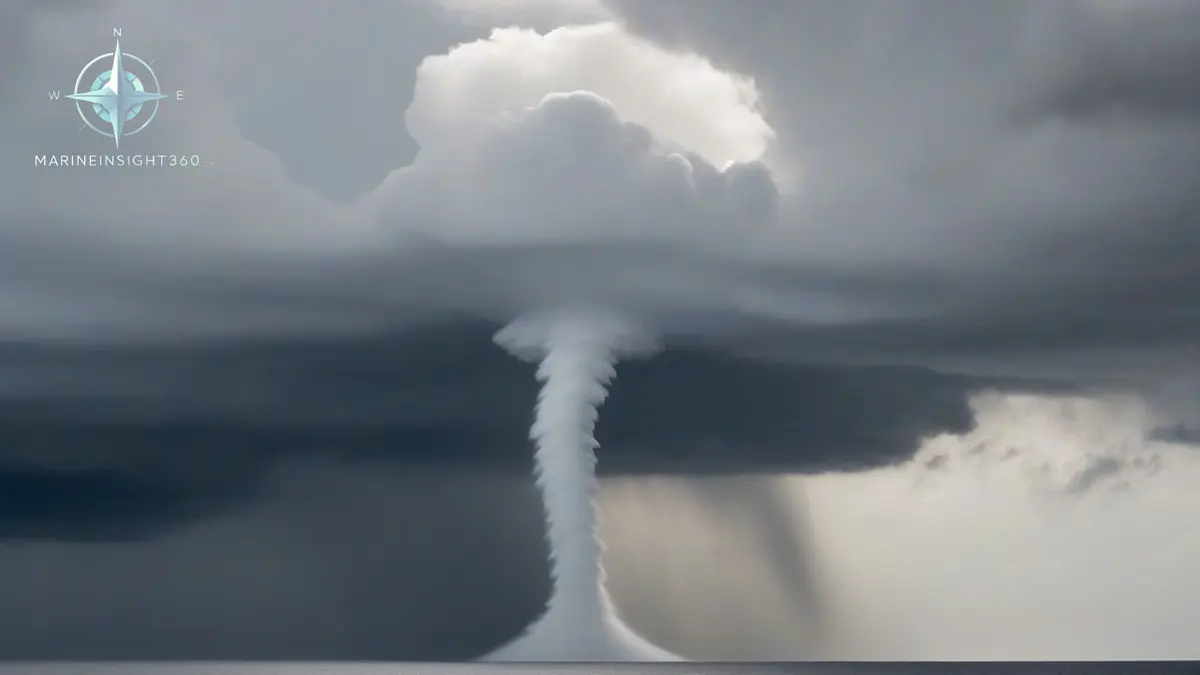
A water tornado is a waterspout
What people call a water tornado is a waterspout. It is a rotating column of air reaching from the sea surface to the cloud above. Two different phenomena share the name. They form by opposite processes, and only one is a tornado in the strict sense. Knowing which one you are looking at changes what you should do. The US National Weather Service issues special marine warnings for waterspouts off Florida most summers.
They are seen in the North Sea and off Australia too.
The visible funnel is condensed water vapour, not lifted sea water. Spray is drawn up only in the lowest few meters, inside the ring of disturbed water at the base. That matters because a waterspout can be fully formed and rotating before any funnel is visible at all.
Two kinds, and the difference matters
Fair weather waterspouts
Fair weather waterspouts build from the bottom up. They form over open water under a line of developing cumulus cloud, usually in light wind and calm conditions, along a boundary where surface air is converging. Rotation begins at the sea surface and works upward toward the cloud base.
They are the common type. They tend to be short lived, they move slowly because the steering flow is weak, and they generally dissipate within minutes. That does not make them harmless. The wind inside one is easily enough to capsize a small craft, tear away canvas and awnings, and put loose gear over the side.
Tornadic waterspouts
Tornadic waterspouts are true tornadoes that either form over water or move onto it from land. They descend from the base of a thunderstorm, top down, and they carry the same hazards as a land tornado: destructive wind, heavy rain, hail, lightning and violent shifts in wind direction. They are far less common and far more dangerous.
The tell is the weather around it. A funnel under a towering, dark thunderstorm with rain and lightning is the tornadic kind. A funnel under a modest line of fair weather cumulus, with no storm activity and a flat calm sea, is almost certainly the other.
The five stages you can watch develop
Fair weather waterspouts pass through a recognisable sequence, and the early stages give useful warning:
- Dark spot: a distinct circular patch of darker water appears on the surface, marking the developing vortex.
- Spiral pattern: light and dark bands of water curve out from the spot.
- Spray ring: a ring of spray, called a cascade, forms around the dark spot as surface winds strengthen.
- Mature funnel: a visible condensation funnel reaches from cloud to water. This is the most intense phase.
- Decay: cooler air from rain undercuts the circulation, the funnel shrinks and breaks up.
The practical lesson is that the first two stages are visible on the water before anything is visible in the sky. A lookout who knows to watch for a dark spot with a spiral pattern gets several minutes of extra warning.
Conditions that favor them
Waterspouts need warm water, a moist and unstable lower atmosphere, light winds aloft and a surface convergence line. They are most common over warm shallow seas in the warmer months, often in the morning and early afternoon before wider convection organizes into storms. The Florida Keys record more of them than anywhere else, and the Gulf coast, the Mediterranean and warm inland lakes see them regularly.
What to do if one forms near you
The guidance from the National Weather Service is direct: never approach one, and move away at 90 degrees to its apparent direction of travel. Because a waterspout tracks with the low level flow rather than with the wind you feel on deck, judging its movement from a fixed reference matters more than judging it by eye alone.
On board, the sequence is straightforward:
- Fix its bearing and take repeated bearings. A steady bearing with closing range means it is heading for you.
- Alter course at right angles to its track and increase speed if the vessel and sea state allow.
- Get crew off open decks. Close hatches, ports and doors, and secure awnings, deck cargo and loose gear.
- On a sailing vessel, reduce sail early. A sudden wind shift at high strength does the damage, not the average wind speed.
- Do not rely on radar to see it. Small spouts often produce no useful return, although the parent shower usually does.
Reporting and staying ahead of them
Coastal weather services issue special marine warnings when waterspouts are sighted or expected, and those are broadcast on VHF weather channels and by continuous marine radio services. A spout that moves onto land is handled as a tornado and warned accordingly, which is the situation that most often threatens marinas, small craft on moorings and port infrastructure.
A sighting is worth reporting to the local coastguard or weather office with position, time, bearing and movement. That report feeds nowcasting for everyone else in the area. For crews working in waters where spouts are common, the most useful preparation is a standing instruction that any dark spot or spray ring on the surface is called to the bridge immediately, not after someone confirms a funnel.
Warnings and response have owners. In United States waters the National Weather Service issues the special marine warning and the USCG broadcasts it on VHF channel 16 and 22A, and it is USCG search and rescue units that answer when a small craft is rolled. Serious casualties involving commercial vessels are investigated by the USCG and, in the worst cases, the NTSB.
The damage list from a waterspout is consistent. Small craft capsize, moored boats are torn from their lines, awnings and biminis are stripped, and loose deck gear goes over the side. On larger vessels the reported faults are broken bridge windows, displaced deck cargo and lashings, and injuries to crew caught on an open deck. The common mistake is treating a modest funnel as a small hazard.
Sources and further reading
- NOAA Ocean Service: What is a waterspout?
- National Weather Service Miami: Waterspouts
- NOAA Ocean Today: Waterspouts
What to read next
Recommended Reading
How Oil Is Separated From Water on Board a Ship
How oil is separated from water on ships: gravity separation, coalescing filters, the 15 ppm monitor and the MARPOL Annex I rules every engineer must follow.
Black Water Flowing Into the Ocean After a Hurricane: What It Means for Ships
What black water flowing into the ocean after a hurricane like Sally really carries, the MARPOL Annex IV sewage limits, and how crews protect ships and health.
What Is the Most Effective Way to Treat Ballast Water on a Ship?
UV and electrochlorination dominate ballast water treatment. Here is how each performs against the IMO D-2 standard and how to match a system to your trade.