
Hydrogen Powered Inland Container Ship Launch: What H2 Barge Proved
Future Proof Shipping launched H2 Barge 1 in Rotterdam in May 2023. How fuel cell retrofits work on inland container ships, and where they stop.
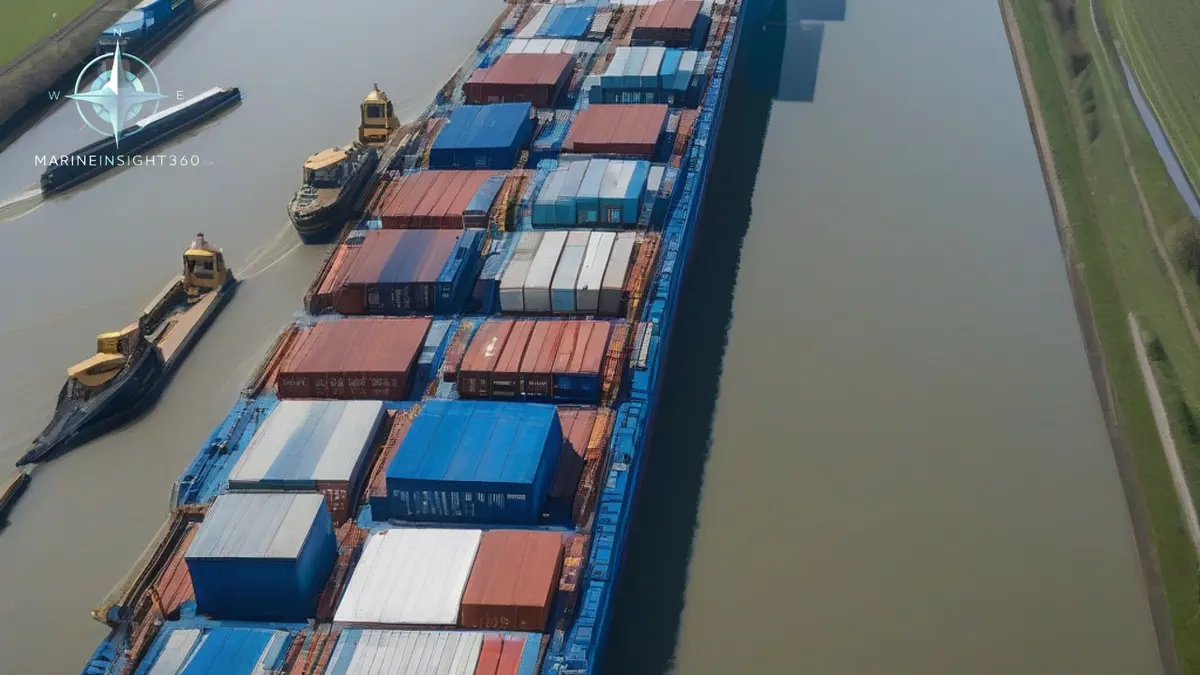
The first hydrogen powered inland container ship launch took place in Rotterdam on 25 May 2023, when Future Proof Shipping put H2 Barge 1 into service. The 110 meter (361 ft) vessel runs on hydrogen fuel cells instead of a diesel main engine, emits only water and humid air, and is expected to avoid around 2,000 tonnes of CO2 a year.
It sails several times a week between the Port of Rotterdam and the BCTN inland terminal at Meerhout in Belgium, carrying containers for Nike.
A second vessel followed. H2 Barge 2 completed its first trials in March 2024 and now works the Rhine corridor between Rotterdam and Duisburg. Both ships are conversions of existing inland vessels rather than new builds, and that detail matters most to anyone assessing whether the model scales.
What is inside the propulsion system
H2 Barge 2 uses six Ballard FCwave fuel cell modules for a combined 1.2 MW. Compressed hydrogen is stored in containerized tanks on deck. The fuel cells feed a DC bus that drives electric propulsion motors, with a battery pack absorbing load swings during maneuvering and lock transits.
That architecture is the practical reason retrofits work on inland ships. Replacing a main engine and gearbox with electric propulsion frees a large volume in the engine room, and deck-mounted hydrogen containers keep the fuel outside the accommodation and machinery spaces. Swapping a spent hydrogen container for a full one also avoids building fixed bunkering infrastructure at every terminal.
Why inland waterways came first
Hydrogen's weakness is energy density by volume. Even compressed, it needs several times the tank space of diesel for the same energy content. On a deep sea voyage that is a hard constraint. On a fixed inland route of a few hundred kilometers, with a predictable schedule and one known refueling point, it is manageable.
Inland shipping also has a regulatory driver. European inland fleets face tightening emission rules and city port access restrictions, and many of the vessels are old enough that a repower was already due. The economics compare a hydrogen retrofit against a diesel repower, not against a paid-off engine.
Route length is the other half of it. An inland container service runs a fixed rotation with the same terminals, the same locks and the same turnaround windows every week. Energy demand can be calculated to within a narrow band, which means the hydrogen storage can be sized tightly instead of carrying a large reserve for contingency.
Deep sea trading has no such certainty, and a tramping vessel would have to carry fuel for a voyage it does not yet know about.
The honest limitations
- Fuel source. The climate benefit depends on the hydrogen being produced from renewable electricity. Hydrogen made from natural gas shifts emissions upstream rather than removing them.
- Cargo space. Deck-mounted fuel containers occupy slots that would otherwise carry paying boxes.
- Bunkering network. Container swap works on a fixed route with a committed supplier. It does not yet support tramping.
- Crew competence. Hydrogen handling needs training in gas detection, leak response and high voltage safety that most inland crews have never received.
- Cost. These vessels exist because a cargo owner and public funding shared the premium. A pure commercial payback at current fuel prices is not there.
What the hydrogen powered inland container ship launch proved
Future Proof Shipping has said it aims to build and operate a fleet of more than ten zero emission inland and shortsea vessels over five years. Whether that target is met matters less than what the first two ships demonstrated: a fuel cell retrofit of a working inland container vessel can hold a commercial schedule for a demanding shipper, week after week.
For an operator weighing the same decision, the sequence used here is worth copying. Secure the cargo commitment first, pick a fixed short route, retrofit rather than build, and put the fuel storage where it can be exchanged rather than pumped.
How this connects to deep sea decarbonization
Inland hydrogen vessels are not a template for a capesize bulker. They are a proving ground for the components: marine fuel cell modules, hydrogen storage and handling procedures, electric propulsion trains and the crew competence to run them. Those pieces transfer. The fuel choice for ocean voyages is still contested between ammonia, methanol and LNG, and the fuel cell work being done on the Rhine feeds into whichever option wins.
Related coverage of alternative fuels and propulsion sits in the Marine Insight 360 Marine Machinery section.
Approval for a fuel cell installation does not come off a shelf. Hydrogen is not covered by the prescriptive rules written for oil and gas fuels, so installations are approved case by case against class rules for fuel cell power together with a risk based alternative design assessment. Bureau Veritas, DNV and Lloyd's Register all publish rules for fuel cell power, and EMSA has published study work on hydrogen as a marine fuel.
Inland navigation adds a further layer. Rhine and Dutch waterway traffic works to the European technical standard for inland vessels rather than to the conventions written for seagoing ships, so a hydrogen retrofit needs its hazardous area zoning, gas detection and ventilation accepted by the inspection body before the vessel certificate is endorsed. Crew competence for gas fuelled operation is handled through a separate training requirement again.
Sources and further reading
- Port of Rotterdam: Future Proof Shipping, first zero-emission hydrogen-powered inland container ship
- Future Proof Shipping launches first hydrogen-powered inland container ship
- Ballard: Hydrogen-powered container vessel completes initial waterway trials
- Ship & Bunker: Hydrogen-Powered Inland Container Ship Launched at Rotterdam
What to read next
Recommended Reading
Container Tracking: How Shippers Actually Follow a Box Across the Ocean
How container tracking works, from free carrier lookups to visibility platforms: what each tool layer does, what it costs, and how to pick for your volume.
The 10,000 Ton Electric Container Ship Powered by a 50,000 kWh Battery
Inside the 10,000 ton electric container ship running on a 50,000 kWh swappable battery bank, and why the model works on rivers but not deep sea.
Tokyo and Manila Launch Intelligence Sharing and Maritime Border Talks: What Changes at Sea
Japan and the Philippines opened intelligence sharing and maritime boundary talks. Here is what the deals change for ships on Asian routes.