
LNG Carrier Shipping: How the Gas Fleet Actually Works
How LNG carrier shipping works: membrane and Moss containment, boil-off gas as fuel, ship sizes, IGC Code rules and the training crews need.
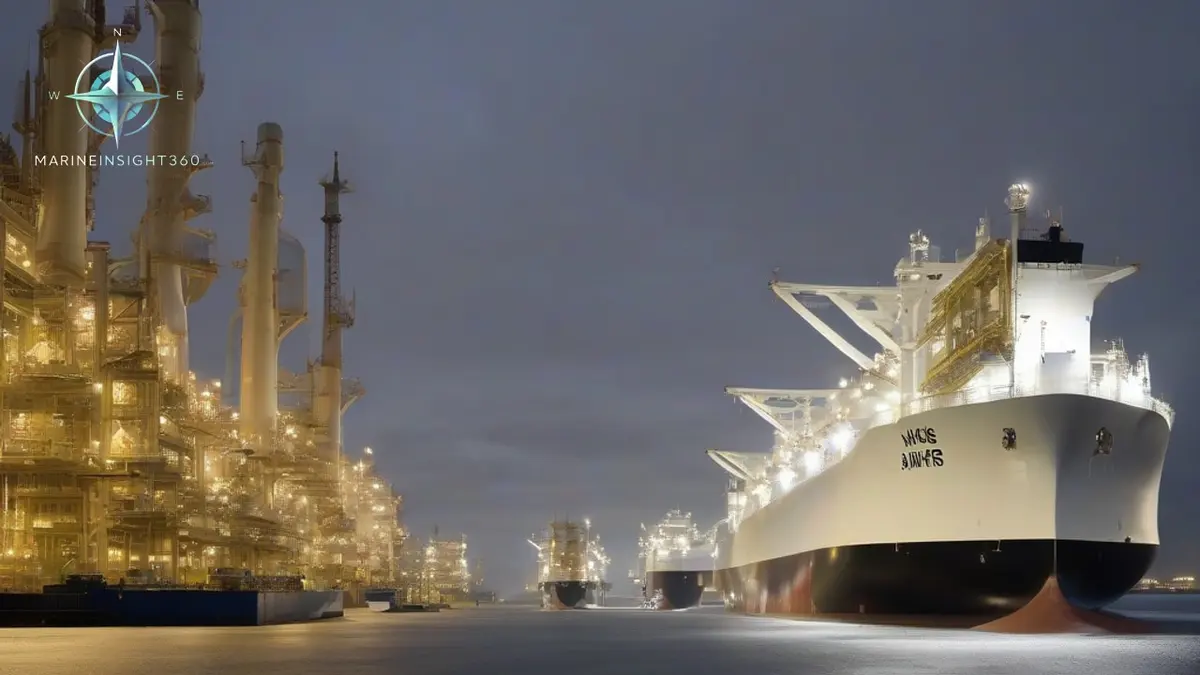
LNG carrier shipping moves natural gas cooled to about minus 162 degrees Celsius (minus 260 F). At that temperature it shrinks to roughly one six-hundredth of its gaseous volume, so a ship can carry an economically useful load. A conventional carrier holds 145,000 to 180,000 cubic meters, kept cold by insulation rather than refrigeration, and discharges to an import terminal that vaporizes it back into a pipeline grid.
The main lanes run from the United States Gulf, Australia and Qatar to Japan, South Korea and northwest Europe. Ships are therefore built to the IGC Code and vetted against USCG, MCA and ClassNK expectations. Three things explain the rest: the containment system, boil-off gas handling, and the certificates the crew must hold.
Two containment systems, two very different ships
Membrane ships carry the cargo in tanks formed by the hull itself. A metal membrane about a millimeter thick, Invar or corrugated stainless steel depending on the system, holds the liquid, backed by insulation panels that transfer the load into the inner hull. The GTT NO96 and Mark III systems are the industry standard, and membrane designs account for roughly 85 percent of recent newbuildings because they use hull volume efficiently and give a flat weather deck.
Moss ships use self-supporting spherical aluminum tanks, the visible domes that made the type recognizable. Under the IMO type B classification a full secondary barrier is not required, because the tank is designed and monitored to leak before it fails. Spheres tolerate partial filling and sloshing better than membranes, which matters for ships that regularly carry part cargoes, but they use hull volume poorly and present a large windage area.
Boil-off gas is cargo, not waste
No insulation is perfect, so a fraction of the cargo evaporates continuously. Modern carriers run a boil-off rate near 0.10 to 0.15 percent of cargo volume per day. Rather than venting it, the ship burns it.
- Steam turbines dominated the fleet for decades precisely because a boiler will burn gas and fuel oil interchangeably, at the cost of poor thermal efficiency.
- Dual-fuel diesel-electric plant replaced steam on most orders from the mid-2000s and improved efficiency substantially.
- Two-stroke dual-fuel engines now dominate new orders, burning boil-off directly in the main engine.
- Reliquefaction plant returns boil-off to the tanks on ships whose commercial case favors delivering maximum volume.
- A gas combustion unit burns surplus gas that propulsion cannot absorb, holding tank pressure down without releasing methane.
Boil-off is a commercial matter as much as a technical one. Charterparties set boil-off warranties, and the volume lost on a long ballast leg is real money.
Ship sizes and the terminals that dictate them
Small-scale carriers below about 30,000 cubic meters serve bunkering and island supply. The conventional fleet sits at 145,000 to 180,000 cubic meters, sized to fit the widest range of terminals. Q-Flex ships hold about 210,000 cubic meters and Q-Max about 266,000, built for a specific long-haul trade rather than for general employment. Berth length, manifold height, jetty draft and receiving tank capacity ashore usually decide vessel selection long before speed or fuel consumption does.
The rulebook: IGC Code and SOLAS Chapter VII
The International Code for the Construction and Equipment of Ships Carrying Liquefied Gases in Bulk, known as the IGC Code, has been mandatory under SOLAS Chapter VII since 1 July 1986. It applies to gas carriers regardless of size, including ships under 500 gross tonnage, and it prescribes design, construction and equipment standards for the cargo system. Secondary barrier requirements, gas detection, emergency shutdown arrangements and relief valve sizing all trace back to it.
What crews need, and the operations that catch people out
Officers and ratings with cargo duties need basic and advanced liquefied gas tanker training under STCW, the international convention setting minimum standards of training, certification and watchkeeping for seafarers. The demanding work is not the loaded passage but the transitions.
- Gassing up and cool down after a docking, where the tank atmosphere moves from inert gas to methane and the structure is chilled gradually to avoid thermal stress.
- Cold spill risk. Liquid at minus 162 C makes ordinary deck steel brittle in seconds, which is why drip trays, stainless plating under the manifold and water curtains exist.
- Sloshing limits. Membrane tanks have restricted fill ranges, so carrying a part cargo at the wrong level is a structural question rather than a stability one.
- Rollover. Loading cargo of a different density onto an existing heel can create stratified layers that later mix suddenly and spike tank pressure.
- Custody transfer measurement. The tank gauging system is the commercial instrument for the whole voyage, and errors in it are expensive.
Where the money and the risk sit
Most LNG carriers work on long-term charters tied to a specific liquefaction project, which is why newbuilding orders track export terminal sanctioning more closely than freight rates. The uncommitted spot fleet is small, so rates swing hard whenever arbitrage between basins opens. For engineers and deck officers the practical consequence is a sector with long employment horizons, high certification barriers and pay bands that reflect both.
The Marine Insight 360 Merchant Navy Careers section covers the gas tanker route into senior rank in more detail.
Sources and further reading
- IGC Code, International Maritime Organization
- LNG Carriers and Shipping Technology
- Cargo Containment, ScienceDirect Topics
What to read next
Recommended Reading
Container Tracking: How Shippers Actually Follow a Box Across the Ocean
How container tracking works, from free carrier lookups to visibility platforms: what each tool layer does, what it costs, and how to pick for your volume.
Hanwha Ocean Wins Qatari LNG Carrier Orders: Inside the QatarEnergy Fleet Build
Hanwha Ocean has booked more 174,000 cbm LNG carriers for the QatarEnergy programme. What the contracts, prices and delivery slots mean for the LNG trade.
Cruise Ship Building Companies: Who Actually Builds the Fleet
Four European yards build almost every large cruise ship. Here is what Fincantieri, Meyer Werft, Meyer Turku and Chantiers de l'Atlantique deliver.