
NEOM Oxagon, the World's Largest Floating City: What It Means for Shipping
NEOM Oxagon is planned as a floating industrial city on the Red Sea with a 3.5 million TEU port. What is real, what is untested, and what to watch.
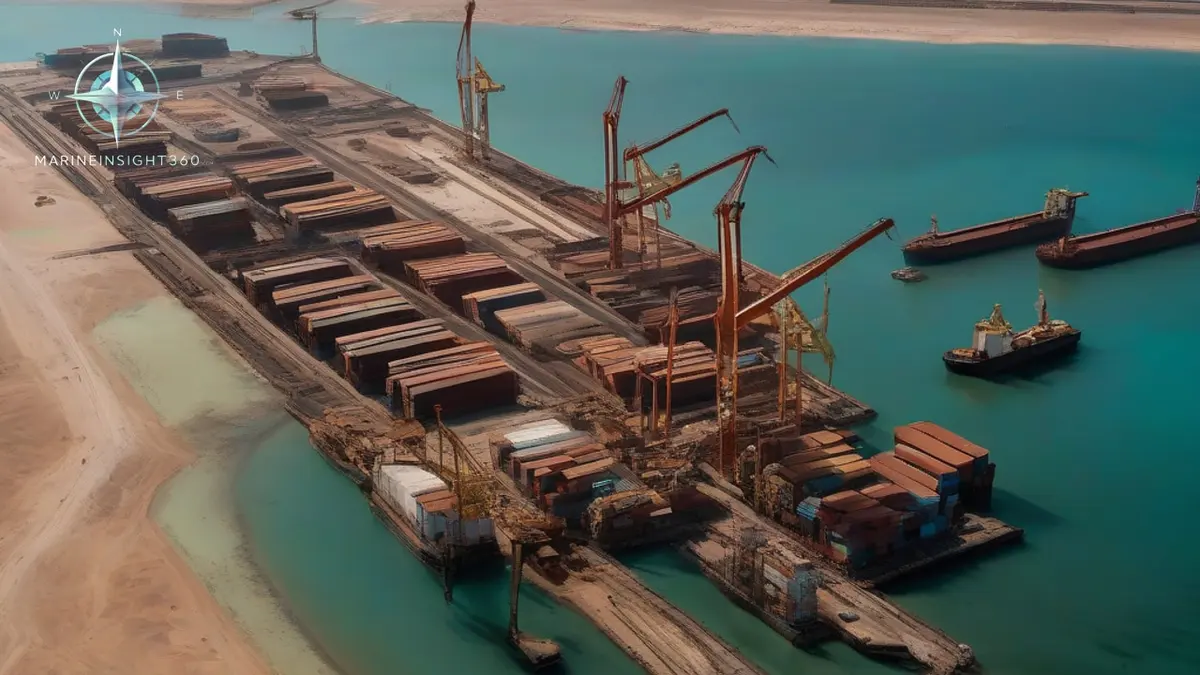
NEOM Oxagon is planned as the world's largest floating city, an octagonal industrial port complex on Saudi Arabia's Red Sea coast where roughly half the development sits on a floating structure offshore. The developer describes a 48 sq km (18.5 sq mi) core area about 7 km (4.3 mi) across, powered entirely by renewable energy, with a port designed for 3.5 million TEU a year.
For shipping, the port capacity figure is the part that matters, because it would place Oxagon among the larger container gateways in the region.
Where Oxagon sits and why that location was chosen
Oxagon lies on the Red Sea within the NEOM development, close to the approaches used by traffic bound for the Suez Canal. A commonly cited figure puts around 12 percent of global trade on that corridor in normal conditions. The pitch is that a manufacturing and logistics hub placed directly on it can serve Europe, Asia and Africa from one site.
What is actually being built at sea
The design puts part of the city on reclaimed land and extends a large section into the Red Sea as a floating structure, arranged around water filled squares linked by canals. The octagon shape is presented as a way to limit environmental footprint and use the site efficiently.
Floating port infrastructure is not new in itself. Floating docks, floating LNG units and floating production storage and offloading vessels are established technology. What is untested at this scale is a permanently moored floating industrial district carrying heavy manufacturing loads, utilities and container handling equipment.
The engineering problems that decide whether it works
- Mooring and station keeping. A structure of this footprint needs a mooring system that handles wind, current and thermal expansion while holding tolerances tight enough for fixed quay cranes to work.
- Wave climate. The Red Sea is comparatively sheltered, but seasonal northerly winds build real fetch. Motion response sets crane operating limits and workable days per year.
- Corrosion and marine growth. Warm, high salinity water is aggressive. Whole of life maintenance access underneath a floating city is a design problem, not an afterthought.
- Utilities across joints. Power, water, sewage and data crossing between fixed and floating sections need flexible connections rated for decades of movement.
- Seismic and reef context. The Red Sea is an active rift, and the coastal coral systems constrain dredging and reclamation.
What a 3.5 million TEU port would mean
Three and a half million TEU a year is a serious terminal, comparable to established regional gateways rather than a niche facility. Filling it requires either transshipment volume taken from competing Red Sea hubs or genuine industrial cargo generated by the seven sectors NEOM lists for Oxagon: sustainable energy, autonomous mobility, water innovation, sustainable food production, health and well being, technology and digital manufacturing, and modern methods of construction.
Transshipment competition in the region is already intense. A new hub has to win calls from carriers on cost, productivity and connectivity, and carriers change hubs slowly because network redesign is expensive.
Industrial cargo is the stronger argument, and it is also the slower one. A port fed by factories on its own doorstep generates volume that does not need to be won from a rival terminal, but the factories have to be built, staffed and profitable first. That sequence runs on a decade timescale, which is why the port and the industrial program either succeed together or not at all.
How to read the NEOM Oxagon announcements
Almost every published figure about Oxagon comes from the developer or from architecture coverage of the developer's renderings, not from independent verification. Capacity, area and timelines have shifted between announcements. For anyone making a commercial decision, the useful signals are physical and contractual: dredging and reclamation contracts awarded, quay wall constructed, crane orders placed, and carriers publishing a scheduled call.
What it would change for seafarers and operators
A new Red Sea industrial port would add a bunkering and crew change option on a corridor where both are constrained, and it would create demand for pilots, tug crews, terminal engineers and marine coordinators in a market that already competes hard for them. It would also add another set of port regulations, VTS procedures and approach constraints to a busy waterway.
Until quay wall and crane contracts are visible, treat Oxagon as a design proposal with a defined port specification rather than a firm addition to Red Sea capacity.
Related coverage of port development and regional capacity sits in the Marine Insight 360 Ports section.
The verification path is the useful thing to watch. A permanently moored floating district is certified like an offshore unit rather than a building, and DNV, Lloyd's Register, ABS and Bureau Veritas all publish rules for floating offshore structures and their moorings. An award to one of those societies, and the class notation chosen, would say more about the design than any rendering.
Traffic arrangements are a second checkable signal. New traffic separation schemes and routeing measures in the Red Sea are adopted through the IMO on a coastal state's proposal, so a genuine port of this scale eventually shows up in that process. Until then the approach, anchorage and pilotage arrangements exist only as design intent, and no bridge team can plan a call against them.
Sources and further reading
- NEOM: Oxagon, an advanced and clean industrial city
- Dezeen: Saudi Arabia unveils plans for Oxagon floating port city in Neom
- US-Saudi Business Council: NEOM's newest city, Oxagon
- Saudipedia: Oxagon
What to read next
Recommended Reading
Namibia Coast Oil Discovery: What the Orange Basin Means for Shipping
Namibia's Orange Basin holds an estimated 20 billion barrels of oil equivalent. What Venus and Mopane mean for offshore vessels, ports and tanker trades.
Strait of Hormuz: What a War Ending Without a Reopening Means for Shipping
The Strait of Hormuz stays shut because war risk and P&I cover, not politics, gate transits. What the closure means for tankers, bunkers and crews.
Freedom Ship: Why the Mile-Long Floating City Has Never Been Built
The Freedom Ship concept explained: the proposed mile-long floating city, its cost estimate, and the naval architecture, class and jurisdiction problems.