
Stornoway Port Welcomes Queen Anne, Its Largest Ever Cruise Ship
Stornoway Port welcomed Queen Anne, its largest ever cruise ship, at a new deep water terminal. What a 332 metre call needs from a small island port.
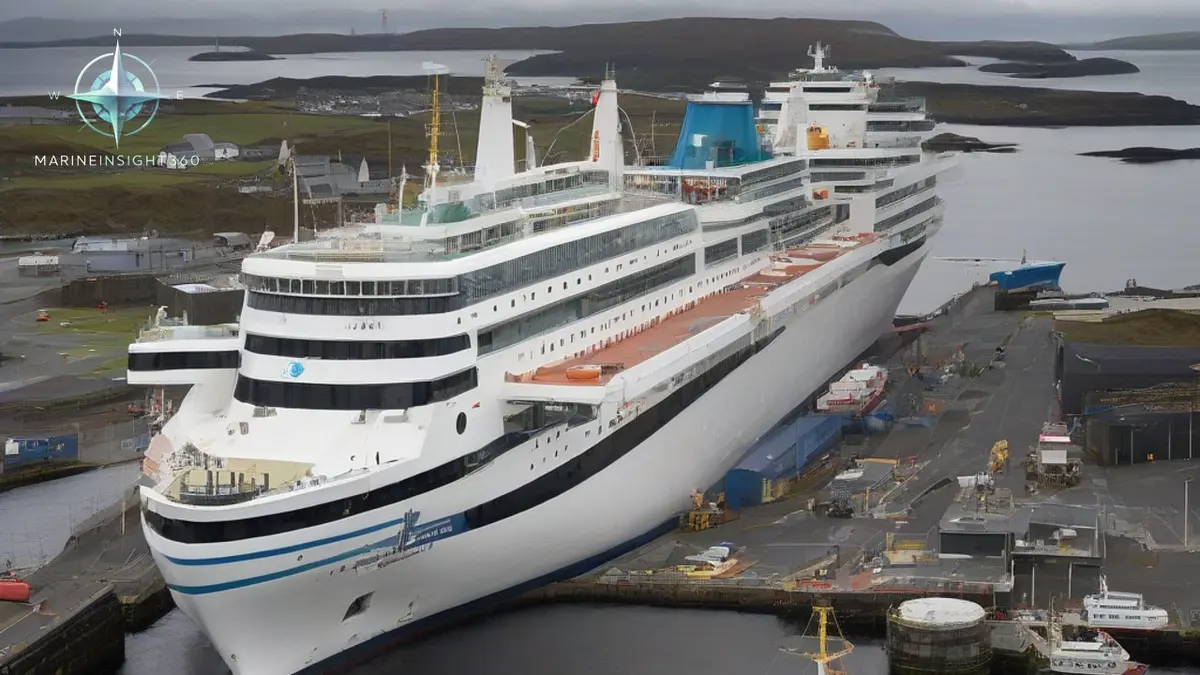
Stornoway Port welcomed Queen Anne in May 2025 on the Cunard ship's maiden call, making her the largest cruise ship ever to dock at the Isle of Lewis harbor. At 332 m (1,089 ft) long and around 113,000 gross tons, she is several times the size of anything the port could take alongside a decade ago. The call was possible because of a GBP 59 million (about $75 million) infrastructure program centered on a new deep water terminal.
That puts one of the United Kingdom's smallest island harbors into the same berthing league as the mainland cruise ports.
For a port of that scale, taking a 332 m ship alongside rather than at anchor is the entire point of the investment. Tendering caps passenger throughput, depends on the weather, and turns a full day ashore into a half day.
Why Queen Anne is Stornoway Port's largest ever cruise ship call
Before the terminal, large cruise ships anchored off and ran tenders. That arrangement limits a port in three ways. Tender operations stop in moderate swell, so calls get canceled at short notice and the port cannot promise reliability to a line planning a season. Landing several thousand passengers by tender takes hours at each end of the day. And above a certain size, a ship cannot be handled at all.
An alongside berth removes all three constraints at once. The port now offers capacity for the largest cruise vessels afloat, along with the wider quay, laydown area and services that go with them. The stated aim is diversification: the same infrastructure supports offshore wind, freight and fisheries work outside the cruise season.
Handling a 332 metre ship at a small island port
The berth is only part of the requirement. A call of this size draws on capabilities that a small port has to build deliberately, and usually well before the first booking is confirmed.
- Pilotage and towage. Ships of this length need pilots trained and assessed on the specific maneuver, with tug support sized to the windage of a high sided cruise hull.
- Mooring. A 113,000 gross ton ship needs bollard strength, line handling gangs and fendering to match, plus a plan for surge from passing traffic.
- Shore reception. Waste, sludge and garbage reception facilities are a MARPOL obligation on the port, not an optional commercial service.
- Passenger flow. Several thousand people ashore in a town of Stornoway's size needs coach staging, taxi ranks and a terminal building that works in Hebridean weather.
- Emergency planning. Mass rescue planning scales with the number of people on board, not with the size of the port.
The economics behind 89 calls in 2026
The port expected more than 60,000 cruise passengers across the 2025 season, contributing an estimated GBP 7.5 million (about $9.5 million) to the local economy. For 2026 it has 89 scheduled calls booked, with Queen Anne returning after the maiden visit.
Those figures explain why small ports build deep water berths. Cruise revenue arrives as port dues, pilotage, towage, waste reception, water and provisioning, and it lands in a compressed season of a few months. The infrastructure then has to earn its keep for the rest of the year from other trades, which is why the diversification argument carries more weight with funders than the passenger count does.
What it signals for Scotland's island ports
Stornoway is one of several northern and western Scottish ports that have invested to move cruise calls from anchorage to alongside. Competitive pressure runs both ways. Lines want alongside berths because they sell more excursions and protect schedule reliability. Ports want the calls because the alternative is watching ships pass to a neighbor with a longer quay.
The constraint is now ashore rather than afloat. Excursion capacity, road access and community tolerance set the practical ceiling on calls per season, not berth length or water depth. Ports that expand faster than their road network can absorb tend to discover this in their second big season.
What it means for crews and agents
Deck and engineering officers on the cruise circuit should expect first call conditions at ports like this: newly commissioned berths, pilots with limited experience of the largest hulls, and reception facilities still bedding in. Build extra margin into the arrival plan and confirm the tug and linesman arrangement in writing.
Agents should verify waste reception capacity, fresh water rates and bunker availability well ahead of arrival rather than assuming a major port standard. The Marine Insight 360 Ports section covers how smaller terminals are scaling up for the cruise trade and where the pinch points usually appear.
A UK harbour authority does not write its own rules for a call like this. The Port Marine Safety Code, published by the Department for Transport, frames the duties of the harbour authority and its duty holder. The Maritime and Coastguard Agency oversees compliance and coordinates search and rescue. When something goes wrong, the MAIB investigates and publishes, which is where the useful lessons end up.
The recurring faults at new cruise berths are mooring and weather, not depth. Ships range along the quay when swell works into the harbour, lines part under snatch loads, and fenders take forces they were never specified for. Tug girting and late line handling appear while pilots are still building experience on the largest hulls. Gangway and shore access injuries are a steady source of casualty reports.
Sources and further reading
- Stornoway Port Welcomes Queen Anne, Largest Vessel in Its History
- Stornoway Port welcomes the Queen Anne, the largest vessel in its history
- Stornoway Port set for major 2026 cruise season with 89 ship calls
- Cunard's new ship Queen Anne marks milestone at Stornoway Port
What to read next
Recommended Reading
Typhoon Class Submarine: The Biggest Boats Ever Sent Under the Sea
The Soviet Typhoon class submarine remains the largest ever built: twin pressure hulls, 20 missile silos, and why nothing since has matched its size.
How Big Is the Largest Submarine Ever Built? Typhoon Class Facts
The Soviet Typhoon class is the largest submarine ever built: 175 m long, 23 m beam, 48,000 tonnes submerged. Why it was that size and what replaced it.
Two Crew Members Seriously Injured in Explosion on Tanker at Ireland's Second Largest Port
An explosion aboard the chemical tanker Bow Hercules at Shannon Foynes seriously injured two crew members. What the case shows about gas cylinder safety.