
Tanker Explodes Off the Indian Coast After Methanol Discharge: The Gas-Freeing Lesson
A product tanker exploded off the Indian coast after discharging methanol and all 21 crew were rescued. Here is how gas-freeing turns an empty tank lethal.
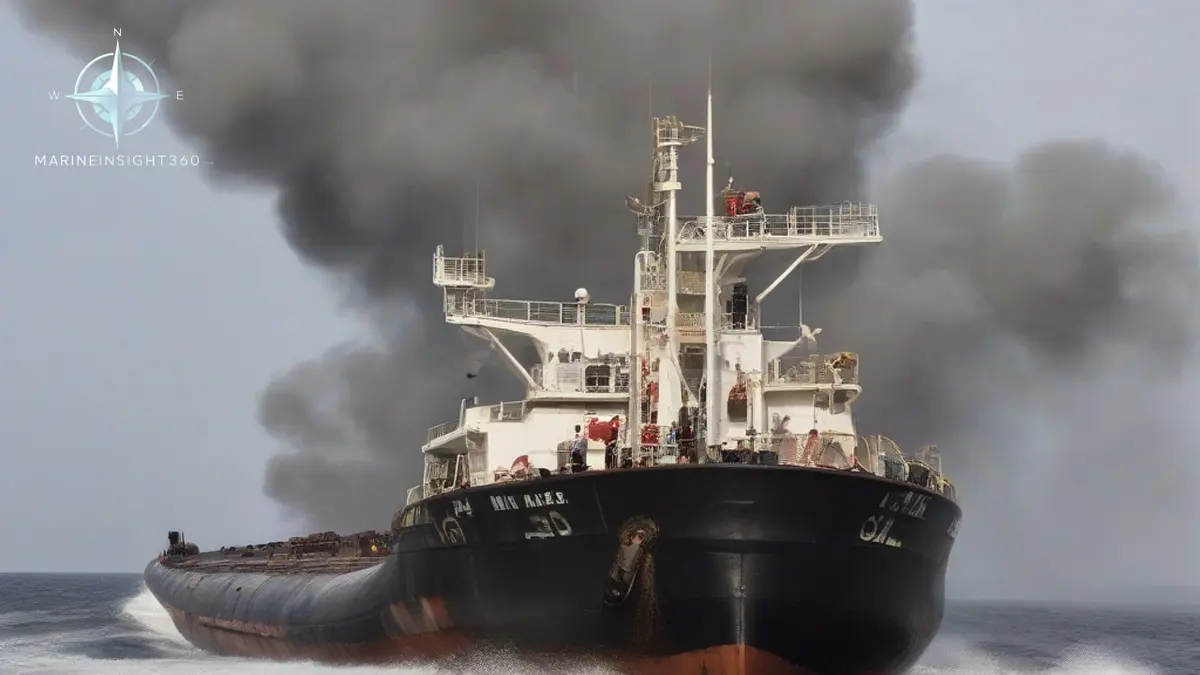
The product tanker Fulda exploded off the Indian coast roughly two hours after discharging a methanol cargo, and all 21 crew were rescued. The 19,477 dwt Hong Kong flagged vessel had sailed from the oil jetty at Deendayal Port, Kandla, bound for Sohar in Oman. Authorities linked the explosion to gas-freeing, and early findings pointed at insufficient flushing and purging plus a likely static ignition source.
The same operation runs on methanol-capable product tankers everywhere, which is why USCG and Paris MOU inspectors treat tank atmosphere records as a boarding priority.
That sequence is the single most dangerous hour in a product tanker's cycle, and it injures crews on ships of every age and flag. The cargo is gone, the paperwork is signed, the ship is at sea, and the tank atmosphere is quietly moving through the one band where it will burn.
Why a tank becomes flammable after the cargo leaves
A cargo tank that has just been emptied is not empty. It holds a vapor and air mixture that is usually too rich to ignite, which is exactly why it feels safe. Gas-freeing dilutes that mixture with fresh air so people can enter for inspection or the next cargo can be loaded. Diluting a rich atmosphere with air does not skip the flammable range. It walks straight through it.
The control is purging with inert gas first. Industry practice under the tanker safety guide is to purge the tank until the flammable vapor content is at or below 2 percent by volume, using outlet pipework sized to maintain an exit velocity near 20 meters per second (66 ft per second) so the incoming gas mixes properly rather than short-circuiting to the vent. Only then is air introduced. Purge first, then gas-free.
Reversing that order builds an explosive atmosphere inside a steel box.
Methanol behaves differently from petroleum products
Officers who have spent years on clean petroleum products can carry the wrong instincts into a methanol trade. Three properties matter.
- A very wide flammable range. Methanol vapor burns across roughly 6 to 36 percent by volume in air, much wider than gasoline. An atmosphere that would be safely over-rich with a petroleum cargo can sit comfortably inside methanol's flammable band.
- A low flash point. Methanol flashes at around 11 degrees C (52 F), so ambient deck temperatures in the Arabian Sea keep it producing ignitable vapor continuously.
- A nearly invisible flame. Methanol burns with a pale blue flame that is very hard to see in daylight, which delays detection and sends responders into a fire they cannot locate.
Methanol is also normally inerted with nitrogen rather than boiler flue gas, because flue gas contaminates the cargo. That changes the inerting arrangement and, on some ships, changes who is actually competent to run it. A crew trained on a flue gas plant is not automatically competent on a nitrogen supply.
Where static electricity comes into it
The initial findings in this case pointed to poor bonding or equipment problems as the likely ignition source. Static charge is generated whenever liquid moves, whenever water is sprayed into a tank, and whenever a non-conductive object is lowered into an ungrounded space. It needs only an isolated conductor to accumulate on and a flammable atmosphere to discharge into.
The controls are old and well documented: bond and ground all portable equipment, use approved conductive and properly earthed tank cleaning hoses and dip tapes, observe the waiting periods after loading or washing before dipping or sampling, and keep the tank inerted while any of that is happening.
What a competent gas-freeing plan contains
The failure mode is rarely one bad decision. It is a plan that was never written down.
- A written gas-freeing plan approved by the master, naming the tanks, the sequence and the responsible officer.
- Confirmation that lines, pumps and drop lines have been drained and flushed, not just the tank itself.
- Inert gas purging to below 2 percent flammable vapor, verified by instrument at several levels, not one reading at the ullage port.
- Calibrated and bump-tested meters, with the operator trained on the difference between a percent LEL reading and a percent by volume reading inside an inerted space.
- Ventilation openings sited to keep vapor clear of accommodation intakes and ignition sources, with smoking and hot work banned across the deck.
- A stop condition: if a reading rises rather than falls, the operation halts and the space is re-inerted.
Why the crew survived and what that says
All 21 crew, a mixed complement from China, Bangladesh, Indonesia and Myanmar, were evacuated safely. Rapid abandonment and an effective coastal search and rescue response turned a catastrophic hull failure into a survivable one. That outcome depends on drills most crews treat as routine: muster lists that reflect actual manning, survival craft that launch under a list, immersion suits sized for the people on board, and a distress alert transmitted before the power fails.
For anyone standing a cargo watch on a chemical or product tanker, the concrete action is to read the ship's gas-freeing procedure before the next discharge and confirm two things: that inert gas purging precedes any admission of air, and that the target is a measured vapor concentration rather than an elapsed ventilation time.
Sources and further reading
- Product Tanker Ripped Apart by Explosion off Coast of India (The Maritime Executive)
- Tanker explosion off Gujarat coast forces crew to abandon ship (SAFETY4SEA)
- Fulda crew rescued after tanker explosion (Seatrade Maritime)
- No inert gas means less tanker safety (The Nautical Institute)
What to read next
Recommended Reading
Shadow Fleet Tanker Detained in Gibraltar After Russian Crew Left Unpaid
A shadow fleet tanker was detained in Gibraltar after its Russian crew went unpaid. What counts as abandonment under MLC 2006 and what seafarers should do.
Sonion Tanker 'Poses Environmental Risk' After Attack In Red Sea
Sonion Tanker 'Poses Environmental Risk' After Attack In Red Sea: safety, training and compliance context for US, UK, Canada, Australia, Singapore and...
Nigeria Upbeat Over Maritime Competitiveness After US Lifts 12-Year Ban
Explore how the U.S. lifting a 12‑year ban on Nigerian vessels opens new routes and compliance requirements for global shipping professionals.