
IRGC Gunboats Open Fire on a Tanker Off Oman: The Crew Response That Matters
UKMTO reported IRGC gunboats firing on a tanker 20 nautical miles off Oman without a radio challenge. What crews do when a state naval unit closes in.
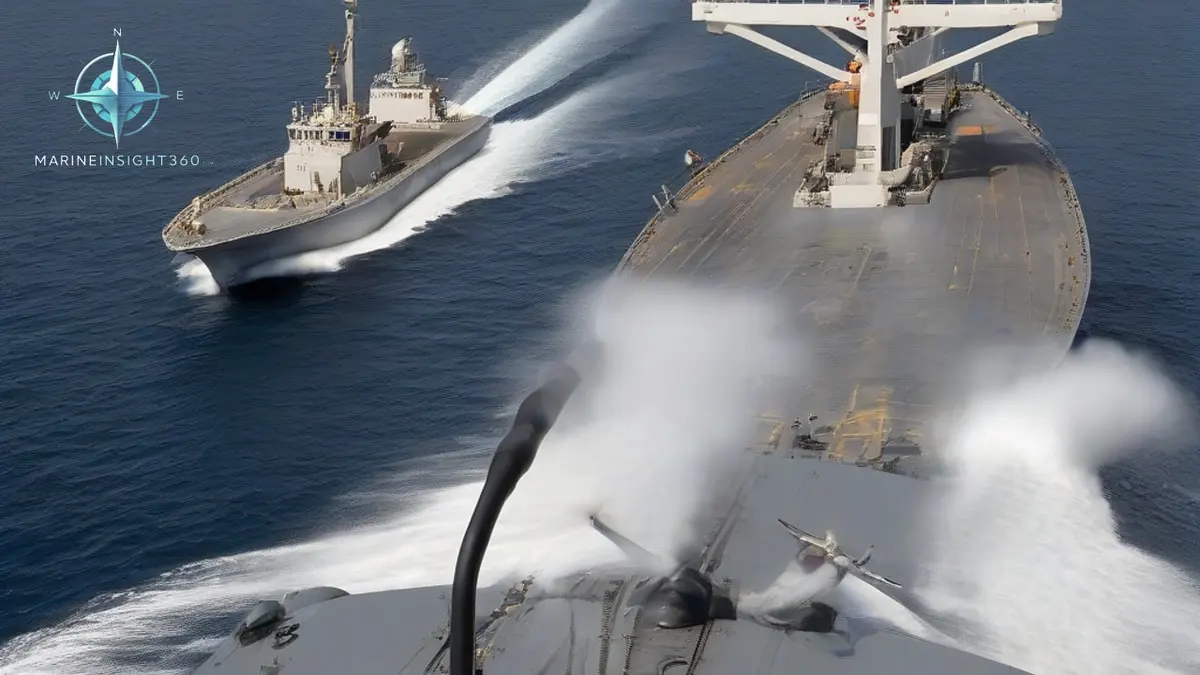
Two gunboats linked to Iran's Islamic Revolutionary Guard Corps fired on a tanker about 20 nautical miles northeast of Oman at 0920 UTC on Saturday 19 April 2026. The report reached UK Maritime Trade Operations, the United Kingdom naval reporting cell in Dubai, from the ship herself.
The master said the IRGC gunboats opened fire without issuing any radio challenge first. The vessel and crew were reported safe. The incident came while Iran was reimposing strict limits on shipping crossing the Strait of Hormuz.
The detail that matters operationally is the absence of a challenge. Almost every merchant security procedure assumes an escalation ladder that starts with communication. When the first indication is weapons fire, the bridge team has seconds rather than minutes, and the piracy playbook most crews have drilled is the wrong tool.
A state naval unit is not a pirate skiff
Anti-piracy preparation is built around irregular attackers who want to board, hold the ship and extract value. The countermeasures follow from that: outrun them, make boarding physically difficult, retreat to a citadel, and wait for a naval response that is on your side.
None of that logic transfers to an encounter with a state naval unit.
- You cannot outrun it. Fast attack craft operating close to their own coast have the speed advantage and the fuel to keep it.
- Resistance escalates. Physical barriers and evasive maneuvering are read as non-compliance by a boarding party that considers itself lawful, which increases the risk to the crew rather than reducing it.
- The citadel does not help. A citadel works because irregular boarders are on a clock and want to leave. A state unit is not on a clock and can remain with the ship.
- Armed guards become a liability. Private security engaging a state naval vessel creates criminal exposure for the team and the ship, and the outcome for the crew would be considerably worse.
The correct posture is compliance under protest, immediate reporting, and meticulous recording. That is not a comfortable instruction to give a crew, but it is the one that keeps people alive and preserves the owner's legal position.
The first ten minutes on the bridge
The sequence should already be written into the ship security plan, and the bridge team should have rehearsed it as a distinct drill from the anti-piracy drill.
- Sound the security alert and get everyone off open decks and away from the ship's side. Small arms fire against accommodation glass and deck fittings is the main injury mechanism.
- Report to UKMTO using the contact details held in the ship security plan, with position, time in UTC, course, speed, craft description and what was fired.
- Notify the company security officer, who notifies the flag state, the charterer and the war risk underwriter.
- Maintain a listening watch on VHF channel 16 and answer any challenge calmly and factually: name, flag, last port, next port, cargo.
- Do not activate the ship security alert system reflexively without knowing what the company procedure expects, and never in place of the voice report.
- Start a dedicated incident log with a named recorder whose only job is writing down times, positions and exact wording.
The instruction to alter course: who decides
The hardest moment is an order to alter into territorial water. Legally, the transit passage regime through an international strait does not permit a coastal state to impede a ship exercising it, and most flag administrations will say so. Practically, a master facing armed craft that have already fired has limited room to argue that position at sea.
This is why the decision must be pre-agreed ashore. Owners should obtain a written flag state position before the ship enters the area, and the master should carry it. The instruction the bridge needs is not a legal essay but a clear line: comply if refusal risks the crew, report immediately, record everything, and let the flag state and the owner take the dispute up afterwards through the proper channels.
What the paperwork does later
Everything recorded during the incident does real work in the weeks after it.
- War risk claims. Additional premium, loss of hire and any damage claim all rest on documented times and positions.
- Charterparty position. Deviation, delay and off-hire arguments turn on whether the ship followed orders, whose orders, and when.
- Flag state investigation. Administrations pursuing a diplomatic protest need a factual account from the ship, not a reconstruction from memory.
- Crew entitlements. War bonus and area entitlements under collective agreements are triggered by documented exposure.
What crews should do before the next Gulf voyage
Review the ship security plan specifically for the state-actor scenario, because most plans only cover piracy. Run a drill in which the first event is weapons fire with no warning, and time how long it takes to clear the decks and make the first report. Confirm that the UKMTO contact details on the bridge are current and that at least two officers know where they are without looking.
The concrete next step before departure is a briefing that separates the two threat types out loud, so that every watchkeeper knows which response applies to a skiff closing on the quarter and which applies to a naval craft ordering the ship to alter course.
Sources and further reading
- IRGC gunboats open fire on tanker off Oman's coast, UK maritime agency says (The Times of Israel)
- Iranian Gunboats Open Fire on Tanker in Strait of Hormuz: UKMTO (Ship & Bunker)
- UK agency says IRGC-linked gunboats fired on tanker near Oman (Middle East Eye)
What to read next
Recommended Reading
Why the Rescue Effort for a Russian Tanker off Oman Failed
A rescue effort for a Russian tanker off Oman stalled for weeks. What the Caroline Bezengi grounding shows about shadow fleet salvage and liability.
Two Crew Members Seriously Injured in Explosion on Tanker at Ireland's Second Largest Port
An explosion aboard the chemical tanker Bow Hercules at Shannon Foynes seriously injured two crew members. What the case shows about gas cylinder safety.
External Explosion Off Oman: What a Waterline Blast Means for the Crew
UKMTO logged an external explosion near a tanker off Oman. What the term means, why waterline damage points to mines or drone boats, and what crews do next.