
What Is a Search and Rescue Transponder (SART)?
A Search and Rescue Transponder (SART) is a lifesaving device used on ships and survival craft to help rescuers quickly locate a vessel or liferaft during distress situations.
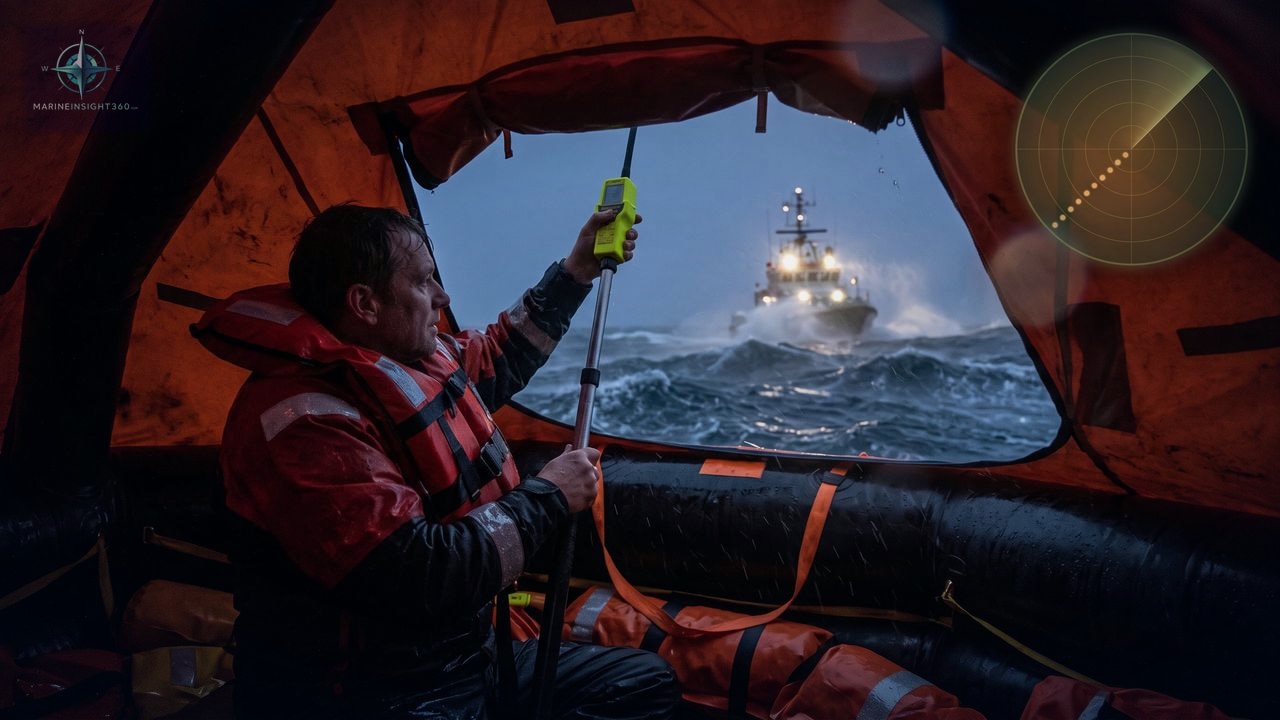
A Search and Rescue Transponder (SART) is a lifesaving device used on ships and survival craft to help rescuers find a vessel or liferaft in distress. Most commercial ships have to carry one under international maritime regulations.
A SART matters most at the end of a search and rescue (SAR) operation, when survivors are hard to spot.
What Does SART Do?
A SART responds to radar signals from nearby ships or aircraft. When it detects a 9 GHz (X-band) radar pulse, it automatically transmits a series of strong replies on the same band.
On the rescuer's radar screen the replies show up as a line of twelve dots running outward from the SART's position along its bearing. The dot nearest the centre of the screen marks the SART. As the rescuer gets within about a mile, the dots stretch into arcs, and very close in they become concentric circles.
Rescuers can home in on it even in fog or darkness.
Where Is a SART Kept on Board?
A SART is usually kept on the bridge, or close to the lifeboats and liferafts, in a bracket where it can be grabbed quickly. Most units float if dropped in the water.
When the crew abandon ship, someone takes the SART into the lifeboat or liferaft so rescuers can find the survivors.
How Does SART Work? (Step-by-Step)
- Activation: someone switches the SART on manually in distress.
- Standby: it waits, listening for radar signals.
- Detection: when an X-band radar pulse reaches it, the SART wakes up.
- Transmission: it sends its reply back on the same frequency.
- Display: the rescuer's radar shows the line of dots leading to the SART.
The closer the rescue vessel gets, the clearer the pattern becomes. Most SARTs also signal with a light or sound when a radar interrogates them.
Range of a SART
Detection range depends mostly on the height of the SART and of the searching radar's antenna, and on sea conditions. As a rough guide:
- About 5 to 10 nautical miles from a ship
- Further if the searching radar's antenna is higher, and much further from a search aircraft
SART vs AIS-SART
Many ships now carry an AIS-SART instead of, or as well as, a radar SART. Since 2010, SOLAS has allowed either type to meet the requirement.
The difference is in how they signal. A radar SART answers X-band radar pulses. An AIS-SART transmits distress messages over AIS, including its GPS position, so it appears as a distress symbol on AIS displays and electronic charts.
An AIS-SART gives a precise position; a radar SART can be seen by any X-band radar.
Regulatory Requirement
The carriage requirement comes from:
- SOLAS (Safety of Life at Sea Convention), Chapters III and IV
- The IMO performance standards and other international maritime safety regulations
- It applies to passenger ships and to cargo ships of 300 gross tonnage and above
SARTs must be tested and inspected regularly to make sure they work.
How many search and rescue transponders must a ship carry?
SOLAS Chapter III sets the count by size. A cargo ship of 300 gross tonnage up to 500 carries at least one search and rescue transponder. A cargo ship of 500 gross tonnage and above, and every passenger ship, carries at least two, stowed one on each side so that whichever side is used for abandonment has one within reach.
The performance standard gives a SART 96 hours in standby and a further 8 hours transmitting once a radar starts interrogating it. Height then decides range far more than the device does. Held at arm's length in a liferaft it may answer at only about 2 nautical miles, while the same unit raised on a pole or mounted on a lifeboat mast reaches considerably further.
Why a working SART is not always seen
The device answers only in the 9 GHz X-band. A searching vessel watching an S-band radar will see nothing at all, which is why a ship joining a search needs the X-band set running and properly tuned.
Settings hide it too. Automatic clutter and rain suppression, and automatic gain, can flatten the line of twelve dots into the sea return. The standard advice is to switch the anti-clutter controls off, take the radar to the 6 or 12 nautical mile range scale, and look for the dots running outward on the bearing. On board, the recurring deficiencies are an expired battery and a unit left out of the monthly test routine.
Why Is SART Important?
A SART is used when a ship sinks, burns, collides or has to be abandoned. Once the survivors are in a liferaft or lifeboat, it makes them visible on radar, which can cut the time it takes rescuers to find them.
Why every seafarer should know how to use one
Every seafarer should know where the ship's SARTs are kept, how to switch one on and how to mount it as high as possible in a survival craft. It is part of the ship's lifesaving and safety systems, alongside the EPIRB.
Recommended Reading
What Are Fast Rescue Boats (FRBs)?
In maritime emergencies, speed can mean the difference between life and death.
Automatic Mutual Assistance Vessel Rescue (AMVER)
The Automatic Mutual Assistance Vessel Rescue ( AMVER ) system is a unique technology developed by the United States Coast Guard in 1958.
What Is A Fast Rescue Boat?
A lifeboat is a floating craft used to rescue the crew and passengers of a ship in the event of an emergency. They can be either rigid or inflatable and vary in size and construction.