
What Are Tugboats? Types, Uses and How They Work
What tugboats are and why ships need them, how bollard pull is measured, direct and indirect towing, conventional, ASD, tractor and rotor tugs, and tug jobs.
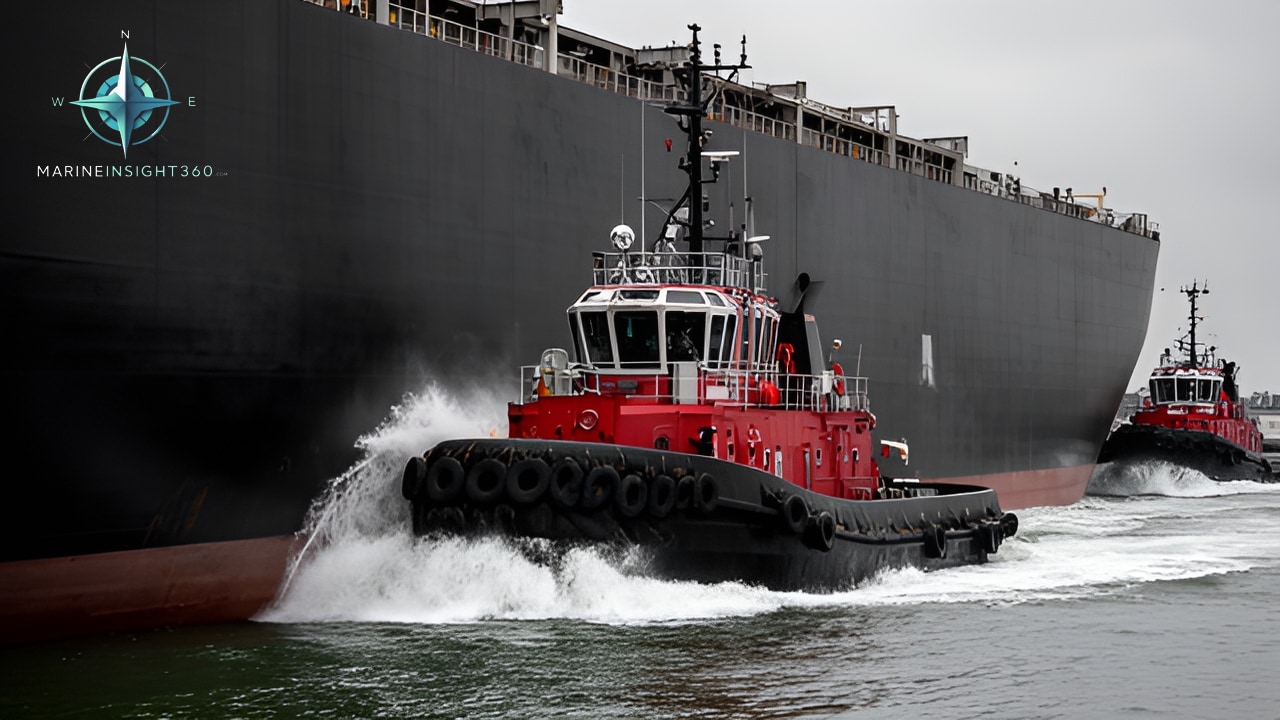
A tugboat, or tug, is a small, very powerful vessel built to move other vessels by pushing or towing them. Tugs berth and unberth large ships in port, escort tankers through narrow channels, tow barges, dead ships and offshore structures, and in many ports provide firefighting and emergency help.
What sets a tug apart is a large amount of propulsion power in a short hull, a strong towing point, and steering that lets it push or pull in almost any direction.
Why ships need tugs
A large merchant ship handles poorly at low speed. Her rudder needs water flowing past it to work, and at the few knots used in a harbour there is little flow unless the engine is turned ahead. She cannot move sideways on her own, and a bow thruster, where fitted, loses most of its effect once the ship is making more than a few knots.
Wind on a high-sided ship, such as a car carrier or a container ship with a full deck load, can push her off course faster than her own controls can correct. Tugs supply the controlled sideways and braking forces a big ship lacks, so she can be turned in a basin, stopped, and placed alongside a berth.
The number and power of tugs used for a job are usually set by port rules or the pilot, depending on the ship's size, the berth and the weather. The pilot on the ship's bridge usually gives orders to the tug masters by VHF radio. The effect of wind on a ship at low speed is explained in our article on wind and current effects on ship handling.
Bollard pull
A tug's power is described by its bollard pull: the pulling force it can exert on a towline at zero speed through the water. It is given in tonnes (tonnes-force) or kilonewtons. Pilots and ports judge whether a tug is big enough for a job by its bollard pull, since two tugs with the same engine power can pull quite differently.
It is measured in a test. The tug is made fast to a strong shore bollard through a load cell and runs up to full power, and the force is recorded. A classification society surveyor normally witnesses the test and the result is recorded on a bollard pull certificate, often giving both a maximum figure and a lower steady figure the tug can hold over a set period.
Test conditions affect the result, so the test is done in deep water with plenty of space around the tug, little current and light wind, so that the propeller wash flows away freely and is not reflected back off a quay or the seabed.
Bollard pull varies widely. Small harbour tugs may produce well under 30 tonnes, many modern harbour tugs in large ports are in the range of about 50 to 80 tonnes, and large escort and ocean towing tugs go well above that.
How tugs work with a ship
There are two basic ways a tug applies its force. It can tow on a line made fast to the ship's bitts, usually led through a fairlead or chock at the bow or stern, or it can push with its fendered bow or side against the ship's hull. Many harbour tugs do both on the same job, pulling on a line and then coming in to push.
When towing on a line, a tug can work in two modes. In direct towing the tug pulls straight along the line with its propulsion. In indirect towing, used by escort tugs at higher speeds, the tug positions itself at an angle to the water flow so that its hull acts like a wing. The water pressure on the hull generates a towline force that can be much greater than the tug's own bollard pull.
Indirect towing only works when the ship has reasonable speed through the water, generally upward of about 6 knots, which is why it suits escort work.
Towing carries a well-known danger called girting (or girding, or tripping). If the towline comes round towards the tug's beam while under heavy load, it can heel the tug over and capsize it within seconds. Tugs that tow from a point near amidships are most at risk. Quick-release towing hooks and winch brakes, a gog rope that holds the towline down near the stern, and a good lookout on the line are the main defences. For the ship's crew, a towline under load carries the same snap-back hazard as a mooring line, discussed in our article on handling mooring ropes.
Tug designs
Tugs are usually classed by where the propulsion sits and where they tow from.
| Design | Propulsion | Usual towing point | Main features |
|---|---|---|---|
| Conventional | One or two propellers aft, with rudders, often in nozzles | Towing hook or winch near amidships | Simple and economical, but less manoeuvrable and most exposed to girting |
| Azimuth stern drive (ASD) | Two azimuth thrusters under the stern that can turn through 360 degrees | Winch on the bow, often with a second winch aft | Very common harbour and escort type; works over the bow and can push and pull in most directions |
| Tractor | Voith Schneider propellers or azimuth thrusters forward of amidships, with a skeg aft | Towing point aft | Highly manoeuvrable and stable when towing; widely used for escort work |
| Rotor | Three azimuth thrusters, two forward and one aft | Winches fore and aft | Thrusters at both ends give very fine control; a less common design |
Types of tug by job
- Harbour tugs berth and unberth ships, turn them in basins and assist in locks and narrow channels.
- Escort tugs accompany large ships, especially laden tankers and gas carriers, through confined approaches, ready to steer or stop the ship if her steering or engine fails. After the Exxon Valdez spill in 1989, escort tugs became mandatory for laden tankers in places such as Prince William Sound in Alaska.
- Ocean-going and salvage tugs tow dead ships, rigs, dry docks and large structures across open sea, and go to the help of ships disabled at sea.
- Anchor handling tug supply (AHTS) vessels set and recover the anchors of drilling rigs and floating installations, tow rigs and carry supplies offshore.
- Pusher tugs push barges, either on rivers in large lashed tows or at sea in articulated tug and barge units, where the tug sits in a notch at the stern of the barge.
- Ice-capable tugs work in ports that freeze in winter, breaking ice in berths and channels as well as assisting ships.
Many harbour and escort tugs carry fire monitors and pumps and hold a firefighting class notation, often written FiFi 1, so they can fight fires on ships and at terminals.
Crews, fuel and newer tugs
A harbour tug is run by a small crew, typically a master, an engineer and one or more deckhands, with larger ocean and offshore tugs carrying more. The different jobs on board are described in our article on types of tugboat jobs.
Most tugs run on diesel engines. Because harbour tugs spend much of their time idling or at low load, and then need full power for short periods, hybrid diesel-electric tugs with batteries have become more common, and a number of fully battery-electric tugs now work in ports that have shore charging. Some ports and operators are trialling tugs that run on alternative fuels as well.
Recommended Reading
What Are Prison Barges? How Do They Work?
A prison barge is a specialized vessel used as a correctional facility. These floating structures provide alternative or supplemental detention space,…
Understanding Ship Fin Stabilizers and How They Work
Fin stabilizers are located at the bottom of the hull and their function is to resist excessive rolling of the ship in any direction.
Ship Propellers - How Do They Work?
Ship propellers are angled blades on a rotating shaft: they draw water in at the leading edge and push it out astern, and the pressure difference across each blade produces forward thrust.