
Selective Catalytic Reduction (SCR) Reactors for Ships – Types, Working Principles, Advantages, and Disadvantages
Nitrogen oxide pollution refers to the pollution caused by the release of nitrogen oxides into the atmosphere in gaseous form during the high-temperature…
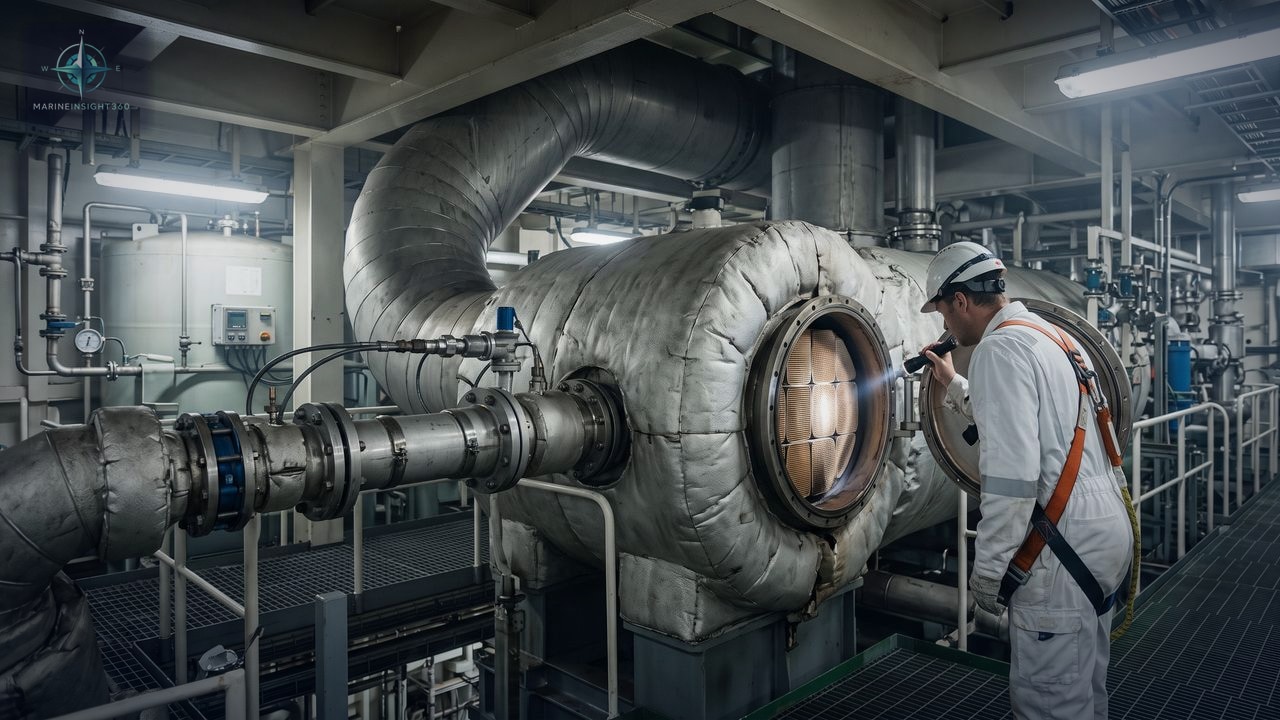
A selective catalytic reduction reactor is an exhaust aftertreatment unit that injects urea into a ship's exhaust gas, where a vanadium pentoxide catalyst converts nitrogen oxides into nitrogen and water and cuts NOx by more than 80%.
What are Nitrogen Oxides (NOx)? Where Do They Come From?
Nitrogen oxides are gases formed when fuel burns at high temperature and the nitrogen and oxygen in the combustion air react with each other. This happens in every diesel engine and fossil-fuelled power plant.
Most of the NOx is nitric oxide (NO) and nitrogen dioxide (NO₂), with small amounts of other compounds. NO and NO₂ are not greenhouse gases themselves, but they form ground-level ozone, which is, so they affect climate indirectly. (Nitrous oxide, N₂O, is a strong greenhouse gas but is not counted as NOx under MARPOL.)
Why are nitrogen oxides an environmental and health concern?
NOx is one of the main ingredients of smog. In sunlight, nitrogen dioxide breaks down and the products react to form ozone (O₃). Volatile organic compounds (VOCs) in the air speed this up, and they also react with NOx to form fine particulate matter. Ozone high in the stratosphere protects us; ozone at ground level is a pollutant.
In rain, nitrogen oxides form nitric acid and add to acid rain.
NO₂, nitric acid and ozone get deep into the lungs and damage lung tissue. Even short exposure irritates the airways of healthy people.
For people with asthma, short exposure can bring on serious attacks. This kind of air pollution contributes to respiratory diseases such as emphysema and bronchitis, worsens heart disease and is linked to a higher risk of premature death.
For ships, the rules have tightened in steps. On 1 January 2016 the International Maritime Organization (IMO) Tier III NOx limits under MARPOL Annex VI came into force for ships built from that date and operating in the North American and US Caribbean Sea Emission Control Areas. The North Sea and Baltic Sea became NOx ECAs for ships built from 1 January 2021.
Regulation 13 of Annex VI of the MARPOLConvention controls NOx emissions from marine diesel engines as follows:
The NOx limit for each engine depends on its rated engine speed (rpm): the slower the engine, the higher the allowed g/kWh. Tier I applies to engines on ships built from 2000 and Tier II to ships built from 2011, worldwide. Tier III applies only inside NOx Emission Control Areas.
The regulation covers diesel engines over 130 kW. Engines used only in emergencies are exempt, and so are engines on ships that sail only in the waters of their flag state, provided those engines are subject to an alternative NOx control measure set by the flag administration.
Tier III limits are about 80% below Tier I. A ship built on or after 1 January 2016 that enters the North American or US Caribbean ECA must meet them there.
In practice, meeting Tier III requires a dedicated NOx control technology. There are two main routes:
1) Burning liquefied natural gas (LNG) in a lean-burn engine.
An example is the WinGD (Winterthur Gas & Diesel) X-DF engine, which injects LNG at low pressure and burns it lean in the cylinder, keeping NOx within Tier III in gas mode.
2) Reducing NOx on a liquid-fuel engine. The options are adding water to combustion (as a fuel-water emulsion, as humidified intake air, or by direct injection into the cylinder), exhaust gas recirculation (EGR), or selective catalytic reduction (SCR).
The rest of this article covers the types, operating principle, components, advantages and disadvantages of marine SCR reactors.
Basic Working Principle
Selective catalytic reduction (SCR) uses a catalyst to convert the nitrogen oxides in exhaust gas into nitrogen (N₂) and water.
A reducing agent, which can be anhydrous ammonia (NH3), ammonia solution (ammonium hydroxide) or urea, is added to the exhaust stream and adsorbed onto the catalyst. Ships almost always use urea, which also produces carbon dioxide (CO2) in the reaction.
The reactions with ammonia are:
- 4NO + 4NH3 + O2 = 4N2 + 6H2O
- 2NO2 + 4NH3 + O2 = 3N2 + 6H2O
- NO + NO2 + 2NH3 = 2N2 + 3H2O
With urea, the overall reaction is: 4NO + 2(NH₂)₂CO + O₂ = 4N₂ + 4H₂O + 2CO₂ (in the presence of a catalyst).
Selective Catalytic Reduction (SCR)
SCR can cut nitrogen oxides by more than 80%. A urea and water solution is sprayed into the exhaust upstream of a catalyst reactor.
Because it treats the exhaust after the engine, SCR does not need changes to the basic engine design or the combustion process.
In the reactor, the urea breaks down to ammonia, which reacts with the NOx on the catalyst surface to form nitrogen and water vapour.
The IMO Marine Environment Protection Committee (MEPC) has issued guidelines for SCR systems, the "SCR Guidelines", in resolution MEPC.198(62). By location, SCR systems fall into two groups: those fitted between the exhaust manifold and the turbocharger, and those fitted between the turbocharger and the exhaust gas boiler.
1) High-Pressure SCR System
In a high-pressure SCR system the reactor sits before the turbocharger. The catalyst needs exhaust at roughly 300°C to 400°C, and on a two-stroke engine the gas after the turbine is too cool for that, especially at low load.
So on two-stroke engines the reactor is usually placed before the turbocharger, where the gas is hotter, which widens the load range over which the SCR works. The combustion process itself is barely affected.
The higher temperature also lets a high-pressure SCR run on heavy fuel oil with higher sulphur content.
2) Low-Pressure SCR
In a low-pressure SCR the reactor sits after the turbine. The exhaust may need heating to reach the catalyst's working temperature at the reactor inlet, which costs extra fuel or energy. Four-stroke engines, with hotter exhaust after the turbocharger, usually have low-pressure SCRs.
Components of an SCR Unit
Dosing Unit
The dosing unit draws urea solution from a storage tank. The tank size depends on how much time the ship spends in Tier III areas and how long the SCR runs there, so it varies a lot between ships.
Marine urea solution is usually 32.5% or 40% urea in water. It is non-toxic and odourless and is safe to transport and store at normal temperature and pressure. In cold weather the tank and lines need protecting, because the solution crystallises at low temperatures.
The dosing system delivers the urea according to signals from the SCR control system and the engine control and monitoring system.
Vaporization/Mixing Unit
The dosing system injects the urea into the mixing unit, where it evaporates and mixes with the exhaust gas.
The mixing unit is a section of the exhaust pipe between the engine and the reactor. Its length and shape are worked out with flow calculations and testing so that the urea spray mixes fully with the hot gas before it reaches the catalyst. It is several metres long, sized to suit the engine.
The injection pipe from the dosing unit enters at the start of the mixing section. Sensors near it measure the NOx concentration and the exhaust back pressure.
Selective Catalytic Reduction (SCR) Chamber
In the reactor chamber the catalyst converts the NOx into nitrogen and water. The chamber holds layers of catalyst elements, which work only within a set temperature window. Too hot and the elements are damaged.
Too cool and the conversion efficiency drops. The catalyst elements contain vanadium pentoxide (V₂O₅), which promotes the reaction between the ammonia from the urea and the NOx. The reactor volume grows with engine power, typically one to a few cubic metres per megawatt.
Fuel Quality and Selective Catalytic Reduction (SCR) Technology
Fuel sulphur content matters a great deal in SCR operation. The sulphur in the fuel ends up as sulphur oxides in the exhaust, and the minimum exhaust temperature at which the SCR can safely run rises with the sulphur content.
With high-sulphur fuel and low exhaust temperature, for example at low engine load, ammonia and sulphur trioxide react to form ammonium bisulphate. With low-sulphur fuel the SCR can run at a lower exhaust temperature.
Ammonium bisulphate is a sticky deposit that condenses on the catalyst elements. The control system therefore keeps the reactor inlet temperature high enough to prevent it, and stops urea dosing when the temperature falls too low.
The deposits cut NOx conversion sharply, block the catalyst passages together with soot, and raise the exhaust back pressure.
Soot Blowing System
A soot-blowing system keeps the catalyst elements clean. It uses compressed air, typically at around 7 bar, to blow soot off the elements at intervals.
Selective Catalytic Reduction (SCR) Sensor Unit
A NOx sensor measures the NOx concentration upstream of the SCR and turbocharger.
Further NOx and temperature sensors are fitted at the reactor outlet.
Ventilation System
When the SCR is switched off and the engine runs in Tier II mode, the reactor is isolated from the exhaust flow. Fresh air can then be blown through the reactor to keep exhaust gas and moisture out and stop soot and acid deposits forming.
On a high-pressure SCR, the reactor is shut off by a reactor sealing valve at its inlet.
A reactor throttle valve is located at its outlet.
When the ship is outside an ECA, or the SCR has a fault, the reactor bypass valve opens and the exhaust goes straight to the turbocharger.
At part load, a cylinder bypass valve can send some scavenge air straight to the turbine inlet. Less air through the cylinders raises the exhaust temperature to keep the SCR in its working range.
On engines with SCR the auxiliary blower settings are slightly different. When the blowers cut out as load rises, the change in air flow can cause a sudden drop in exhaust temperature, so a short delay is built in.
The reverse also happens: the exhaust temperature can jump when the blowers stop. To smooth this, the cylinder bypass valve opens first to raise the temperature gradually, then the blowers stop, and finally the valve closes according to engine load.
Advantages and Disadvantages of Selective Catalytic Reduction (SCR) Systems
Exhaust temperature has to be watched closely to keep NOx removal going and prevent fouling.
Advantages
- Meets Tier 3 NOx standards.
- Highly effective NOx removal (60-90%) under most engine loads.
- SCR has been used on ships for decades, so there is a large reference list of installations.
Disadvantages
- Relatively high initial investment cost.
- Limited NOx removal rate under low engine loads.
- Unlike some other Tier III solutions, it needs a urea tank that has to be refilled, which adds running cost.
- May increase fuel consumption slightly (figures around 1% are often quoted).
- Urea used while in Emission Control Areas (ECAs) is an extra operating cost.
Maintenance
- NOx sensors have a limited life and are replaced at the interval the maker specifies.
- Catalyst elements in the reactor also wear out and are replaced. Their life depends heavily on fuel sulphur content and on how often the SCR runs at low exhaust temperature. NOx reduction efficiency must be checked regularly, as set out in the engine's Technical File, to confirm Tier III compliance.
When the NOx reduction falls below the level set by the manufacturer, the catalyst elements are replaced according to the manufacturer's instructions.
- The soot blower consists of a compressed air cylinder, a diaphragm valve and a pressure switch. All pressure hoses must be inspected and maintained.
- The dosing system consists of a urea solution tank, liquid filter, dosing pump, nozzle assembly, flow meter, valves, and pressure switch.
- A typical schedule is filter cleaning every week, injector inspection every month, and a performance check of all components every six months.
Benefits for Ship Owners/Operators
Apart from meeting the regulations, Tier III NOx technology can show charterers and cargo owners that the company takes its emissions seriously, which matters more in tenders than it used to.
There is also a direct saving, because several major ports give discounts on port dues to cleaner ships. Many of them use the Environmental Ship Index (ESI), a score that rates a ship's NOx, SOx and CO2 performance, to decide who qualifies.
NOx performance has a large weight in the ESI score, so a ship with Tier III engines scores noticeably higher than a similar Tier II ship.
Ports that have used ESI-based incentives include:
- Los Angeles
- Hamburg
- Rotterdam
- Antwerp-Bruges
The thresholds and discounts change from year to year, so check each port's current scheme before counting on the saving.
Recommended Reading
Complete Guide of PMMC -Composition, Advantages & Disadvantages
The full name of PMMC is Permanent Magnet Moving Coil. It is an analog instrument commonly used to measure electrical quantities such as voltage and current.
Diwali at Sea: Far from Home, Together as One Crew
What Diwali looks like on a merchant ship: a crew of different faiths and nationalities celebrating together, thousands of miles from home.
Ramadan at Sea: Fasting, Prayer and Watchkeeping for Muslim Seafarers
A practical guide to Ramadan on board: fasting and watchkeeping, rest hours, suhoor and iftar timings across time zones, galley, prayer and Eid.