
Storms are the Period of Greatest Container Loss
The vastness of the ocean has always posed challenges for seafarers. In modern shipping, a single severe storm can devastate a cargo ship, not to mention…
Storms are the Period of Greatest Container Loss
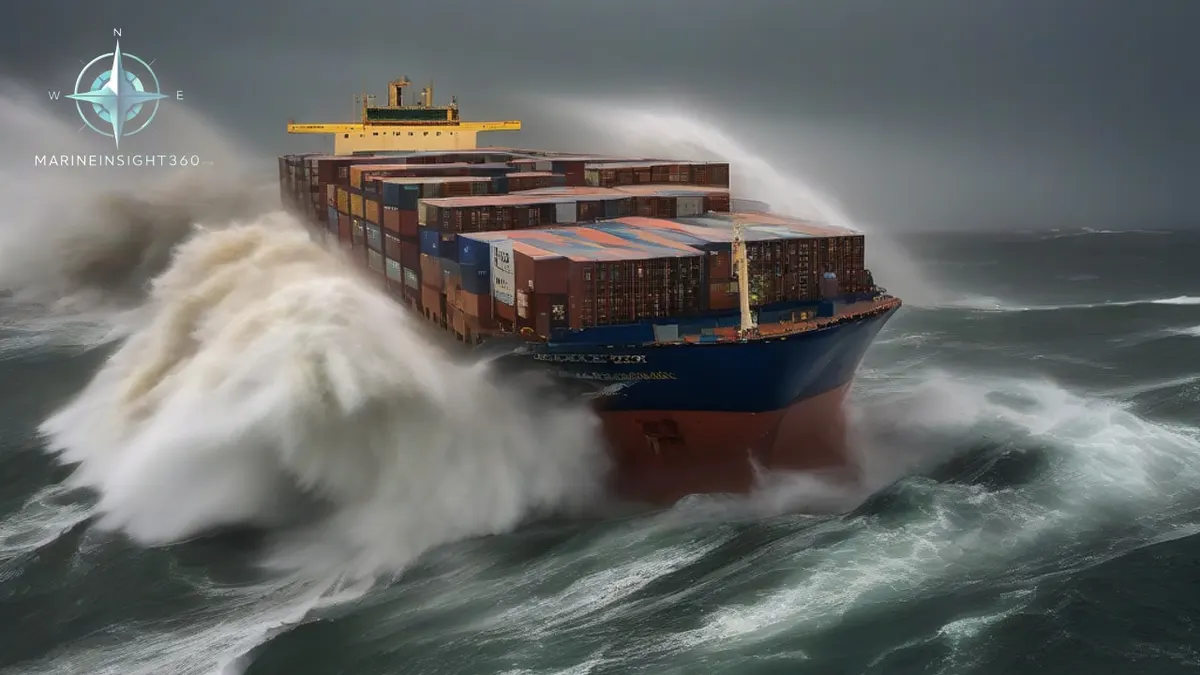
The vastness of the ocean has always posed challenges for seafarers. In modern shipping, a single severe storm can devastate a cargo ship, not to mention the resulting cargo damage. While container losses are common, one notable storm incident was the November 2020 incident involving the container ship One-Apos.
On November 30, 2020, the container ship One-Apos, operated by Ocean Network Express, was transiting the Pacific Ocean approximately 1,600 nautical miles northwest of Hawaii. Carrying over 14,000 TEUs, the vessel encountered an extremely severe storm characterized by fierce waves and raging winds.
Crew members described the ship's violent rolling, with containers stacked on deck beginning to sag and break free from their moorings.
When the ship arrived at the Port of Kobe, Japan, for assessment and repairs, it was discovered that 1,816 containers had been lost during the storm. Several additional containerswere damaged and collapsed on the deck, posing a risk to salvage efforts.
The accident shocked the marine insurance industry and reignited debate about container lashing standards and maintaining ship stability in adverse weather conditions. It highlighted the importance of properly securing cargo and designing ships to withstand the harshest sea conditions.
- Best Container Tracking Software
- Top Types Of Containers
- What Is Container Loading And Unloading?
- Jawaharlal Nehru Port: Largest Container Port In India
Maersk Essen Incident
The Maersk Essen incident is another of the largest maritime container losses during a storm. The accident occurred on January 16, 2021, while the 13,100 TEU (twenty-foot equivalent units) vessel was en route from Xiamen, China, to Los Angeles, California.
The ship was in the North Pacific, approximately 450 nautical miles north of Hawaii, when it encountered adverse weather. This triggered parametric roll, a phenomenon in which the ship's rolling motion is amplified by waves.
A stack of containers collapsed, resulting in approximately 750 containers lost at sea. Additional containers were damaged but not lost at sea. Fortunately, the crew is reported safe.
The vessel subsequently sailed to the port of Lazaro Cardenas, Mexico, where the damaged containers were unloaded. Repairs and maintenance work have also begun.
M/V Comfort sank, with the loss of 4,293 containers.
The largest container ship loss at sea was not due to weather conditions, but rather structural failure, resulting in the sinking and loss of 4,293 containers.
The M/V Comfort incident occurred on June 17, 2013, while the 8,110 TEU container ship was traveling from Singapore to Jeddah across the Indian Ocean.
The weather was not severe, but the crew noticed an unusual bending in the vessel's hull. Due to a weak hull, the vessel broke in two.
The bow and stern separated, and the two vessels began drifting in opposite directions. The 26 crew members abandoned ship and were rescued by nearby vessels. On June 27, 2013, the ship sank stern first, carrying approximately 1,700 containers and 1,500 metric tons of fuel oil. On July 6, while the bow was being towed, a fire broke out in the vessel's hull and quickly spread out of control due to the containers and cargo on board.
The fire consumed the hull, and on July 11, the bow sank along with all 2,400 containers.
The Japanese Ministry of Land, Infrastructure, Transport and Tourism (MLIT) and the Classification of Japanese Ships (ClassNK) immediately launched an investigation.
The investigation concluded that the ship's hull could not withstand the impact. The ship suffered "stress fatigue," with the extremities experiencing greater pressure than the center, and the hull was insufficiently strong to withstand it.
This incident served as a warning, and subsequently, six sister ships of the MOL Comfort class were temporarily decommissioned and their hulls reinforced to prevent similar incidents in the future.
Why parametric roll catches containerships in particular
Parametric rolling is not ordinary rolling in a beam sea. It develops in head or following seas, where a ship should be pitching rather than rolling, and it feeds on the change in the shape of the waterplane as the hull moves through the wave.
The mechanism needs a particular hull. A modern containership has a wide flared bow and a broad flat stern, so waterplane area grows sharply as the bow immerses and shrinks as it emerges. When the encounter period sits near half the ship's natural roll period, that variation pumps energy into the roll once every half cycle.
The build-up is fast. A ship rolling a couple of degrees can reach an angle that throws containers off the stack within a handful of cycles, which is why the Maersk Essen loss is described as triggered by a phenomenon rather than by the height of any single wave. The correction is a change of speed or heading to move the encounter period away from resonance.
What holds a deck stack down
Containers on deck are locked to each other and to the ship by twistlocks in the corner castings, with lashing rods and turnbuckles running from the lashing bridge to the second and sometimes third tier. Above that the stack is held only by the twistlocks between boxes.
The limits come from the cargo securing manual approved by the classification society, and they are limits on force rather than on lashing count. Transverse acceleration from roll rises with roll angle and with height above the roll axis, so the top of an outboard stack sees far more than the bottom of an inboard one.
Weight in the wrong place turns that arithmetic against the ship. Since 2016 SOLAS Chapter VI has required the shipper to declare a verified gross mass for every packed container before it may be loaded, precisely because a heavy box stowed high on a guessed weight loads the stack in a way the plan never allowed for.
Counting the losses is a separate exercise. The World Shipping Council surveys its member lines and publishes an annual figure for containers lost at sea, and it is the only industry-wide count that exists. Individual casualties like the ones described here dominate the total in the years they happen.
Recommended Reading
Container Loading and Unloading: How Boxes Move Between Ship, Yard and Warehouse
How container loading and unloading actually works: stowage plans and cut-off dates, ship-to-shore cranes, yard handling, and stuffing at the warehouse.
Container Tracking: How Shippers Actually Follow a Box Across the Ocean
How container tracking works, from free carrier lookups to visibility platforms: what each tool layer does, what it costs, and how to pick for your volume.
Container Tracking Systems: A Comprehensive Guide
Container Tracking Systems: A Comprehensive Guide: ports, trade and shipping-market context for US, UK, Canada, Australia, Singapore and European...