
How Hovercraft Work: Lift, Skirts, Propulsion and Steering
How a hovercraft lifts on an air cushion, why the flexible skirt matters, how lift fans, air propellers and rudders work, and where hovercraft are used.
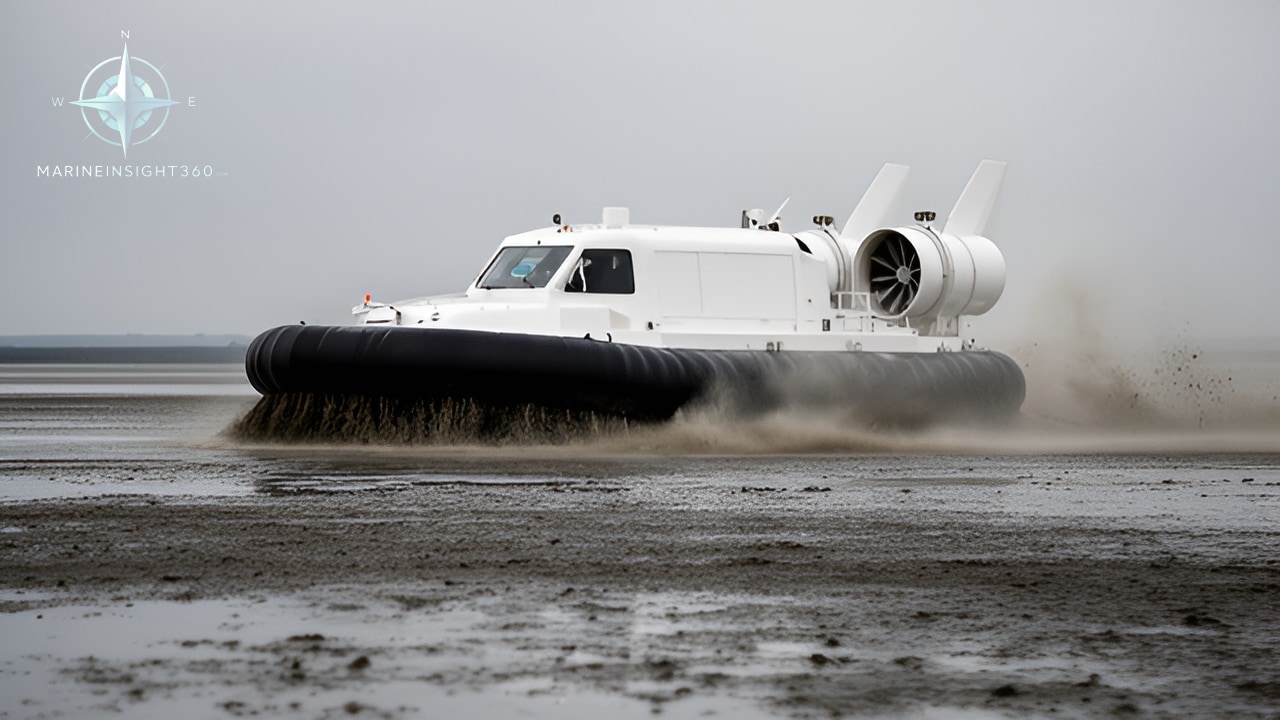
A hovercraft rides on a cushion of air trapped under the hull by a flexible skirt. A lift fan blows air into the space beneath the craft faster than it can leak out under the skirt's lower edge, so the pressure there rises a little above atmospheric and lifts the whole craft clear of the surface. Air propellers push it along and air rudders steer it.
Because the hull never touches the water, the same craft can run over water, mud, sand, ice and flat ground.
How the air cushion lifts the craft
The physics is simple. The cushion pressure multiplied by the area of the cushion has to equal the weight of the craft. A hovercraft's cushion covers almost its whole footprint, so the pressure needed is small, only a tiny fraction of atmospheric pressure. That is why a fan is enough to do the job and no compressor is needed.
The air does not stay put. It escapes all the time through the narrow gap between the bottom of the skirt and the surface, and the lift fan has to keep replacing it. The skirt hangs well below the rigid hull, so the craft can ride over waves and obstacles roughly as high as the skirt is deep while the leakage gap at the hem stays small.
A small gap means less air lost and less engine power spent on lift.
A hovercraft is a different thing from a planing boat. A planing hull lifts itself partly out of the water through hydrodynamic pressure on its bottom, which only happens once it is moving fast. A hovercraft gets its lift from the fan and can hover while stationary.
Plenum chambers and the momentum curtain
The simplest arrangement is the plenum chamber: an open-bottomed box with a fan blowing air into it. It works, but air pours out round the whole edge and a lot of power is needed for very little height.
Christopher Cockerell's contribution in the 1950s was the peripheral jet, often called the momentum curtain. Air is ducted to a narrow slot running round the edge of the hull and blown downwards and slightly inwards. The moving sheet of air acts as a seal and holds the cushion pressure with far less leakage than an open plenum.
Cockerell famously proved the idea with two tins, an air blower and a pair of kitchen scales, and filed his patent in December 1955.
The jet curtain on its own still gave only a small hover height, which limited early craft to calm water. What made hovercraft practical at sea was the flexible skirt. C. H. Latimer-Needham is generally credited with the invention; he patented the idea and in 1961 sold his skirt patents to Westland, which had taken over the Saunders-Roe hovercraft work.
Skirts were fitted to the SR.N1 and later craft in the early 1960s and greatly increased the height of wave or obstacle a craft could clear. Most modern craft combine a skirt with a plenum-type cushion, and the skirt now does most of the sealing.
Skirt designs
The skirt takes most of the punishment and is the part of a hovercraft that wears out. It is usually made from rubber-coated nylon fabric. The common arrangements are:
- A bag skirt, an inflated loop of fabric round the hull, which is simple and used on many small craft.
- A finger skirt, made of rows of separate fabric segments hanging from the hull edge. Each finger can fold over a wave or a rock and spring back, and a damaged finger can be replaced on its own.
- A bag and finger skirt, with fingers hung below an inflated bag. This is the usual design on larger passenger and military craft.
Larger craft divide the cushion into compartments with internal skirts or keels. Without them, air would rush to the low side when the craft rolled or pitched, and the craft would lose stability.
Lift and propulsion machinery
The lift fan is a centrifugal fan on many larger craft and usually an axial fan on small ones. It draws air from above deck and discharges it into the skirt and cushion. Thrust comes from one or more air propellers at the stern, normally running inside ducts that make them quieter and safer for people nearby.
Some craft have separate engines for lift and thrust. Many small and medium craft use one engine for both, with the drive split between the lift fan and the propeller, and some use a single fan whose airflow is divided between the cushion and a thrust duct. On single-engine craft, more engine speed means more lift and more thrust together, so craft with variable-pitch propellers control speed largely through pitch. Reversing the pitch gives reverse thrust, which is the nearest thing a hovercraft has to brakes.
The big cross-Channel SR.N4 craft used marine gas turbines, and the US Navy's LCAC landing craft use gas turbines today. Most modern commercial hovercraft use diesel engines, which burn less fuel.
Steering and handling
Air rudders, hinged vertical aerofoils standing in the propeller slipstream, turn the craft. They work on the same principle as a ship's rudder, in air instead of water. At low speed, when there is little slipstream, pilots use puff ports (nozzles that blow cushion air sideways) and differential thrust where the craft has more than one propeller.
Handling is unlike a boat. With nothing in the water to grip, a hovercraft skids through turns and drifts sideways in a crosswind, so the pilot often has to point the bow off the intended track to make good a straight course. Over water, drag rises sharply at one particular speed, known as the hump, because the cushion presses a hollow into the surface and pushes a wave ahead of it. Once past the hump the drag falls away.
An overloaded craft or one heading into a strong wind can struggle to get over it.
At sea a hovercraft is treated as an air-cushion vessel under the COLREGs. When operating in the non-displacement mode it shows an all-round flashing yellow light in addition to the normal lights of a power-driven vessel (Rule 23).
History and present uses
The Swedish scientist Emanuel Swedenborg sketched an air-cushion craft in 1716, and the engineer John Thornycroft experimented with air lubrication of hulls in the 1870s. Neither had an engine light enough to make it work. Cockerell's patent led to the SR.N1, built by Saunders-Roe, which first flew in June 1959 and crossed the English Channel from Calais to Dover on 25 July 1959.
The largest commercial hovercraft were the SR.N4 car ferries, which ran across the Channel from 1968 to 2000; the stretched Mk III version could carry over 400 passengers and around 60 cars. Rising fuel costs, competition from fast catamarans and the Channel Tunnel ended that trade. Hovertravel's service between Southsea and Ryde on the Isle of Wight, running since 1965, is the longest-running passenger hovercraft route in the world.
Today hovercraft are used where boats and road vehicles both struggle: rescue work on mudflats, ice and flood water, survey and patrol over shallow ground, and military landings. The LCAC carries vehicles from amphibious ships straight up onto a beach, and the Russian Zubr class are the largest military hovercraft built. Passenger hovercraft on international voyages are built and operated under the IMO High-Speed Craft Code, and many national rules for domestic craft are based on it. The limits are well known: hovercraft are noisy, thirsty, sensitive to wind and heavy seas, and their skirts need constant maintenance. For a wider view of where they sit among other vessel types, see the evolution of water transport.
Recommended Reading
LNG Propulsion Systems: A Complete Technical Guide
How LNG-fuelled ships work: low- and high-pressure dual-fuel engines, fuel storage and supply under the IGF Code, emissions, methane slip and bunkering.
Steering Gear on Ships: Ram Type vs Rotary Vane, and How Both Work
How ship steering gear works: electro-hydraulic ram and rotary vane types compared, the SOLAS 28-second rule, and the tests crews run before every departure.
Diwali at Sea: Far from Home, Together as One Crew
What Diwali looks like on a merchant ship: a crew of different faiths and nationalities celebrating together, thousands of miles from home.