
What is a Ship Arrestor?
What is a Ship Arrestor?: ports, trade and shipping-market context for US, UK, Canada, Australia, Singapore and European maritime readers.
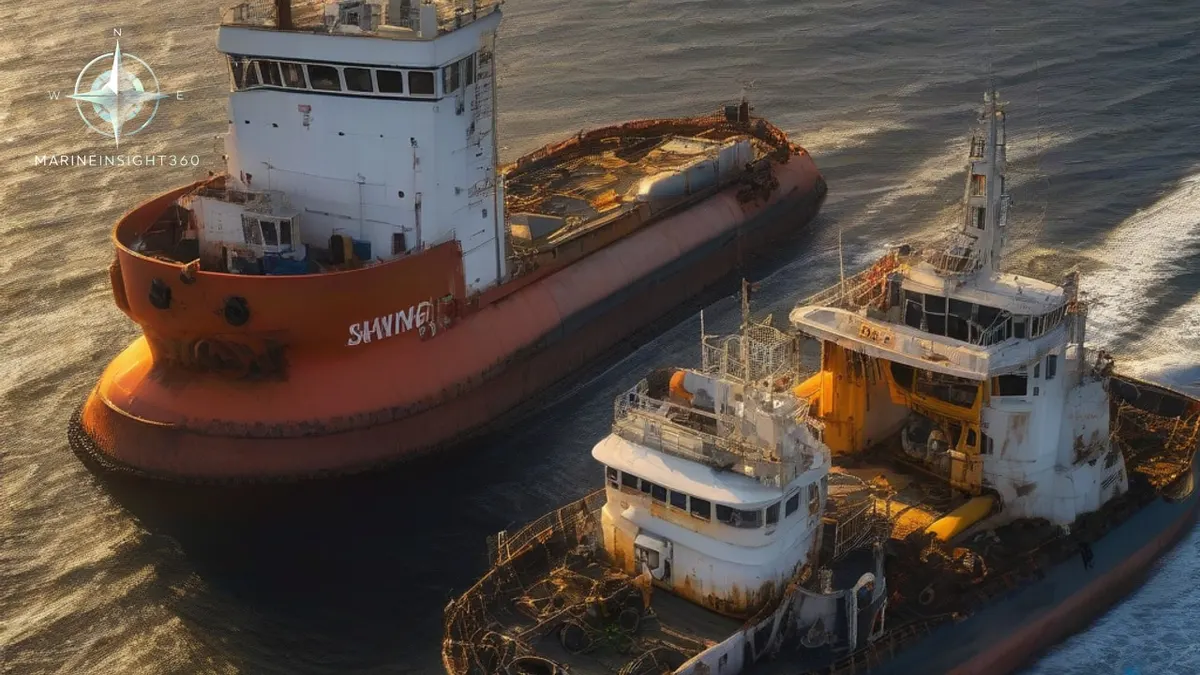
A ship arrestor is an EU-funded emergency system in which a helicopter attaches a towline and a large sea anchor to a drifting vessel, halving its drift so rescue tugs can reach it.
Why was the Ship Arrestor system developed?
The "Ship Arrestor" project, selected from 1,200 EU-funded projects, aims to protect coastlines from the environmental damage caused by grounded oil tankers. A consortium of eight European organizations, led by Mikko Marine, developed the "Ship Interceptor" concept with partial funding from the EU's Competitiveness, Research, and Innovation Framework.
Participants in the project include organizations from France, Germany, the Netherlands, and Austria, including the Norwegian Institute of Technology and the UK's Ship Stability Research Centre. They applied their expertise to address this challenge, developing a technology that allows a towline to be attached to a drifting vessel via helicopter. The towline is attached to a floating anchor that cuts the vessel's drifting speed in half, giving rescue tugboats more time to intercept the vessel before it runs aground.
Ships losing control at sea are not uncommon, and the consequences of a grounding can be devastating to the environment. Introducing a method to recapture these vessels is now seen as an important new option for coastal authorities. The British Isles are particularly vulnerable due to the loss of funding for four emergency tugboats in the UK. Therefore, the ShipArrestor system is considered a solution, allowing fewer rescue tugboats to service the same area at a lower cost.
Meco Marinedeveloped the ShipArrestor system's technology and hardware, enabling conventional search and rescue helicopters to deploy a towline around a winch on the foredeck of an abandoned vessel. The helicopter then positions the towline upwind and releases it, securing it to a floating anchor. Comprehensive trials have proven the system's effectiveness. In one trial, a 30-meter-diameter nylon sea anchor successfully steered a 120,000-ton liquefied natural gas (LNG) tanker into the wind, reducing its drift by 58%. This is crucial for improving the survival rate of a stranded vessel and safeguarding the cargo and crew on board as it lurches in heavy waves.
Part of this project involved the necessary mathematical modeling to determine the required anchor size for ships of different tonnages. This affects the anchor's weight and its ability to be transported by helicopter. Similar requirements apply to the towline, which must be strong and durable enough to withstand the wear and tear of the ship's winch and side. This led to the development of a unique chain that is half the weight of traditional chains while offering the same performance.
The Ship Arrestor project also enables anchors to be permanently transported on board ships for emergency use. This need was recently demonstrated when a multi-million dollar wind farm lift platform separated from a heavy lift vessel due to engine failure in the mid-Atlantic. This incident highlighted the risk of excessive capsizing when a vessel is unable to steer into the wind, and Meco Marine is confident it can provide a solution to this risk.
Following the completion of the ShipArrestorsystem development project, it is currently being offered to national maritime authorities who need to protect their coastlines from the high costs and liabilities associated with large vessels running aground in their jurisdictions. The Norwegian and Swedish Coastal Administrations are seriously considering the system, and the German company Havari Kommando Nord plans to test a version specifically designed for their needs in early 2012.
Ship Behavior in Shallow Water; Resistance & Speed
What is ship anchoring technology?
Sometimes, for various reasons, oil tankers drift at sea. In such cases, a device called a ship anchor is designed to prevent them from colliding with oil platforms, hitting distant shores, or other marine structures.
The ship anchor is an innovative invention that effectively controls the sinking of stranded oil tankers. With the help of a helicopter and an anchor chain, the ship's anchor can control a drifting tanker.
The process of using a ship anchor to stabilize a ship is simple: simply attach an anchor chain to the stranded tanker. This anchor chain is referred to as a "towline," and the operation is assisted by a specially designed helicopter. The anchor attached to the towline is specially designed to restrain the tanker's movement and prevent it from drifting.
Ship Anchoring Device
The towline is approximately 200 meters long and, crucially, prevents a stranded oil tanker from coming to a complete stop. It prevents the tanker from drifting rapidly and colliding with an oil platform or shallow waters. This innovative ship drifting device can autonomously control a drifting tanker or oil tanker. This device utilizes modern technology to reduce the risk of casualties when rescue teams are dispatched to reach these drifting vessels.
In addition, it can help mitigate potential threats to the marine environment. If a drifting tanker collides with an oil platform, it could cause an oil spill into the ocean. Such an unexpected oil spill could devastate marine life, not to mention marine flora and fauna. Furthermore, it would require significant investment of funds and other resources, leading to costly cleanup efforts.
Another important solution provided by the device is the ability to attach a towline to the anchor, preventing the tanker from moving too quickly due to ocean currents, allowing rescue vessels to reach and tow it to the correct location.
Technological advances are helping the world overcome challenges and move forward smoothly. The development of ship arresting device technology in 2009 is another example of proactive engineering progress.
Ship arresting devices can mitigate all potential threats to one or more tankers and protect the marine ecosystem, benefiting not only shipping companies but also the governments of countries that rely heavily on maritime transport.
Recommended Reading
Iran retaliates with missiles and drones, defying Trump’s warning
Learn iran with practical maritime context, safety checks, operational guidance and related resources for global shipping readers.
Hapag-Lloyd Invests in APM Terminals Rotterdam to Drive Growth
Hapag‑Lloyd’s new stake in APM Terminals Rotterdam aims to expand capacity, improve hinterland links and enhance crew efficiency in Europe’s busiest port.
Saildrone Completes Missile Launch Test Aboard its Sail-Powered Surveyor
Saildrone’s autonomous vessel successfully launched a missile‑type payload, showing new possibilities for armed surveyors and implications for shipping operator