
What Is Dredging, and Why Is It Important?
What dredging is, why ports silt up, capital and maintenance work, disposal of dredged material under the London Protocol and how impacts are controlled.
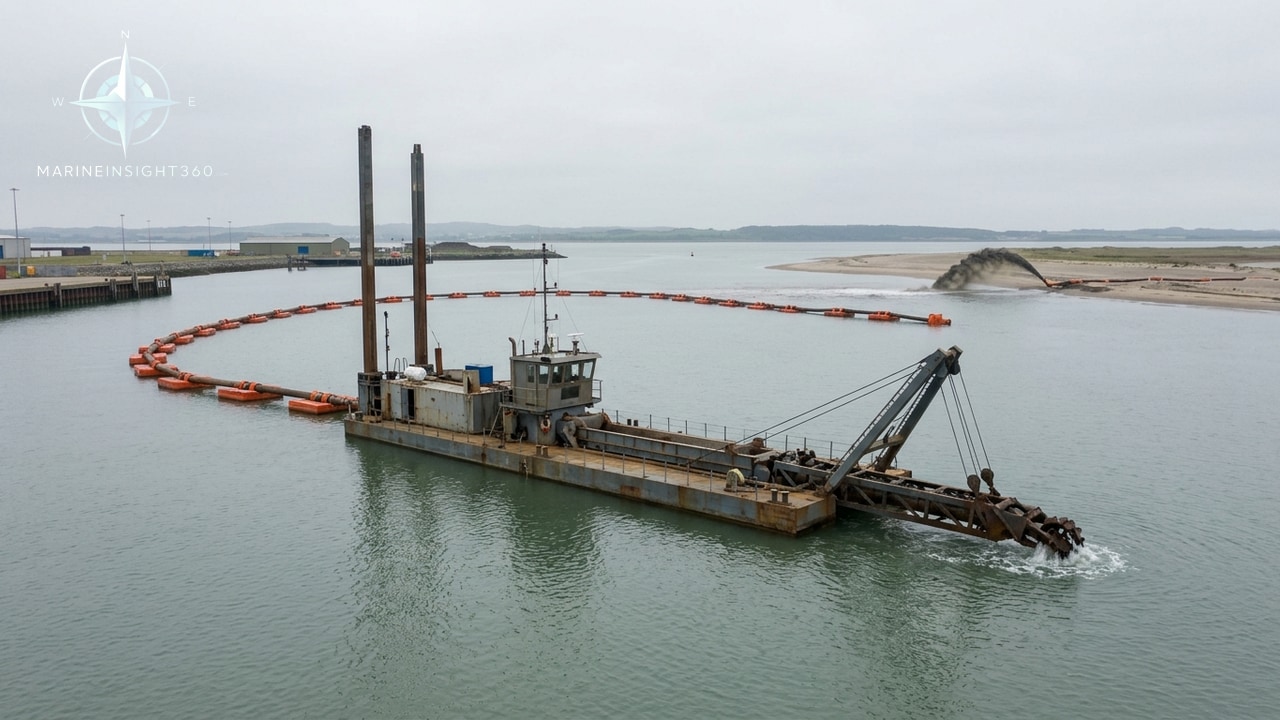
Dredging is the removal of sediment and debris from the bed of a harbour, channel, river or lake, and its transport to somewhere else. It is important because most ports would gradually become too shallow for loaded ships without it: rivers and tides keep bringing in silt and sand, and the charted depth a ship relies on has to be dug out again and again. Dredging is used to build new channels, berths and land as well.
Why ports and channels silt up
Many of the world's big ports sit on estuaries and river mouths, where sediment carried down by the river meets the sea. Where the current slows, in a dock basin, at the edge of a channel or where fresh water meets salt, fine particles settle on the bed. In exposed coastal channels, waves and tidal currents move sand along the coast and into the dredged cut. Some ports lose only a little depth in a year.
Others, on muddy rivers, need dredgers working for much of the year.
The depth matters because the margin is small. A large container ship or bulk carrier may load to a draught of 15 m or more, and the port has to keep a safe under-keel clearance beneath it, allowing for squat at speed, wave motion and the tide. Port authorities survey their channels regularly with multibeam echo sounders and publish the maintained depths. When a survey shows the bed has risen, either the channel is dredged or ships have to load less cargo or wait for the tide. Natural deep-water anchorages, such as those in our list of the world's greatest natural harbours, need far less of this work.
Types of dredging work
Capital dredging
Capital dredging creates something new: a deeper or wider approach channel, a new turning basin, a new berth pocket or a trench for a tunnel or pipeline. It often goes into ground that has never been dredged, including stiff clay and rock, and can be one of the largest costs of a new port. For a sense of what new port works can cost, see our list of the most expensive port construction projects.
Maintenance dredging
Maintenance dredging removes the soft material that has settled since the last campaign, keeping channels and berths at their declared depth. It is repeated work, sometimes continuous, and is a routine running cost for most ports.
Reclamation, nourishment and environmental dredging
Dredged sand is used to build land. Rotterdam's Maasvlakte 2 port extension, opened in 2013, and Hong Kong's Chek Lap Kok airport were built largely on reclaimed land. Beach nourishment pumps sand back onto eroding coasts. Environmental or remedial dredging removes contaminated sediment, for example from old industrial docks, so it can be treated or stored safely.
How sediment is removed
The method depends on the material, the depth, the distance to the disposal site and whether the channel must stay open to traffic.
- Trailing suction hopper dredgers drag a suction pipe along the bed while under way, fill their own hopper and sail to the disposal site. They suit maintenance dredging in busy channels because they keep moving with the traffic.
- Cutter suction dredgers are held in place by a spud and swing a rotating cutter head across the bed, pumping the loosened material through a pipeline. They can cut clay and softer rock.
- Backhoe, grab and bucket dredgers dig mechanically and load the material into barges. They work well close to quay walls and in confined spaces.
- Water injection dredging pumps water into soft silt at low pressure so it forms a dense layer that flows away along the bed under gravity.
The vessels themselves are covered in detail in our article on the types of dredger and their uses.
Where dredged material goes
Dumping dredged material at sea is regulated internationally by the London Convention of 1972 and its 1996 Protocol, administered by the IMO. Under the Protocol, dumping is prohibited except for a short list of materials, and dredged material is one of them. Even then, a permit is needed, and the national authority has to assess the material, its contaminants, the disposal site and the alternatives first.
Clean sand and gravel can often be put to beneficial use, in reclamation, beach nourishment or building up wetlands and intertidal habitat. Fine silt is harder to reuse. Contaminated sediment, which may contain heavy metals, oil residues or old antifouling compounds such as tributyltin, is usually placed in confined disposal facilities on land or in sealed pits, away from open water.
Environmental effects and how they are controlled
Dredging changes the bed it works on and the water around it. The main effects are:
- plumes of suspended sediment that cut light to seagrass and coral and can smother them as they settle;
- release of contaminants that had been locked in the sediment;
- loss of the animals living on and in the dredged bed, which usually recolonise over time;
- underwater noise, and the risk of drawing fish or turtles into suction pipes;
- changes to currents, waves and sediment movement after a channel is deepened, which can affect nearby shores.
Large projects normally need an environmental impact assessment before a permit is given. Controls written into permits can include seasonal working windows that avoid spawning or migration, turbidity limits measured by monitoring buoys, silt curtains around the work, limits on hopper overflow, and turtle deflectors on drag heads.
Who does the dredging
The international market for large projects is dominated by four Belgian and Dutch companies: Boskalis, Van Oord, Jan De Nul and DEME. Chinese state-owned dredging companies are very large too, working mainly in China and on projects abroad.
In the United States, the Army Corps of Engineers is responsible for federal navigation channels and contracts much of the work to private American dredging firms; foreign-built dredgers are largely barred from dredging in US waters by the Foreign Dredge Act of 1906, now part of 46 U.S.C. 55109.
Recommended Reading
Diwali at Sea: Far from Home, Together as One Crew
What Diwali looks like on a merchant ship: a crew of different faiths and nationalities celebrating together, thousands of miles from home.
Ramadan at Sea: Fasting, Prayer and Watchkeeping for Muslim Seafarers
A practical guide to Ramadan on board: fasting and watchkeeping, rest hours, suhoor and iftar timings across time zones, galley, prayer and Eid.

Ship Earthing Systems: Insulated Networks, Bonding and Earth-Fault Monitoring
Why ships use insulated electrical systems, how earth faults are found, high-voltage resistance earthing, bonding, tanker rules and shore power.