
What to Do in Case of Purifier Room Fire?
What to Do in Case of Purifier Room Fire?: technology, equipment and fleet context for US, UK, Canada, Australia, Singapore and European maritime readers.
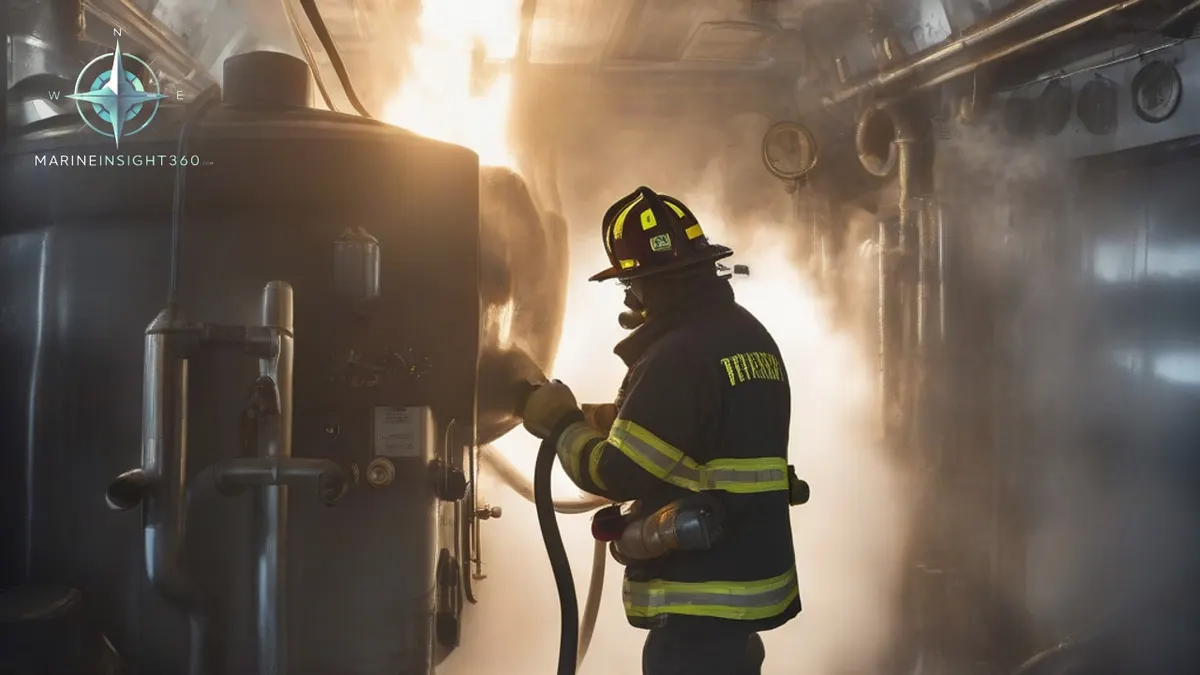
What to Do in Case of Purifier Room Fire?
Purifier rooms are among the most fire-prone areas in engine rooms. Purifier room fires have caused serious accidents on several ships. This article will introduce you to all aspects of cleanroom fires.
Causes of Purifierroom Fires
As is well known, a fire requires three basic elements, all of which are present in a cleanroom. These three elements are: fuel (lubricating oil in the lubricating oil separator and fuel or diesel in the fuel separator), air for combustion, and a heat source (such as high-temperature oil or a short circuit).
A fire will occur when these elements are present simultaneously and within a flammable range.
Therefore, if oil leaks through pipes onto high-temperature surfaces or electrical components, it will immediately ignite a fire.
Cleanroom Fire Prevention
To prevent fires in cleanrooms, the following measuresmust be taken:
1) All pipes leading to the separators must be double-insulated. This is because if the inner pipe leaks, the oil will not spread throughout the room but will leak into the outer pipe.
2) An oil drip collection tray must be installed below the purifier or separator to prevent oil from spreading throughout the room and coming into contact with hot materials, potentially causing a fire.
3) All pipes with flanges or connections must be covered with spill-proof tape to prevent oil spills in case of leaks.
4) A fire suppression system, such as a water mist system or a carbon dioxide system, must be installed.
5) Quick-shutdown valves and remote shut-off systems must be installed for pumps and purifiers.
6) A fire detection and alarm system must be installed to ensure rapid response.
- Fire on Russian Spy Ship Near Syria
- Water Sprinkler and Water Mist Fire Extinguishing Systems
- Understanding the Fire Safety Systems (FSS) Code on Ships
- How Do Ships Survive Storms?
- What is a Beaching Of Ships?
How to Extinguish a Fire in a Cleanroom?
Small fires in a cleanroom can be easily extinguished with a small fire extinguisher. In case of a larger fire, follow these steps:
1) After the fire alarm sounds, immediately contact the chief engineer and determine the location of the fire.
2) If an oil leak occurs, close the quick-shutdown valve.
3) Shut down the transfer pump.
4) Both the transfer pump and the quick-shutdown valve can be shut down remotely, for example, from the ship's control center or engine room.
5) Use the emergency stop button located outside the cleanroom to shut off all motors and electrical equipment.
6) Fire extinguishers can be used to extinguish the fire.
7) In case of a large fire, shut off the air supply pumps and smoke vents inside the cleanroom.
8) If the ship is equipped with a water mist fire suppression system, the fire can be extinguished by activating that system.
9) When entering the purge room, fire suits, self-contained breathing apparatus (SCBA), and fire hoses must be worn.
10) Fires can be extinguished by spraying water.
11) If the fire persists, the chief engineer will decide whether to use carbon dioxide cylinders for fire suppression.
12) No one should be present in the purge room when using carbon dioxide cylinders, as carbon dioxide will displace air, causing asphyxiation and potentially death.
Why does purifier room oil ignite so easily?
Heavy fuel oil is heated to around 98 degrees Celsius at the purifier inlet so that water and sludge will separate out. Marine fuel oil must have a flashpoint of at least 60 degrees Celsius under SOLAS, so the oil in that compartment is already well above the temperature at which its vapour will light.
A pinhole in a pressurised line makes it worse. The oil leaves as a fine mist, and a mist takes fire from a source that would never light a pool. SOLAS chapter II-2 requires surfaces above 220 degrees Celsius to be shielded for exactly that reason, and oil soaked lagging on an exhaust or a steam line is the ignition source that keeps returning in casualty reports.
What is usually found broken afterwards
The quick closing valves and the remote stops decide whether a purifier room fire stays small, and they are the items inspections keep finding defective. Linkages seize, operating wires part, and valves are found blocked or wired open because they kept tripping in a seaway.
The drip tray is the other one. If the tray drain to the sludge tank is blocked, the tray fills and oil goes over the coaming instead of away from the hot surfaces. Both are proved by operating them, not by looking at them.
Before the carbon dioxide goes in
Releasing a fixed carbon dioxide system into a machinery space is a one-shot decision, and the sequence around it matters as much as the release. Account for every person, stop the ventilation fans, shut the skylights and dampers, and close the quick closing valves so no more oil feeds the fire.
After release the space stays shut. Boundary cooling continues, because steel that is still hot will reflash the moment a door is opened and air returns. Re-entry is made with breathing apparatus once the space has been ventilated and tested, and the party goes in expecting the fire to come back.
Recommended Reading
Marine Fire Safety: What the FSS Code Requires on Every Ship
How marine fire safety works under the FSS Code: fire mains and pumps, fixed gas and sprinkler systems, detection, escape gear and the drills that bind it all.
Water Sprinkler and Water Mist Fire Extinguishing Systems
Water Sprinkler and Water Mist Fire Extinguishing Systems: safety, training and compliance context for US, UK, Canada, Australia, Singapore and...
Different Types of Fire Extinguisher Used on Ships
Different Types of Fire Extinguisher Used on Ships: regulatory and compliance context for US, UK, Canada, Australia, Singapore and European maritime...