
Understanding a Turning Circle in Ship
Turning Circle is a fundamental performance characteristic of any vessel. It refers to the vessel's ability to change course or direction, deviating from its intended route.
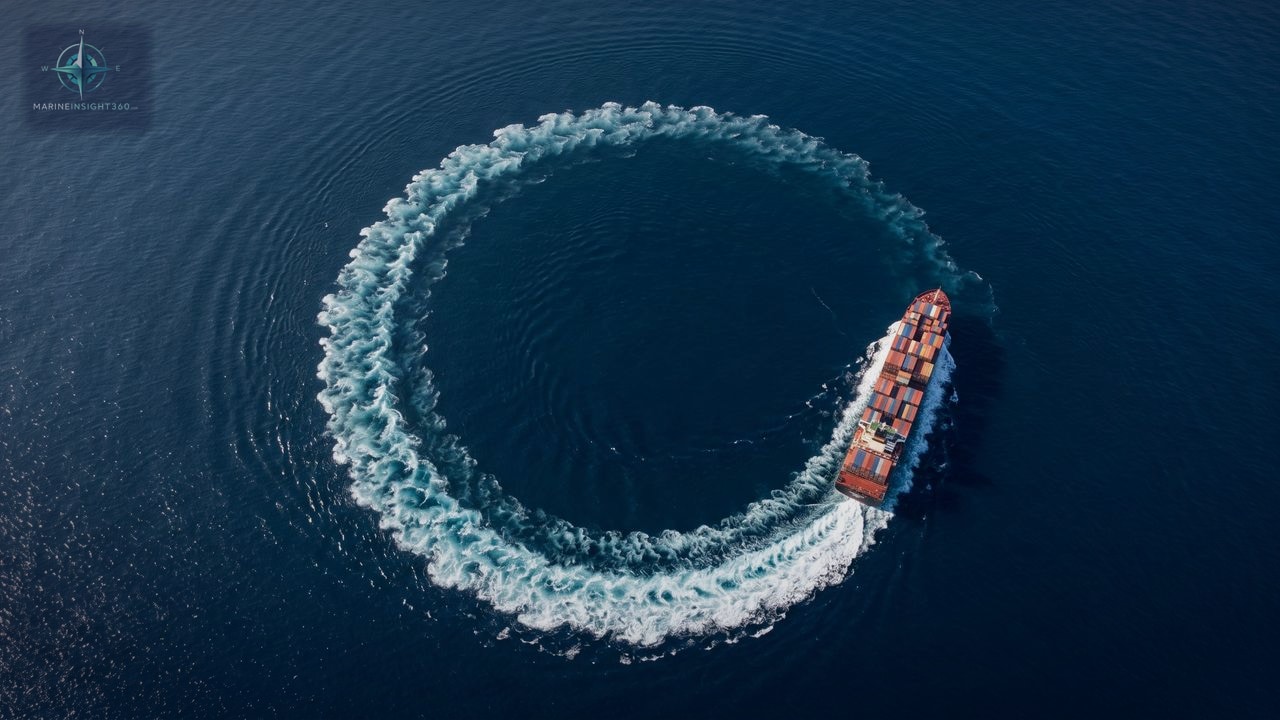
Understanding a Turning Circle in Ship
The turning circle is one of the basic measures of how a ship handles. It is the path the ship follows when the rudder is put hard over and held there, and it tells the master how much room the ship needs to change heading. Every ship has to alter course for one reason or another:
- Routine alterations of course on passage.
- Alterations for weather, heavy seas, or a problem on board.
- Holding a course against wind and current.
- Navigating winding channels such as rivers and canals.
- Avoiding hazards such as land, rocks, coral reefs, offshore structures and other vessels.
- Turning short of a berth, dock or island because of limited space, tide, sea state, weather or heavy traffic.
Turning Radius
Once a new ship is built, manoeuvring trials form part of her sea trials. They measure how the ship turns, checks and stops, and the results go into the manoeuvring booklet and the wheelhouse poster the bridge team uses for the rest of her life.
The International Maritime Organization (IMO) sets these tests in its Standards for Ship Manoeuvrability, resolution MSC.137(76). The standards apply to ships of 100 metres in length and over, and to all chemical tankers and gas carriers regardless of length, built on or after 1 January 2004.
High‑speed craft are excluded because they behave so differently in the water. The standard tests are the turning circle, the zig‑zag test, and the stopping test from full speed ahead with the engine put full astern. Spiral and reverse spiral tests are also used to check directional stability. For a pass, the advance in a turning circle must not exceed 4.5 ship lengths and the tactical diameter 5 ship lengths.
The trials are run in standard conditions so that results can be compared:
- Deep, unrestricted water, at least four times the ship's mean draught.
- Light wind and a calm sea, with as little current as possible.
- Fully loaded, on even keel.
- A steady approach at the test speed, which is at least 90% of the speed the ship makes at 85% of maximum continuous engine output.
- Open water clear of traffic and other obstructions.
Resistance and propulsion are usually predicted from model tests in a towing tank, and the turning circle can be predicted that way too at the design stage. The IMO standards still call for the ship's manoeuvring performance to be confirmed by full‑scale trials, and where the trials can't be run in the standard condition (a ship that can't be fully loaded for trials, for example), the results are corrected to it.
The International Towing Tank Conference (ITTC) publishes the recommended procedures for both the model tests and the full‑scale trials.
What is a turning circle?
Drive a car across an empty car park with the steering wheel held at one position and it will trace a circle. A ship with her rudder held at one angle does the same. A small boat can turn in a circle not much bigger than her own length; a loaded bulk carrier needs several of hers.
Several measurements describe the turn. Advance is the distance the ship travels in her original direction from the moment the rudder is put over until she has turned through 90 degrees. Transfer is how far she has moved sideways at that point. The tactical diameter is the sideways distance covered by the time she has turned through 180 degrees, and the final or steady turning diameter is the diameter of the circle she settles into after that.
During the turn the ship moves crabwise: her heading points inside the circle, and the angle between heading and the direction of travel is the drift angle. The point about which she appears to rotate, the pivot point, moves forward to roughly a quarter or a third of the length from the bow when she is turning ahead.
This is why the stern swings out much further than the bow, which matters when turning close to a berth or another ship.
What are the stages of rotation?
When the rudder is put over, the side force on it first pushes the stern away from the direction of the turn, and for a short time the whole ship moves slightly to the opposite side. This is often called the kick.
The ship then starts to swing. The hull takes up a drift angle, water pressure on the hull adds to the turning moment, and the rate of turn builds up while the ship loses speed.
Finally the turning forces, hull resistance and centrifugal force come into balance. The rate of turn and speed become steady and the ship follows a circle of constant diameter for as long as the rudder is held. In a hard‑over turn, a ship can lose a third or more of her approach speed.
Factors Affecting Turning Radius
These are the main factors that change the size of a ship's turning circle for a given rudder angle:
- Ship Dimensions and Length
- Hull Shape
- Draft and Trim
- Available Depth
- Propulsion System and Machinery
- Rudder Angle and Rudder Area
- Displacement and Load Distribution
- Speed
- External Forces and Wind Conditions
A longer ship generally needs a bigger circle. Hull form matters as much as length: a fine, slender hull with a low block coefficient is more directionally stable and turns in a wider circle than a full one. A container ship or frigate therefore turns wider than a bulk carrier of the same length in the same conditions.
Water depth has a large effect. In shallow water the small clearance under the keel changes the flow round the hull, resistance rises and the ship becomes much more reluctant to turn. The turning diameter can double or more when the depth is less than about one and a half times the draught, so the figures on the wheelhouse poster, which are for deep water, can't be relied on in shallow channels.
Draught and trim also count. A ship trimmed by the stern is more directionally stable and turns in a larger circle; trimmed by the head, she becomes less stable on course and turns tighter, but is harder to steady. A ship in ballast with the rudder and propeller partly out of the water has less rudder force to work with.
Speed has less effect than many people expect. In deep, calm water the diameter of a hard‑over turn changes little with approach speed, although the turn is completed in less time at higher speed. The exception is at very low speed, where the rudder loses effect, and when the engine is used: a burst of power with the rudder hard over gives a strong turning force without much increase in speed, which is how ships are turned in confined water.
Wind, current and waves change the shape of the turn. A ship with a high superstructure or a large deck cargo has a big windage area, and the wind can drive her well off the circle she would make in calm air. A current carries the whole turning circle along with it.
Recommended Reading
Diwali at Sea: Far from Home, Together as One Crew
What Diwali looks like on a merchant ship: a crew of different faiths and nationalities celebrating together, thousands of miles from home.
Ramadan at Sea: Fasting, Prayer and Watchkeeping for Muslim Seafarers
A practical guide to Ramadan on board: fasting and watchkeeping, rest hours, suhoor and iftar timings across time zones, galley, prayer and Eid.
Ship Earthing Systems: Insulated Networks, Bonding and Earth-Fault Monitoring
Why ships use insulated electrical systems, how earth faults are found, high-voltage resistance earthing, bonding, tanker rules and shore power.