
What Flags on Ship Represents? - A Detailed Guide
The flags on a ship are used to show its nationality and to send messages, since the national ensign marks the country of registration while International Code of Signals flags stand for letters, numbers and standard…

The flags on a ship show its nationality and send messages. The national ensign marks the country of registration, while the flags of the International Code of Signals stand for letters, numbers and standard messages.
What Flags on Ship Represents? - A Detailed Guide
A ship's flags identify her, let her communicate with other ships, port authorities and shore stations, and show that she is following certain rules, such as the courtesy flag in foreign waters. Some flags also show the ship's owner or company, or mark ceremonies and traditions. This guide covers theimportance of ship flags, the main types, and the rules for flying them.
What does a ship's flag represent?
Above all, a ship's flag shows her nationality. The national flag a ship flies is called her ensign, and it shows the country where she is registered, her flag state.
Warships fly their own naval ensigns, which identify them as warships of a particular navy. Ships also use signal flags to warn other vessels, for example that divers are down or that the ship is in distress.
Why is the national flag important on a ship?
A ship must follow the laws of the country whose flag she flies, and that country is responsible for her safety standards, crew certification and conditions on board. The ensign is the most recognisable flag on a ship. On the high seas and in international waters, the flag state has jurisdiction over the ship, and the ensign shows which state that is.
Merchant ships usually fly the ensign at the stern. Some countries have a separate civil ensign for merchant ships that differs from the national flag flown ashore, such as the British Red Ensign.
The Role of Ship Flags in Maritime Communications
Signal flags let ships communicate with each other and with shore stations without radio, using a standard code that is understood in any language.
The International Code of Signals (INTERCO) sets out the flags and their meanings.
The full set has 40 flags: 26 letter flags, which are square except for the swallow-tailed A and B, 10 numeral pennants, three substitutes (repeaters) and one answering pennant. The substitutes repeat a flag already in the hoist, so a message with the same letter twice can be sent with one set of flags.
Each letter flag has a phonetic name: Alpha, Bravo, Charlie, Delta and so on.
The 10 numeral pennants stand for the digits 0 to 9, and larger numbers are made by flying several together.
The flags use only red, blue, yellow, black and white, the colours easiest to tell apart at a distance.
Flags can be flown alone or in groups, depending on the message.
For example, the A or Alpha flag on its own means "I have a diver down; keep well clear at slow speed."
The B or Bravo flag means "I am taking in, discharging or carrying dangerous goods."
The D or Delta flag means "Keep clear of me; I am manoeuvring with difficulty," and the V or Victor flag means "I require assistance."
Single-letter signals are used for messages that are very urgent, important or common.
Two-letter signals make up the general section of the Code and cover topics such as distress, emergencies, casualties, navigation and manoeuvring.
Three-letter signals beginning with M make up the medical section.
Numerals can be added to a signal to give details such as a course, a bearing, a time, a position or a quantity.
Other Uses of Flags on Ships
NATO and other navies use many of the same flags, but also have their own flags, pennants and signal books for tactical and classified messages.
Flags are also used in yacht racing to signal to competitors. The S flag signals a shortened course, and the P flag is the preparatory signal before a start.
When a ship enters the waters of another country, she flies that country's flag as a courtesy flag, as a sign of respect. It should be clean and in good condition and is normally flown from the starboard yardarm.
Religious Flags
Religious flags have a long history at sea. Many ships in the age of sail carried flags or banners with religious symbols, and some missionary ships flew flags showing their church or mission.
The best known today is the church pennant, which navies such as the Royal Navy and the US Navy fly during religious services on board, the only time a flag is flown above the national ensign.
Historical or Ceremonial Flags
Pirate, naval and merchant ships all have a history of ceremonial and historical flags.
The Jolly Roger, a white skull and crossbones on black, is the best known pirate flag. Warships and many merchant ships "dress ship" for special occasions, such as national days and the monarch's official birthday in the United Kingdom, flying a line of signal flags from bow to stern over the mastheads.
Maritime Regulations for Flying Flags
In the maritime sector, flags are governed by international law and by the rules of each flag state, which set out the proper use of flags so that ships can be identified and meet their legal obligations under international maritime law. The United Nations Convention on the Law of the Sea (UNCLOS) contains the basic regulations regarding flags: every ship has the nationality of the state whose flag she is entitled to fly, and she may sail under one flag only.
Common rules and customs include:
Flag Position: The ensign is flown at the stern, or from the gaff at sea. Warships and some other ships also fly a jack at the bow when in port.
Half-mast: When a country is in mourning, ships fly their ensigns at half-mast as a mark of respect.
Distress Flag: A ship in distress can signal it with flags. The best known flag signal is "November Charlie" (NC), which means "I am in distress and require immediate assistance."
Quarantine and diver flags
Two flags are worth knowing even ashore. A ship arriving from abroad flies the yellow Q flag, which means "My vessel is healthy and I request free pratique", and takes it down once the port health authority clears her. A vessel with divers in the water flies the A flag, and other ships should keep well clear at slow speed.
Recommended Reading
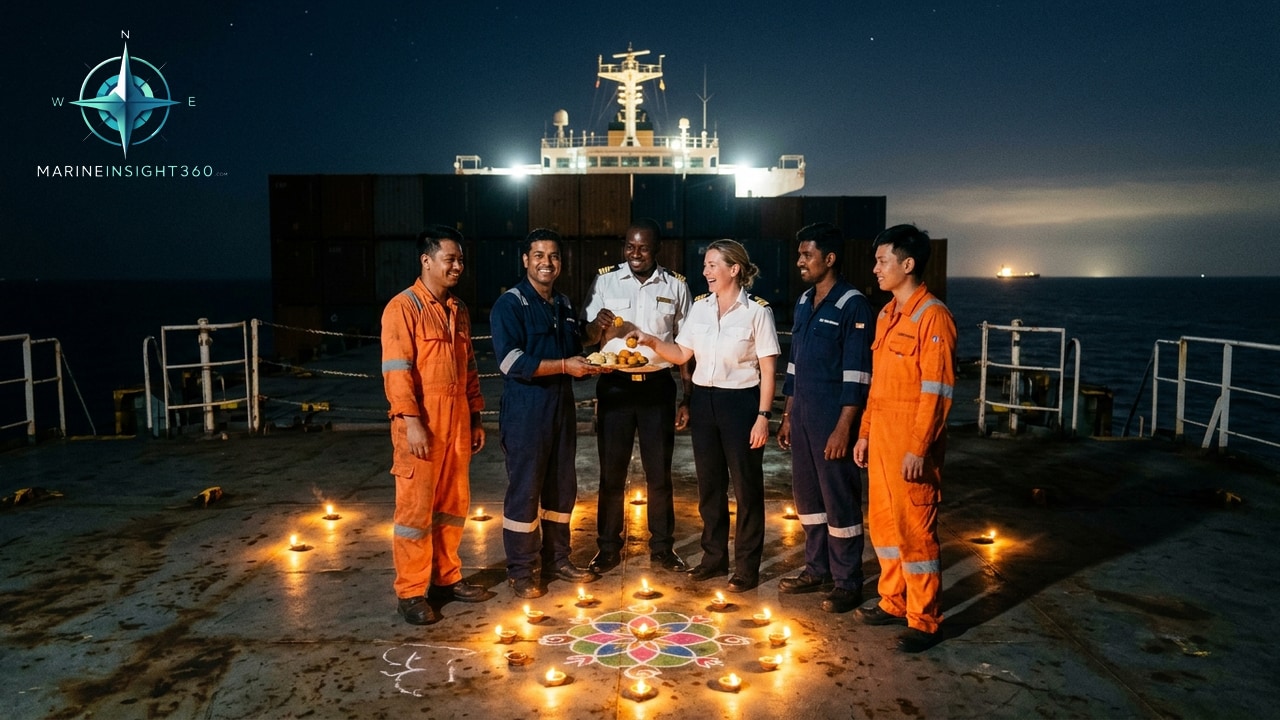
Diwali at Sea: Far from Home, Together as One Crew
What Diwali looks like on a merchant ship: a crew of different faiths and nationalities celebrating together, thousands of miles from home.
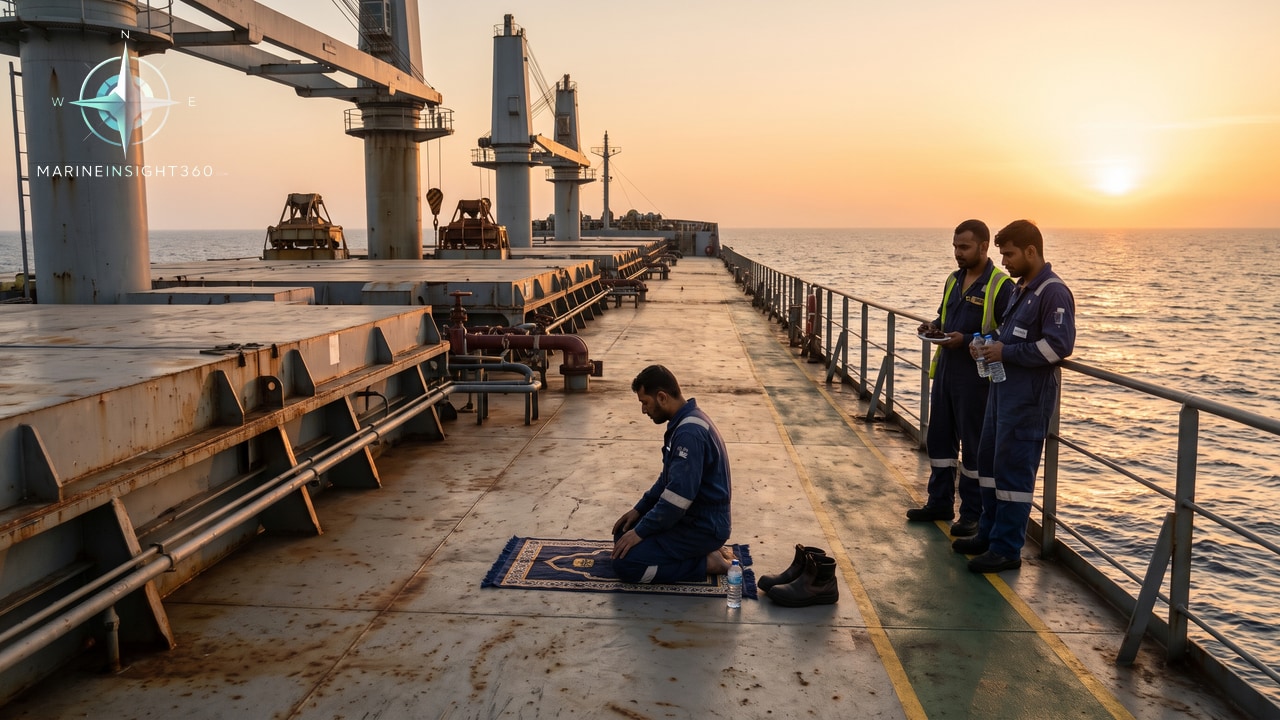
Ramadan at Sea: Fasting, Prayer and Watchkeeping for Muslim Seafarers
A practical guide to Ramadan on board: fasting and watchkeeping, rest hours, suhoor and iftar timings across time zones, galley, prayer and Eid.

Ship Earthing Systems: Insulated Networks, Bonding and Earth-Fault Monitoring
Why ships use insulated electrical systems, how earth faults are found, high-voltage resistance earthing, bonding, tanker rules and shore power.