
World's Largest FPSO Platform
World's Largest FPSO Platform: ports, trade and shipping-market context for US, UK, Canada, Australia, Singapore and European maritime readers.
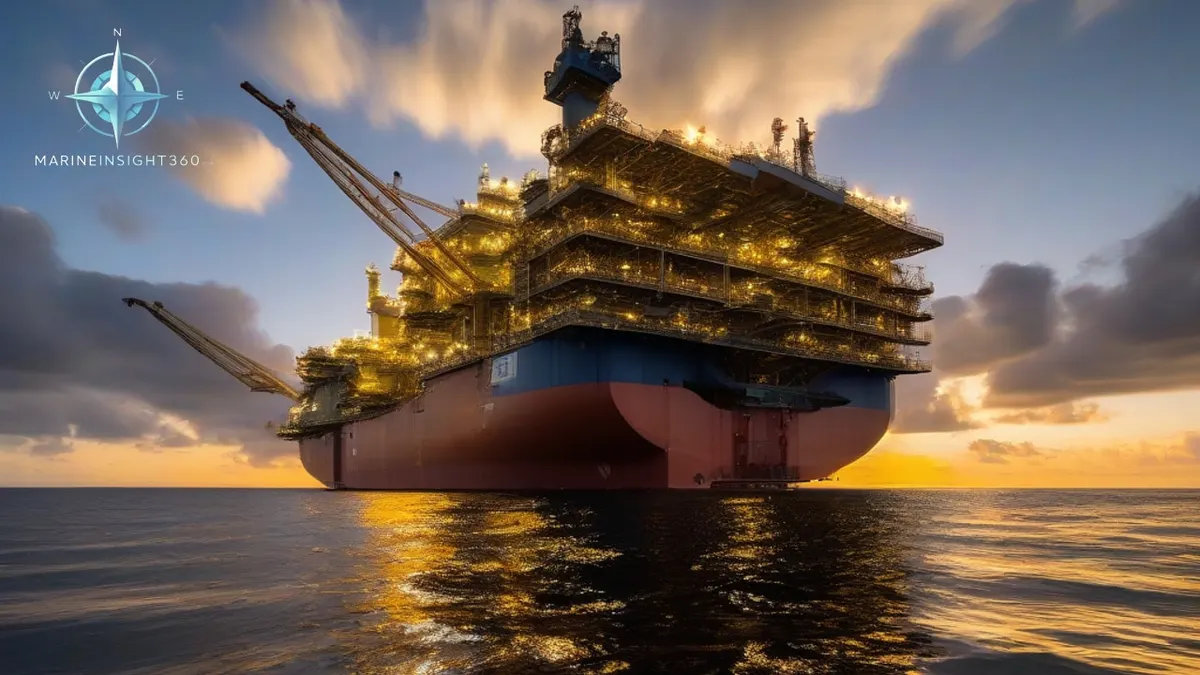
The World's Largest Floating Production Storage and Offloading (FPSO) Platform:
Operated by Total Energy, the Egina FPSO is the world's largest oil storage platform, with a capacity of approximately 2.3 million barrels and a daily production of 200,000 barrels.
Located 130 kilometers off the coast of the Egina oil field in Nigeria, discovered in 2003 within Block 130 of the exploration concession, the platform covers an area of 500 square miles and has estimated recoverable reserves of 550 million barrels of oil.
The Egina FPSO is 330 meters long, 61 meters wide. 34 meters high, operating at a depth of 1,600 meters in the Gulf of Guinea. Its superstructure has a gross tonnage of 47,500 tons, is equipped with a 100-meter-high flare tower, and can accommodate 200 people.
This floating production storage and offloading (FPSO) vessel was built under a $3 billion contract awarded to Samsung Heavy Industries. It was completed at Samsung's shipyard on Geoje Island, South Korea, and then transported to Nigeria for commissioning. The FPSO, named "Egina," is connected to 44 subsea oil wells and began producing oil for the first time in December 2018. Currently, it contributes approximately 10% of Nigeria's total oil production.
By tonnage, the world's largest FPSO is currently MO26, built by COSCO Shipping (Qidong) Offshore Co., Ltd., a subsidiary of COSCO Shipping Heavy Industry Co., Ltd.
- World’s Abandoned Oil Rigs
- Worst Biggest Oil Spills in History
- What Are Gas Tankers? Types Of Gas Tankers
- What Are Very Large Gas Carriers (VLGC)
- Top Oil and Gas Terminals in Middle East
This vessel is designed for operations in extremely deep waters, particularly suitable for pre-salt basin projects in Brazil. It is 335.3 meters long, 60 meters wide, and 33.5 meters high.
This floating production storage and offloading (FPSO) has a storage capacity of up to 1.4 million barrels and a daily production capacity of 180,000 barrels of crude oil and 12 million cubic meters of natural gas.
Built in Jiangsu Province, China, the vessel was launched on December 16, 2024. It broke the record for towing capacity on the Yangtze River, with a 784-meter-long fleet of tugboats, escort vessels, and patrol boats providing security. Because it can handle large quantities of oil and gas on board, this vessel is often referred to as a "floating refinery."
It is equipped with advanced oil and gas extraction, storage, and processing systems.
Operational context
What to verify next
- Check whether largest fpso affects safety, commercial planning, crew training, documentation or compliance.
- Confirm the latest company procedure, manual, port instruction or training requirement before acting.
- Link this page with one related article or knowledge-base topic so readers can continue their research naturally.
Recommended Reading
Knock Nevis – World’s Largest Supertanker
Knock Nevis – World’s Largest Supertanker: ports, trade and shipping-market context for US, UK, Canada, Australia, Singapore and European maritime readers.
Largest Ships in Maritime History
Find out which vessel holds the record for length, gross tonnage and displacement. Includes specs for Seawise Giant, Pioneering Spirit and Shell Prelude.
Largest Ship Ever Built
Find out why Seawise Giant (Knock Nevis) remains the biggest ship ever built, its dimensions, history and how it compares with modern giants.