
Ship Behavior in Shallow Water; Resistance & Speed
When a ship moves from deep to shallow water, its resistance and speed change significantly, here, we will compare and contrast the behavior of a ship in shallow and deep water and its effects on resistance and speed.
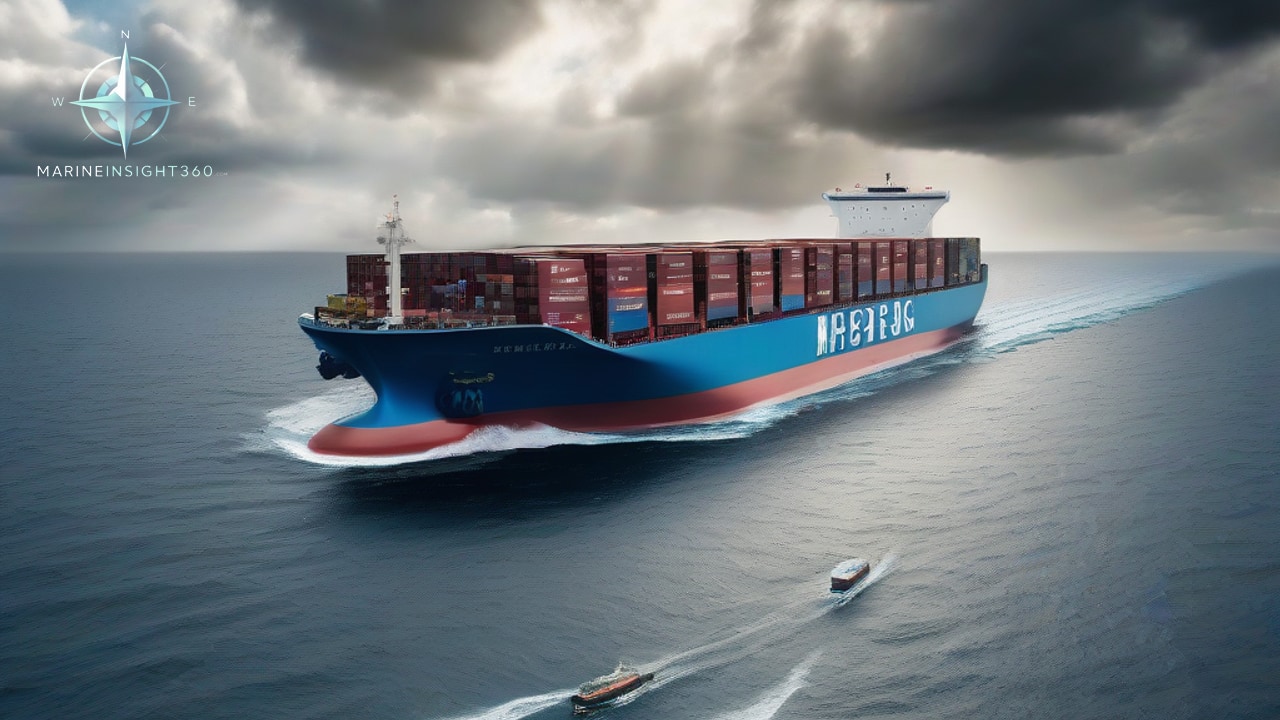
Ship Behavior in Shallow Water: Its Effects on Resistance and Speed
When a ship moves from deep into shallow water, her resistance rises and, for the same engine power, her speed falls. This article compares the behaviour of aship in shallow and deep water and how it affects resistance and speed. The effects matter in ship design, and they matter even more on the bridge, because shallow water also makes a ship sit lower in the water and steer differently.
From deep water to shallow
Any ship coming off the open ocean into a shallow area will notice the change: speed drops, vibration often increases, and the ship becomes sluggish on the helm. In deep water, a ship's resistance is mostly frictional resistance from water flowing along the hull and wave‑making resistance from the waves she generates. Their balance at a given speed sets her wave pattern and her fuel consumption.
The movement of a ship in water, deep or shallow, follows the same laws of fluid mechanics. In deep water the water can flow freely around and under the hull.
In shallow water the seabed gets in the way. The water displaced by the hull has less room to pass underneath, so it speeds up, and that changes both the pressure on the hull and the waves the ship makes.
Naval architects have studied the effect of shallow water on ship resistance for over a century, first through model tests and later with mathematical models. The method published by the German engineer Otto Schlichting in 1934, described below, is still the best‑known way to estimate it.
Understanding Dynamics
1. Speed and Buoyancy
In shallow water the limited depth makes the water under the hull flow faster. By Bernoulli's principle, faster‑moving water has lower pressure, so the pressure supporting the bottom of the hull drops and the whole ship sinks bodily deeper into the water. This is called squat.
Squat increases roughly with the square of the ship's speed, so halving speed cuts it to about a quarter. It also increases as the clearance under the keel shrinks and as the channel gets narrower. A large, full‑bodied ship running at speed in a shallow, narrow channel can squat a metre or more, enough to touch bottom where the charted depth looked sufficient.
How much a particular ship squats depends on her speed, her hull form and the depth and width of the water. Masters use empirical formulas for a quick estimate, and modern computational fluid dynamics (CFD) tools and pilotage software can predict it for a given ship and channel.
2. Pressure and balance effects
Squat does not usually act evenly along the length. Ships with a full hull form and a high block coefficient, such as tankers and bulk carriers, tend to squat more at the bow and trim by the head. Fine‑lined ships, such as container ships and passenger ships, tend to squat more at the stern. Trim by the head makes the ship harder to steer and adds to her resistance.
The cause is the uneven pressure distribution along the hull as the flow speeds up under it. The bodily sinkage combined with the change of trim is what seafarers call squat, and the maximum squat at the bow or stern is what eats into the under‑keel clearance.
Squat is most serious in narrow channels, where the sloping banks and the shape of the channel restrict the flow even more. Allowing for it in the passage plan and the under‑keel clearance policy, and slowing down where the water is shallow, is how ships avoid grounding.
3. Changes in wave morphology
Shallow water also changes the waves a ship makes. In deep water her wave system follows the Kelvin pattern, which does not depend on depth. In shallow water the speed of a wave depends on the depth as well as its length, so the wave pattern changes shape.
The wave pattern is closely tied to wave‑making resistance. In deep water the Kelvin system is made up of transverse waves, running across the ship's track, and divergent waves, spreading out from the bow and stern, all inside a wedge of fixed angle either side of the track. As the water gets shallower and the ship approaches the critical speed, the angle of the wedge widens toward 90 degrees and the waves become larger.
Above the critical speed the transverse waves can no longer keep up with the ship and disappear, leaving only divergent waves.
These changes show up directly in speed, fuel consumption and the wash the ship throws onto banks and moored vessels.
Wave pattern changes
Deep water
In deep water the wave pattern is made up of transverse and divergent waves contained inside the "Kelvin wedge," whose half‑angle is always about 19.5 degrees (19°28′) regardless of the ship's speed.
Midwater
As the water gets shallower relative to the ship's speed, the wedge angle increases. The key figure is the critical speed, the speed of a long wave in that depth, equal to the square root of g times the water depth. In 10 metres of water, for example, it is about 9.9 m/s, or roughly 19 knots. As a ship approaches it, the transverse waves grow and wave‑making resistance rises steeply.
Shallow water
At speeds close to the critical speed the wave pattern changes sharply, with a single large wave front forming almost at right angles to the ship. Below the critical speed the ship is said to run at subcritical speed; above it, at supercritical speed, where the transverse waves vanish completely and only divergent waves remain.
Resistance peaks around the critical speed and then falls again at supercritical speeds, which is why only high‑speed craft, and not ordinary displacement ships, operate above it.
The practical effects are real. Ferry operators on shallow coastal routes, for example, have to allow for them in their schedules and fuel planning, and for the wash their vessels make near shore.
Schlichting Method and Resistance Prediction
Less depth changes both wave‑making and frictional resistance. Schlichting's method estimates the speed a ship loses in shallow water for the same total resistance she has in deep water. It assumes that the wave‑making resistance in shallow water at a given speed equals the wave‑making resistance in deep water at a lower, "intermediate" speed, the speed at which the waves she makes have the same length.
Wave-forming resistance:
In shallow water the waves a ship makes are longer, for the same speed, than they would be in deep water, so the ship behaves as if she were going faster. As she approaches the critical speed the energy going into the waves rises sharply, and so does her resistance.
Frictional resistance:
Because the water flows faster past the hull when the seabed is close, frictional resistance also increases.
Reducing speed:
Schlichting accounted for this second effect with a further speed reduction that depends on the ratio of the square root of the hull's midship cross‑sectional area to the water depth. Adding it to the wave‑length correction gives the total speed loss in shallow water.
Schlichting worked out these corrections from model tests and presented them as curves of speed ratio against depth parameters, which designers could read off for a given hull and depth.
Practical Insights
The method rests on two simple ratios: the ship's speed to the critical speed in that depth, and the square root of her midship section area to the water depth. Together they show how strongly the water depth will restrict the flow around a given hull.
Schlichting's method is simple to apply and still gives a useful first estimate, but it was derived from a limited set of model tests, so results for a particular ship should be checked against model tests or other data where possible.
Today the same ideas are built into simulation tools, which help engineers design hull forms and propulsion systems for ships that work mostly in shallow water.
Wider implications of shallow water dynamics
Shallow water behaviour matters beyond the individual ship. Port and channel planners have to allow for squat and resistance when they decide how deep a channel must be, and dredging to maintain navigable waterways is planned around the ships expected to use them, balancing depth against cost and environmental impact.
Higher resistance in shallow water also means more fuel burned and more CO2 emitted for the same distance, so slowing down in shallow stretches saves fuel as well as reducing squat and wash.
Wave resistance in shallow water vs. deep water
Schlichting's method is an empirical approximation rather than an exact theory, and it is meant for subcritical speeds, which covers the great majority of merchant ships in shallow water. Within that range it gives a practical estimate of how much speed a ship will lose for a given water depth.
Recommended Reading

Bioluminescent Bays: Where the Water Glows and Why It Happens
What makes a bioluminescent bay glow, where the world's brightest bays are, the best conditions for seeing them, and how fragile these lagoons really are.

What Is Water Hammer? Causes and Prevention on Ships
Why water hammer happens in ship steam and water lines, the warning signs, and the drain-and-warm procedure and design measures that prevent it.
Why Is Reducing Ship Resistance So Important?
Managing the dynamics of water resistance (both literally and figuratively) is one of the greatest challenges in ship design.